Zuniga-Soto Evelyn, Mullins Ewen, Dedicova Beata
International Center for Tropical Agriculture (CIAT) Transformation Platform, International Center for Tropical Agriculture (CIAT), A.A. 6713 Cali, Colombia ; Department of Crop Science, Teagasc Crops Research Centre, Oak Park, Carlow, Ireland.
Department of Crop Science, Teagasc Crops Research Centre, Oak Park, Carlow, Ireland.
Springerplus. 2015 Oct 13;4:600. doi: 10.1186/s40064-015-1369-9. eCollection 2015.
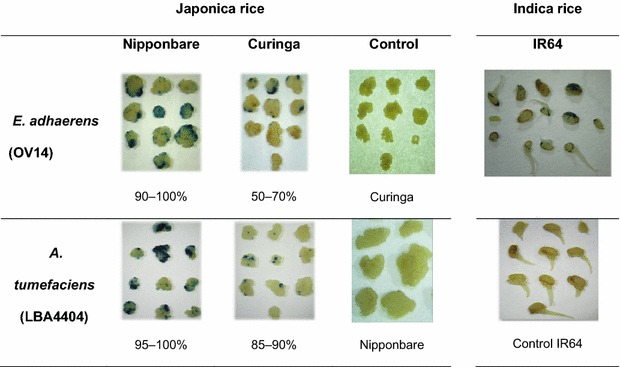
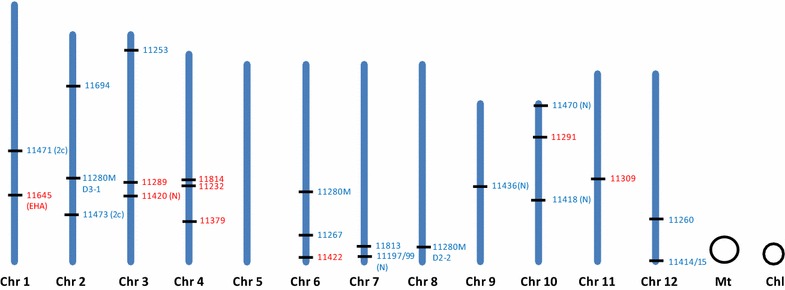
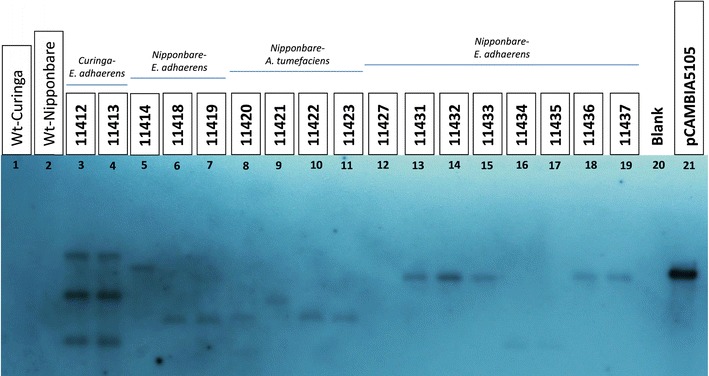
While Agrobacterium-mediated transformation (AMT) remains the most widely used technique for gene transfer in plants, interest exists for the use of non-Agrobacterium gene delivery systems due to freedom-to-operate issues that remain with AMT across several jurisdictions. In addition, the plant pathogenic mode of action of Agrobacterium tumefaciens significantly increases the costs to passage engineered cultivars through the regulatory process. Ensifer adhaerens (OV14) is a soil-related bacterium with the proven ability to genetically modify the model plant A. thaliana and the staple crop S. tuberosum (Wendt et al., Trans Res 21:567-578, 2012). While previous work was relevant for dicotyledonous species, in this study, the efficacy of Ensifer adhaerens (OV14)-mediated transformation (EMT) was determined on two japonica rice varieties, Curinga and Nipponbare, and the recalcitrant indica variety, IR64. The results indicated that E. adhaerens (OV14) exhibits infection efficiencies ranging between 50-70 %, 90-100 % and 90-95 % for Curinga, Nipponbare and IR64 respectively. Curinga and Nipponbare plants transformed with E. adhaerens (OV14) and A. tumefaciens (LBA4404 and EHA105) were regenerated achieving transformation efficiencies of 16 % and 26-32 % for Curinga and 7 and 4 % for Nipponbare respectively. Separately, the transformation of IR64 was only recorded via EMT (transformation efficiency ~1 %). Integration analyses conducted on 24 transgenic rice lines illustrated that T-DNA insertion occurred randomly throughout the rice genome for EMT (and AMT), with similar integration patterns in the rice genomic DNA observed for both bacterial species.
虽然农杆菌介导的转化(AMT)仍然是植物基因转移中使用最广泛的技术,但由于在多个司法管辖区,AMT仍存在操作自由的问题,因此人们对使用非农杆菌基因传递系统很感兴趣。此外,根癌农杆菌的植物致病作用方式显著增加了工程品种通过监管程序的成本。Ensifer adhaerens(OV14)是一种与土壤相关的细菌,已被证明能够对模式植物拟南芥和主粮作物马铃薯进行基因改造(Wendt等人,《转基因研究》21:567 - 578,2012年)。虽然之前的工作与双子叶植物物种相关,但在本研究中,测定了Ensifer adhaerens(OV14)介导的转化(EMT)对两个粳稻品种Curinga和日本晴以及顽固的籼稻品种IR64的效果。结果表明,Ensifer adhaerens(OV14)对Curinga、日本晴和IR64的感染效率分别在50 - 70%、90 - 100%和90 - 95%之间。用Ensifer adhaerens(OV14)和根癌农杆菌(LBA4404和EHA105)转化的Curinga和日本晴植株再生后,Curinga的转化效率分别为16%和26 - 32%,日本晴的转化效率分别为7%和4%。另外,IR64的转化仅通过EMT记录(转化效率约为1%)。对24个转基因水稻品系进行的整合分析表明,对于EMT(和AMT),T - DNA插入在水稻基因组中随机发生,两种细菌物种在水稻基因组DNA中观察到相似的整合模式。