Meisel Samuel N, Colder Craig R
Department of Psychology, The State University of New York, University at Buffalo, Buffalo, New York.
Alcohol Clin Exp Res. 2015 Dec;39(12):2455-62. doi: 10.1111/acer.12906. Epub 2015 Nov 11.
The literature distinguishes 2 types of social normative influences on adolescent alcohol use, descriptive norms (perceived peer alcohol use) and injunctive norms (perceived approval of drinking). Although theoretical formulations suggest variability in the salience and influence of descriptive and injunctive norms, little is understood regarding for whom and when social norms influence adolescent drinking. Strong agentic and communal social goals were hypothesized to moderate the influence of descriptive and injunctive norms on early adolescent alcohol use, respectively. Developmental changes were also expected, such that these moderating effects were expected to get stronger at later grades.
This longitudinal study included 387 adolescents and 4 annual assessments (spanning 6th to 10th grade). Participants completed questionnaire measures of social goals, social norms, and alcohol use at each wave.
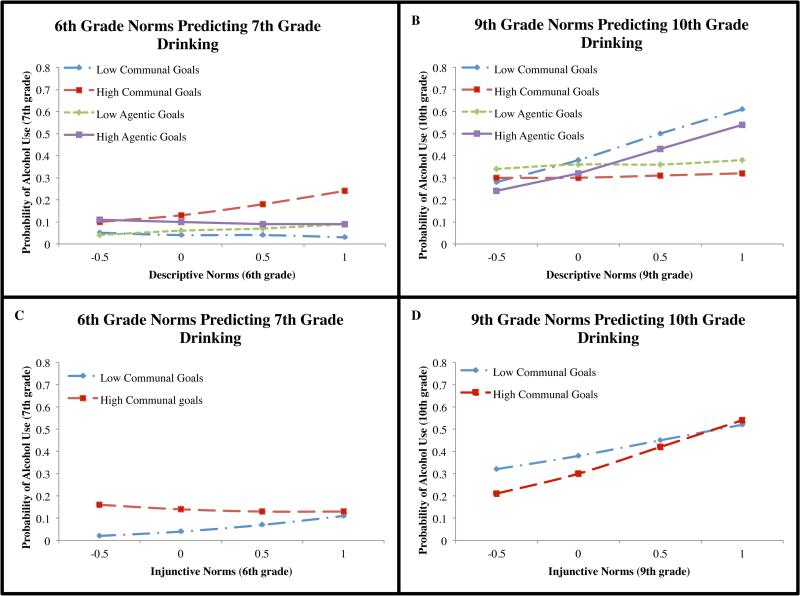
Multilevel logistic regressions were used to test prospective associations. As hypothesized, descriptive norms predicted increases in the probability of alcohol use for adolescents with strong agentic goals, but only in later grades. Injunctive norms were associated with increases in the probability of drinking for adolescents with low communal goals at earlier grades, whereas injunctive norms were associated with an increased probability of drinking for adolescents with either low or high communal goals at later grades. Although not hypothesized, descriptive norms predicted increases in the probability of drinking for adolescents high in communal goals in earlier grades, whereas descriptive norms predicted drinking for adolescents characterized by low communal goals in later grades.
The current study highlights the importance of social goals when considering social normative influences on alcohol use in early and middle adolescence. These findings have implications for whom and when normative feedback interventions might be most effective during this developmental period.
文献区分了两种对青少年饮酒的社会规范影响,即描述性规范(感知到的同伴饮酒情况)和指令性规范(感知到的对饮酒的认可)。尽管理论阐述表明描述性规范和指令性规范的显著性和影响力存在差异,但对于社会规范在何时以及对谁的饮酒行为产生影响,我们了解甚少。研究假设强烈的能动型和社群型社会目标分别会调节描述性规范和指令性规范对青少年早期饮酒行为的影响。同时预计会有发展变化,即这些调节作用在更高年级时会更强。
这项纵向研究包括387名青少年,并进行了4次年度评估(涵盖6年级到10年级)。参与者在每次评估时完成关于社会目标、社会规范和饮酒情况的问卷调查。
采用多水平逻辑回归来检验前瞻性关联。如假设所示,描述性规范预测了具有强烈能动目标的青少年饮酒可能性的增加,但仅在更高年级时如此。指令性规范与低年级时社群目标较低的青少年饮酒可能性增加相关,而指令性规范与高年级时社群目标低或高的青少年饮酒可能性增加相关。尽管未作假设,但描述性规范预测了低年级时社群目标高的青少年饮酒可能性增加,而描述性规范预测了高年级时社群目标低的青少年饮酒。
本研究强调了在考虑社会规范对青少年早期和中期饮酒行为的影响时社会目标的重要性。这些发现对于在这个发展阶段规范反馈干预对谁以及何时可能最有效具有启示意义。