
生态学与进化领域的公共数据存档:我们做得如何?
Public Data Archiving in Ecology and Evolution: How Well Are We Doing?
作者信息
Roche Dominique G, Kruuk Loeske E B, Lanfear Robert, Binning Sandra A
机构信息
Division of Evolution, Ecology and Genetics, Research School of Biology, The Australian National University, Canberra, Australian Capital Territory, Australia.
Éco-Éthologie, Institut de Biologie, Université de Neuchâtel, Neuchâtel, Switzerland.
出版信息
PLoS Biol. 2015 Nov 10;13(11):e1002295. doi: 10.1371/journal.pbio.1002295. eCollection 2015.
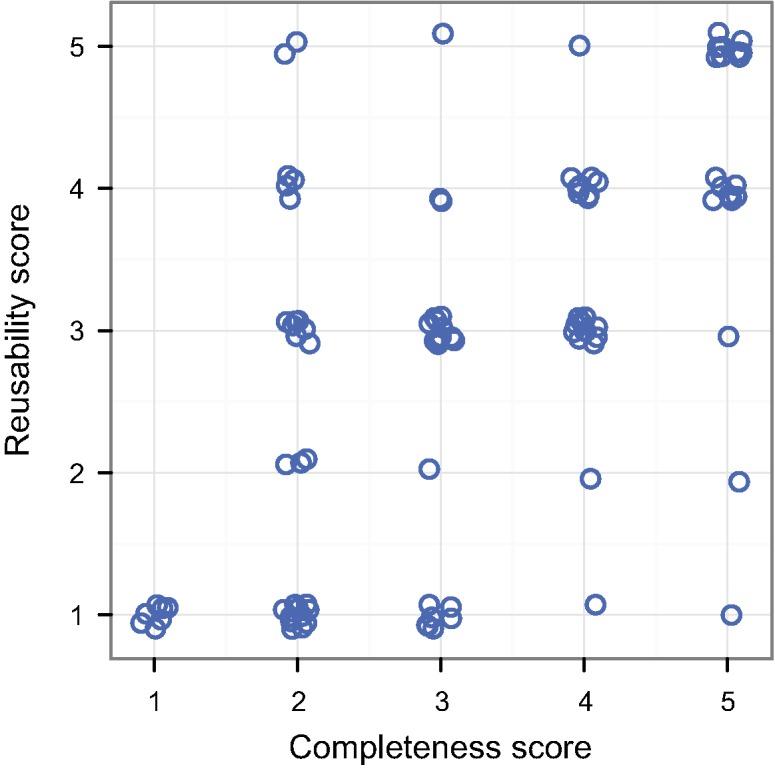
Policies that mandate public data archiving (PDA) successfully increase accessibility to data underlying scientific publications. However, is the data quality sufficient to allow reuse and reanalysis? We surveyed 100 datasets associated with nonmolecular studies in journals that commonly publish ecological and evolutionary research and have a strong PDA policy. Out of these datasets, 56% were incomplete, and 64% were archived in a way that partially or entirely prevented reuse. We suggest that cultural shifts facilitating clearer benefits to authors are necessary to achieve high-quality PDA and highlight key guidelines to help authors increase their data's reuse potential and compliance with journal data policies.
强制要求进行公共数据存档(PDA)的政策成功地提高了对科学出版物所依据数据的获取性。然而,数据质量是否足以支持重复使用和重新分析呢?我们调查了100个与非分子研究相关的数据集,这些研究发表在通常发表生态和进化研究且有强有力的PDA政策的期刊上。在这些数据集中,56%是不完整的,64%的存档方式部分或完全阻碍了重复使用。我们认为,要实现高质量的PDA,促进为作者带来更清晰利益的文化转变是必要的,并强调了关键指导方针,以帮助作者提高其数据的重复使用潜力并遵守期刊数据政策。


 Zotero 插件