Sharifi-Zahabi Elham, Entezari Mohammad H, Maracy Mohammad R
Food Security Research Center and Department of Clinical Nutrition, School of Nutrition and Food Sciences, Isfahan University of Medical Sciences, Isfahan 81746-73461, Iran.
Department of Epidemiology and Biostatistics, School of Public Health, Isfahan University of Medical Sciences, Isfahan 81746-73461, Iran.
Clin Nutr Res. 2015 Oct;4(4):225-34. doi: 10.7762/cnr.2015.4.4.225. Epub 2015 Oct 31.
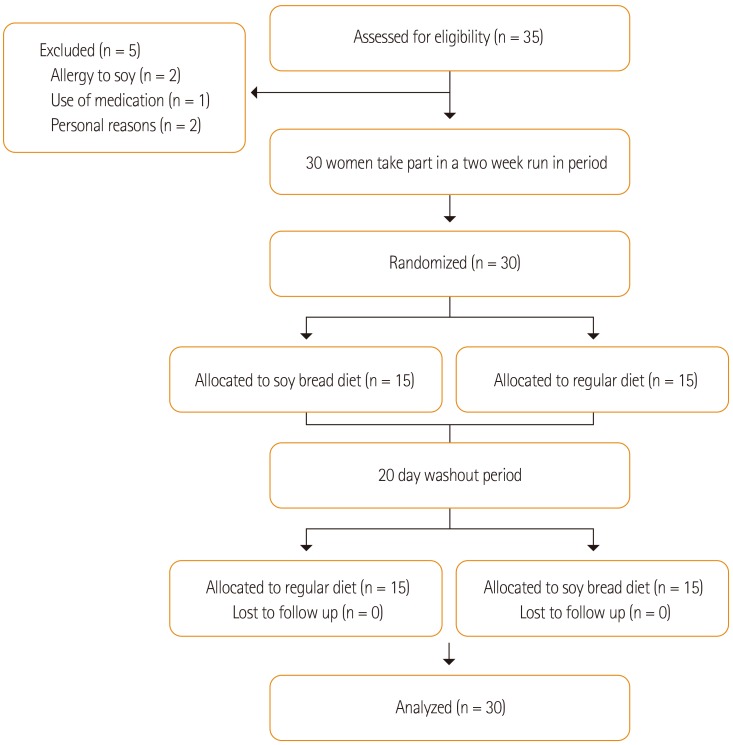
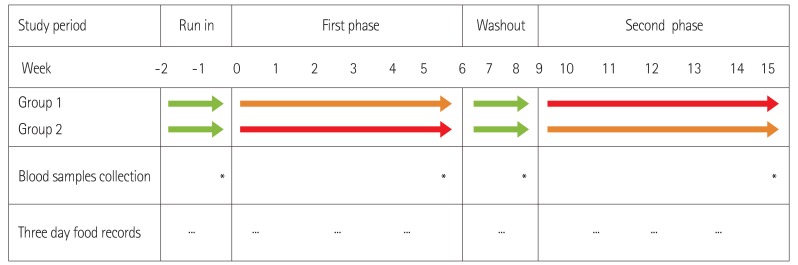
Recent studies suggest that inclusion of soy product in the diet may have favorable effects on relief of cardiovascular diseases (CVDs) and risk factors. These effects might be associated with the presence of specific polymorphism in gene. The aim of this study was to examine the effects of consumption of soy flour fortified bread on cardiovascular risk factors in overweight and obese women according to APOE genotype. In a randomized cross-over clinical trial 30 overweight and obese women received a mild weight loss diet and assigned to a regular diet and a soy bread diet, each for 6 weeks and a washout period for 20 days. Subjects in the soy bread diet were asked to replace 120 grams of their daily usual bread intake with equal amount of soy bread. No significant effects of soy bread on serum lipid, systolic blood pressure and anthropometric indices were observed compared to the regular diet (p > 0.05). For diastolic blood pressure (DBP), comparison of mean differences between two groups showed a marginally significant effect of soy bread (p = 0.06). Compared to regular diet, soy bread had a significant effect on DBP in E2 genotype group (ε2/ε2) (p = 0.03). Having ε2 allele may influences responses of CVD risk factor to soy bread consumption. However more nutrigenetic studies are required.
近期研究表明,饮食中摄入大豆制品可能对缓解心血管疾病(CVDs)及其风险因素具有有益作用。这些作用可能与基因中特定多态性的存在有关。本研究的目的是根据载脂蛋白E(APOE)基因型,探讨食用强化大豆粉面包对超重和肥胖女性心血管风险因素的影响。在一项随机交叉临床试验中,30名超重和肥胖女性接受轻度减重饮食,并被分配到常规饮食组和大豆面包饮食组,每组为期6周,中间有20天的洗脱期。大豆面包饮食组的受试者被要求用等量的大豆面包替代其日常120克的普通面包摄入量。与常规饮食相比,未观察到大豆面包对血脂、收缩压和人体测量指标有显著影响(p>0.05)。对于舒张压(DBP),两组平均差异的比较显示大豆面包有轻微显著影响(p=0.06)。与常规饮食相比,大豆面包对E2基因型组(ε2/ε2)的舒张压有显著影响(p=0.03)。携带ε2等位基因可能会影响心血管疾病风险因素对食用大豆面包的反应。然而,还需要更多的营养遗传学研究。