Lin Chien-Ling, Taggart Allison J, Lim Kian Huat, Cygan Kamil J, Ferraris Luciana, Creton Robbert, Huang Yen-Tsung, Fairbrother William G
Molecular Biology, Cell Biology and Biochemistry, Brown University, Providence, Rhode Island 02912, USA;
Molecular Biology, Cell Biology and Biochemistry, Brown University, Providence, Rhode Island 02912, USA; Center for Computational Molecular Biology, Brown University, Providence, Rhode Island 02912, USA;
Genome Res. 2016 Jan;26(1):12-23. doi: 10.1101/gr.181008.114. Epub 2015 Nov 13.
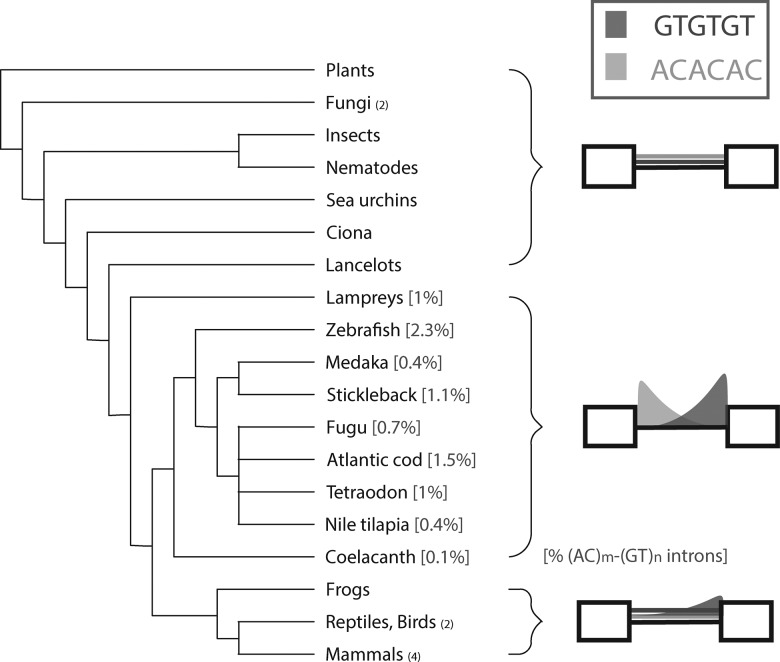
RNA secondary structure plays an integral role in catalytic, ribosomal, small nuclear, micro, and transfer RNAs. Discovering a prevalent role for secondary structure in pre-mRNAs has proven more elusive. By utilizing a variety of computational and biochemical approaches, we present evidence for a class of nuclear introns that relies upon secondary structure for correct splicing. These introns are defined by simple repeat expansions of complementary AC and GT dimers that co-occur at opposite boundaries of an intron to form a bridging structure that enforces correct splice site pairing. Remarkably, this class of introns does not require U2AF2, a core component of the spliceosome, for its processing. Phylogenetic analysis suggests that this mechanism was present in the ancestral vertebrate lineage prior to the divergence of tetrapods from teleosts. While largely lost from land dwelling vertebrates, this class of introns is found in 10% of all zebrafish genes.
RNA二级结构在催化性RNA、核糖体RNA、小核RNA、微小RNA和转运RNA中发挥着不可或缺的作用。然而,要证明二级结构在信使核糖核酸(mRNA)前体中普遍存在则更具挑战性。通过运用多种计算和生化方法,我们发现了一类核内含子,它们依赖二级结构进行正确的剪接。这些内含子由互补的AC和GT二聚体的简单重复扩增所定义,这些二聚体在一个内含子的相对边界共同出现,形成一种桥接结构,从而确保正确的剪接位点配对。值得注意的是,这类内含子在其加工过程中并不需要剪接体的核心成分U2AF2。系统发育分析表明,在硬骨鱼和四足动物分化之前,这种机制就已存在于脊椎动物的祖先谱系中。虽然这类内含子在陆生脊椎动物中大多已消失,但在所有斑马鱼基因中,有10%的基因含有这类内含子。