Adegbija Odewumi, Hoy Wendy E, Wang Zhiqiang
Centre for Chronic Disease, School of Medicine, University of Queensland, Brisbane, Queensland, Australia.
BMJ Open. 2015 Nov 13;5(11):e009185. doi: 10.1136/bmjopen-2015-009185.
There have been suggestions that currently recommended waist circumference (WC) cut-off points for Australians of European origin may not be applicable to Aboriginal people who have different body habitus profiles. We aimed to generate equivalent WC values that correspond to body mass index (BMI) points for identifying absolute cardiovascular disease (CVD) risks.
Prospective cohort study.
An Aboriginal community in Australia's Northern Territory.
From 1992 to 1998, 920 adults without CVD, with age, WC and BMI measurements were followed-up for up to 20 years.
Incident CVD, coronary artery disease (CAD) and heart failure (HF) events during the follow-up period ascertained from hospitalisation data. We generated WC values with 10-year absolute risks equivalent for the development of CVD as BMI values (20-34 kg/m(2)) using the Weibull accelerated time-failure model.
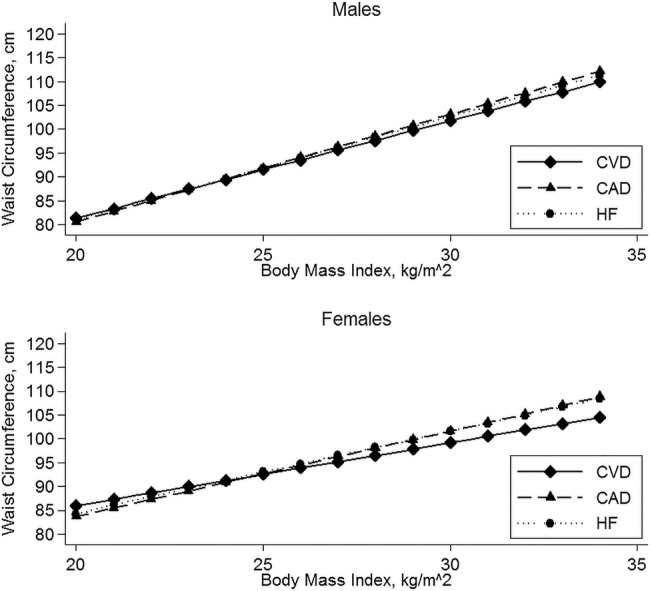
There were 211 incident cases of CVD over 13,669 person-years of follow-up. At the average age of 35 years, WC values with absolute CVD, CAD and HF risks equivalent to BMI of 25 kg/m(2) were 91.5, 91.8 and 91.7 cm, respectively, for males, and corresponding WC values were 92.5, 92.7 and 93 cm for females. WC values with equal absolute CVD, CAD and HF risks to BMI of 30 kg/m(2) were 101.7, 103.1 and 102.6 cm, respectively, for males, and corresponding values were 99.2, 101.6 and 101.5 cm for females. Association between WC and CVD did not depend on gender (p=0.54).
WC ranging from 91 to 93 cm was equivalent to BMI 25 kg/m(2) for overweight, and 99 to 103 cm was equivalent to BMI of 30 kg/m(2) for obesity in terms of predicting 10-year absolute CVD risk. Replicating the absolute risk method in other Aboriginal communities will further validate the WC values generated for future development of WC cut-off points for Aboriginal people.
有人提出,目前针对欧洲裔澳大利亚人推荐的腰围(WC)切点可能不适用于体型特征不同的原住民。我们旨在得出与体重指数(BMI)切点相对应的等效WC值,以识别绝对心血管疾病(CVD)风险。
前瞻性队列研究。
澳大利亚北领地的一个原住民社区。
1992年至1998年,对920名无CVD的成年人进行了年龄、WC和BMI测量,并随访了长达20年。
根据住院数据确定随访期间的新发CVD、冠状动脉疾病(CAD)和心力衰竭(HF)事件。我们使用威布尔加速时间失效模型得出了与BMI值(20 - 34 kg/m²)具有等效10年CVD发生绝对风险的WC值。
在13669人年的随访中,有211例新发CVD病例。在平均年龄35岁时,男性中与BMI为25 kg/m²具有等效CVD、CAD和HF绝对风险的WC值分别为91.5、91.8和91.7厘米,女性对应的WC值分别为92.5、92.7和93厘米。男性中与BMI为30 kg/m²具有等效CVD、CAD和HF绝对风险的WC值分别为101.7、103.1和102.6厘米,女性对应的WC值分别为99.2、101.6和101.5厘米。WC与CVD之间的关联不取决于性别(p = 0.54)。
就预测10年绝对CVD风险而言,91至93厘米的WC相当于超重的BMI 25 kg/m²,99至103厘米的WC相当于肥胖的BMI 30 kg/m²。在其他原住民社区重复绝对风险方法将进一步验证为原住民未来制定WC切点而生成的WC值。