Yin Ling, Chen Changming, Chen Guoju, Cao Bihao, Lei Jianjun
Department of Hortscience, South China Agricultural University, Guangzhou 510642, China.
Molecules. 2015 Nov 11;20(11):20254-67. doi: 10.3390/molecules201119688.
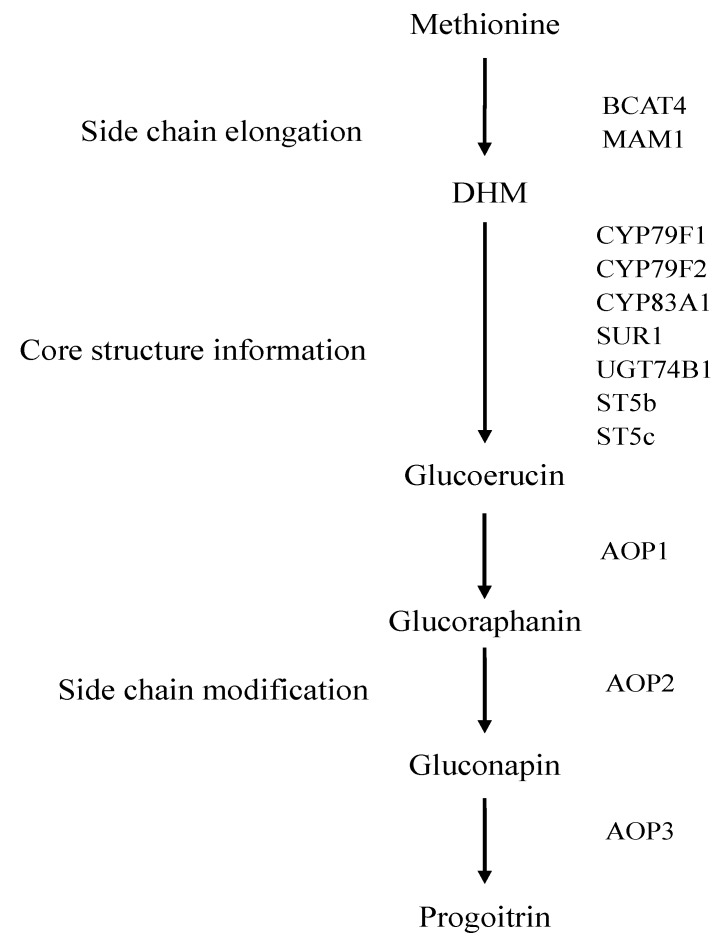
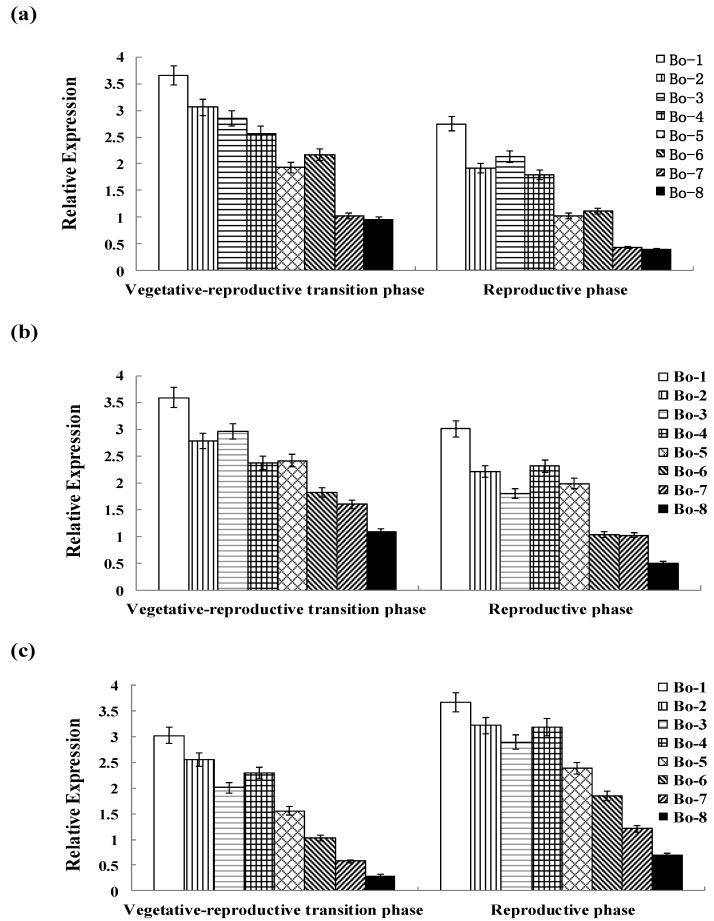
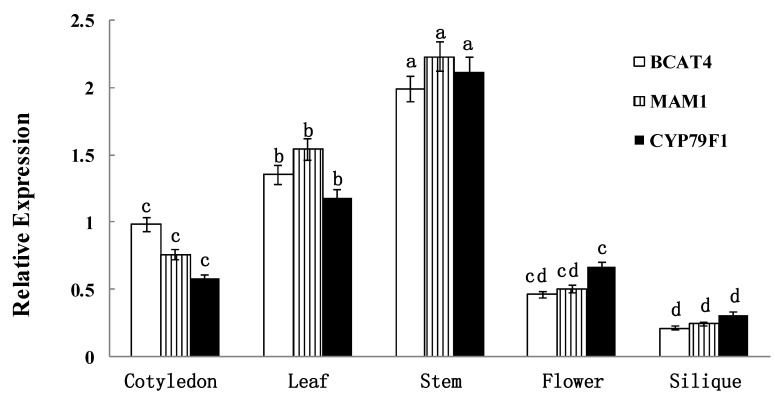
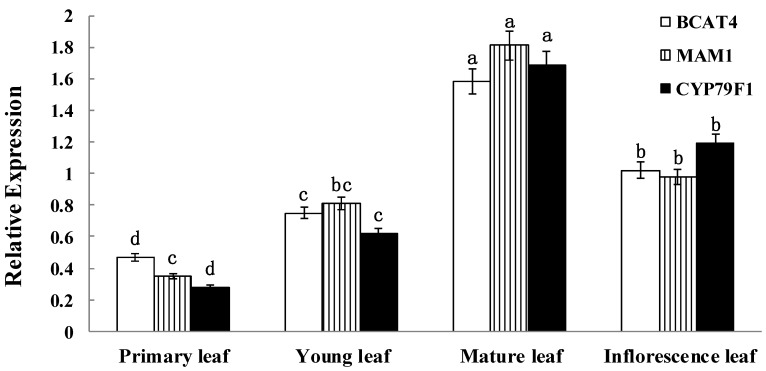
Glucoraphanin is a plant secondary metabolite that is involved in plant defense and imparts health-promoting properties to cruciferous vegetables. In this study, three genes involved in glucoraphanin metabolism, branched-chain aminotransferase 4 (BCAT4), methylthioalkylmalate synthase 1 (MAM1) and dihomomethionine N-hydroxylase (CYP79F1), were cloned from Chinese kale (Brassica oleracea var. alboglabra Bailey). Sequence homology and phylogenetic analysis identified these genes and confirmed the evolutionary status of Chinese kale. The transcript levels of BCAT4, MAM1 and CYP79F1 were higher in cotyledon, leaf and stem compared with flower and silique. BCAT4, MAM1 and CYP79F1 were expressed throughout leaf development with lower transcript levels during the younger stages. Glucoraphanin content varied extensively among different varieties, which ranged from 0.25 to 2.73 µmol·g(-1) DW (dry weight). Expression levels of BCAT4 and MAM1 were high at vegetative-reproductive transition phase, while CYP79F1 was expressed high at reproductive phase. BCAT4, MAM1 and CYP79F1 were expressed significantly high in genotypes with high glucoraphanin content. All the results provided a better understanding of the roles of BCAT4, MAM1 and CYP79F1 in the glucoraphanin biosynthesis of Chinese kale.
萝卜硫苷是一种植物次生代谢产物,参与植物防御,并赋予十字花科蔬菜促进健康的特性。在本研究中,从芥蓝(Brassica oleracea var. alboglabra Bailey)中克隆了3个参与萝卜硫苷代谢的基因,即支链氨基转移酶4(BCAT4)、甲硫基烷基苹果酸合酶1(MAM1)和二高蛋氨酸N-羟化酶(CYP79F1)。序列同源性和系统发育分析鉴定了这些基因,并确定了芥蓝的进化地位。与花和角果相比,BCAT4、MAM1和CYP79F1在子叶、叶和茎中的转录水平更高。BCAT4、MAM1和CYP79F1在叶片发育过程中均有表达,在较幼嫩阶段转录水平较低。不同品种间萝卜硫苷含量差异很大,范围为0.25至2.73 μmol·g(-1)干重(DW)。BCAT4和MAM1的表达水平在营养生长-生殖转变阶段较高,而CYP79F1在生殖阶段表达较高。BCAT4、MAM1和CYP79F1在萝卜硫苷含量高的基因型中表达显著较高。所有结果有助于更好地理解BCAT4、MAM1和CYP79F1在芥蓝萝卜硫苷生物合成中的作用。