Wang Zi, Ma Bianyin, Li Hui, Xiao Xiaojuan, Zhou Weihua, Liu Feng, Zhang Bin, Zhu Min, Yang Qin, Zeng Yayue, Sun Yang, Sun Shuming, Wang Yanpeng, Zhang Yibin, Weng Haibo, Chen Lixiang, Ye Mao, An Xiuli, Liu Jing
The State Key Laboratory of Medical Genetics and School of Life Sciences, Central South University, Changsha, China.
Department of Medicine, University of California, Irvine, CA, USA.
Oncotarget. 2016 Jan 5;7(1):509-23. doi: 10.18632/oncotarget.6312.
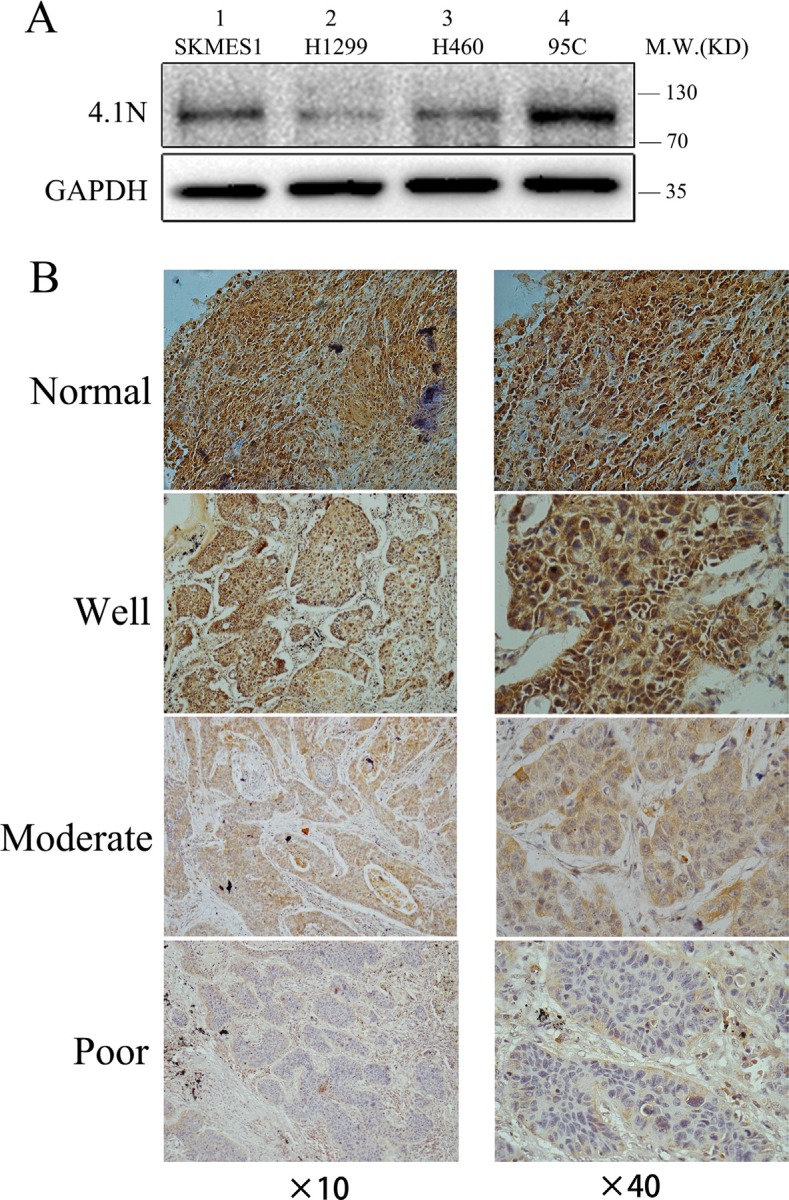
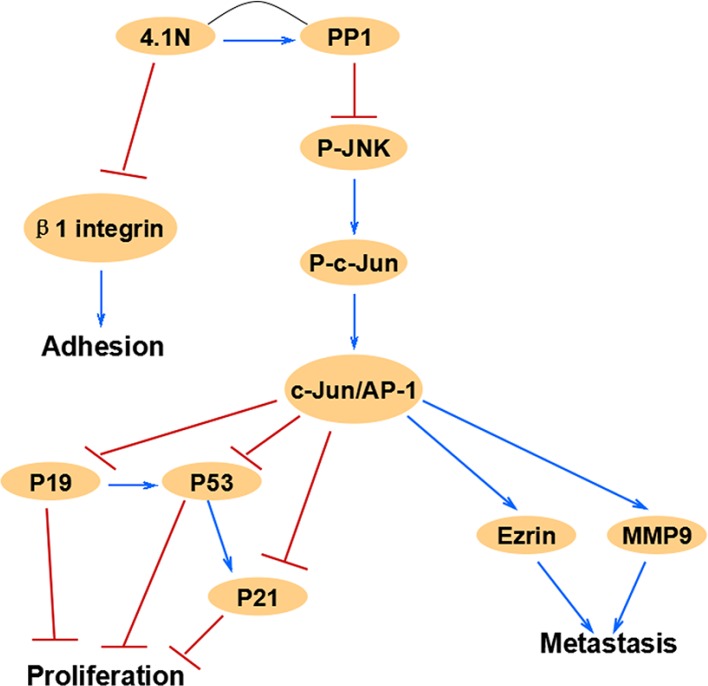
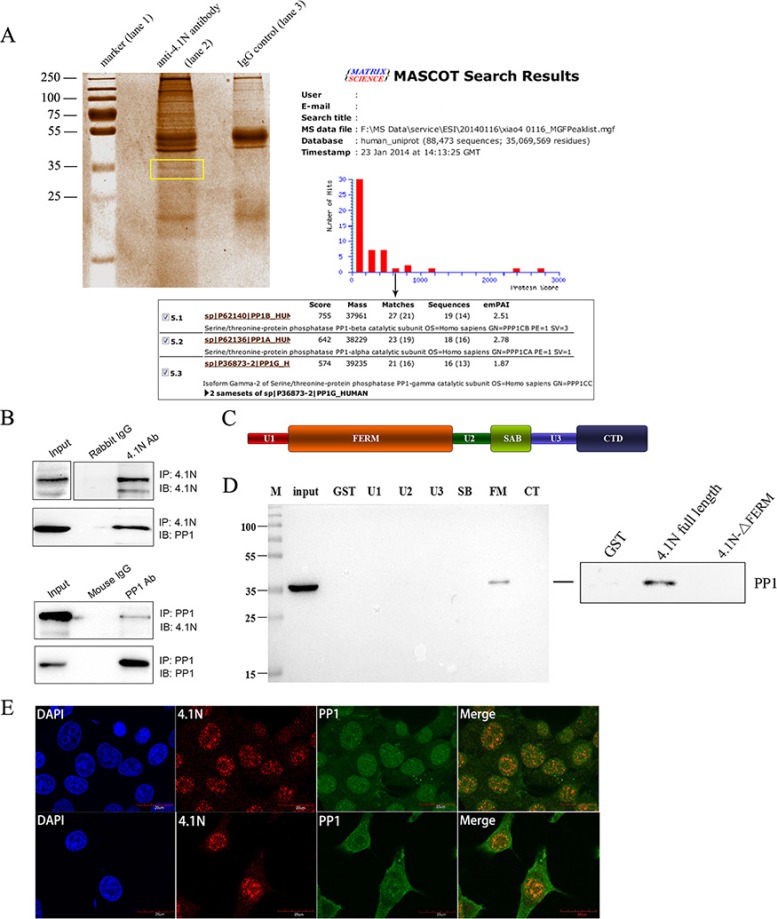
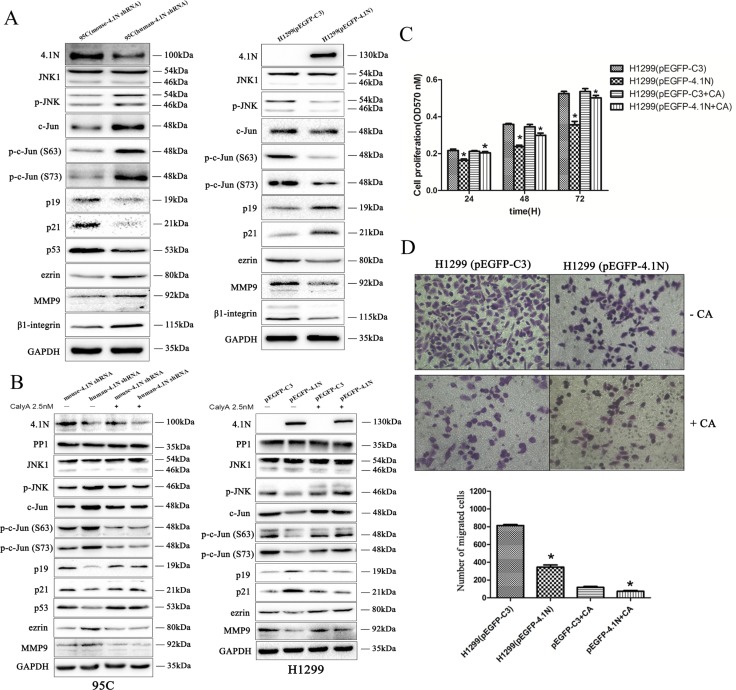
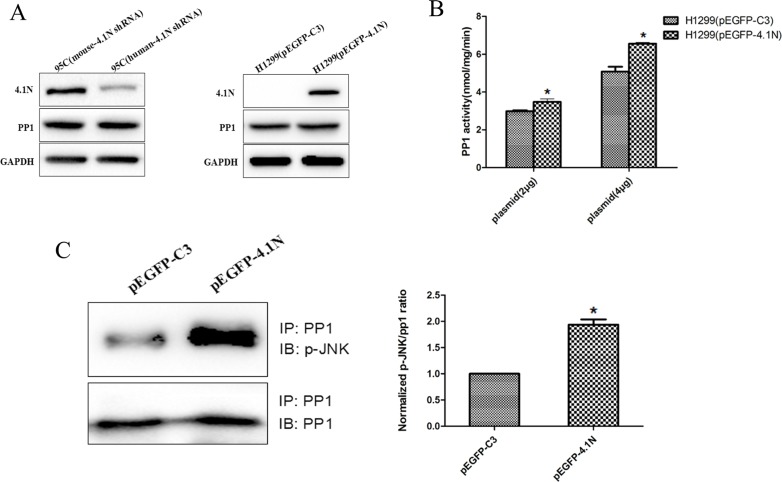
Protein 4.1N is a member of protein 4.1 family and has been recognized as a potential tumor suppressor in solid tumors. Here, we aimed to investigate the role and mechanisms of 4.1N in non-small cell lung cancer (NSCLC). We confirmed that the expression level of 4.1N was inversely correlated with the metastatic properties of NSCLC cell lines and histological grade of clinical NSCLC tissues. Specific knockdown of 4.1N promoted tumor cell proliferation, migration and adhesion in vitro, and tumor growth and metastasis in mouse xenograft models. Furthermore, we identified PP1 as a novel 4.1N-interacting molecule, and the FERM domain of 4.1N mediated the interaction between 4.1N and PP1. Further, ectopic expression of 4.1N could inactivate JNK-c-Jun signaling pathway through enhancing PP1 activity and interaction between PP1 and p-JNK. Correspondingly, expression of potential downstream metastasis targets (ezrin and MMP9) and cell cycle targets (p53, p21 and p19) of JNK-c-Jun pathway were also regulated by 4.1N. Our data suggest that down-regulation of 4.1N expression is a critical step for NSCLC development and that repression of JNK-c-Jun signaling through PP1 is one of the key anti-tumor mechanisms of 4.1N.
蛋白质4.1N是蛋白质4.1家族的成员,已被公认为实体瘤中的一种潜在肿瘤抑制因子。在此,我们旨在研究4.1N在非小细胞肺癌(NSCLC)中的作用及机制。我们证实4.1N的表达水平与NSCLC细胞系的转移特性及临床NSCLC组织的组织学分级呈负相关。特异性敲低4.1N可促进体外肿瘤细胞增殖、迁移和黏附,以及小鼠异种移植模型中的肿瘤生长和转移。此外,我们鉴定出PP1是一种新的与4.1N相互作用的分子,4.1N的FERM结构域介导了4.1N与PP1之间的相互作用。进一步地,4.1N的异位表达可通过增强PP1活性以及PP1与p-JNK之间的相互作用来使JNK-c-Jun信号通路失活。相应地,JNK-c-Jun通路潜在的下游转移靶点(埃兹蛋白和基质金属蛋白酶9)以及细胞周期靶点(p53、p21和p19)的表达也受4.1N调控。我们的数据表明4.1N表达下调是NSCLC发生发展的关键步骤,并且通过PP1抑制JNK-c-Jun信号通路是4.1N的关键抗肿瘤机制之一。