Fu Qiangqiang, Liu Hongwu Liu, Wu Ze, Liu An, Yao Cuize, Li Xiuqing, Xiao Wei, Yu Shiting, Luo Zhi, Tang Yong
Guangdong Province Key Laboratory of Molecular Immunology and Antibody Engineering, Department of Bioengineering, Jinan University, Guangzhou, 510632, People's Republic of China.
Integrated Optics and Biophotonics Laboratory, Department of Electronic Engineering, Jinan University, Guangzhou, 510632, People's Republic of China.
J Nanobiotechnology. 2015 Nov 14;13:81. doi: 10.1186/s12951-015-0142-0.
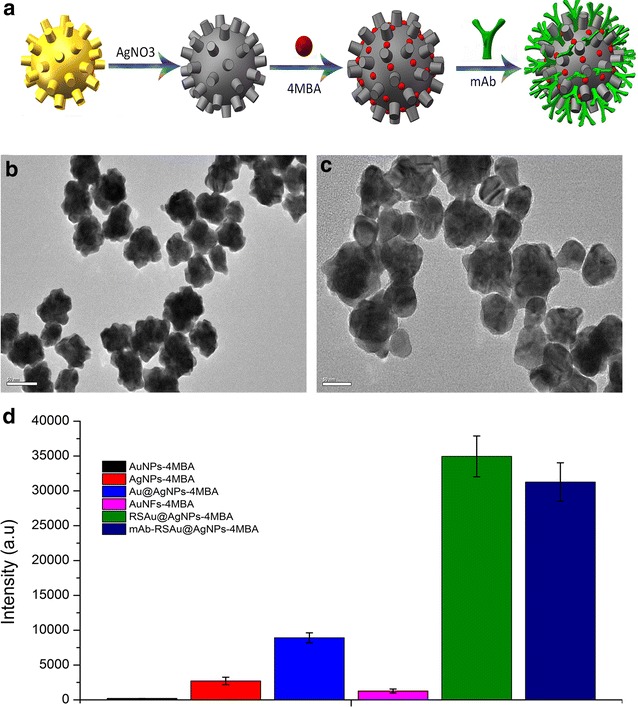
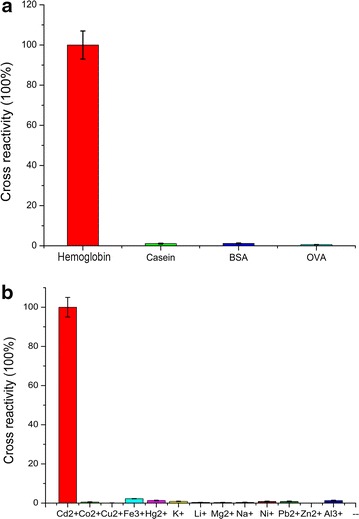
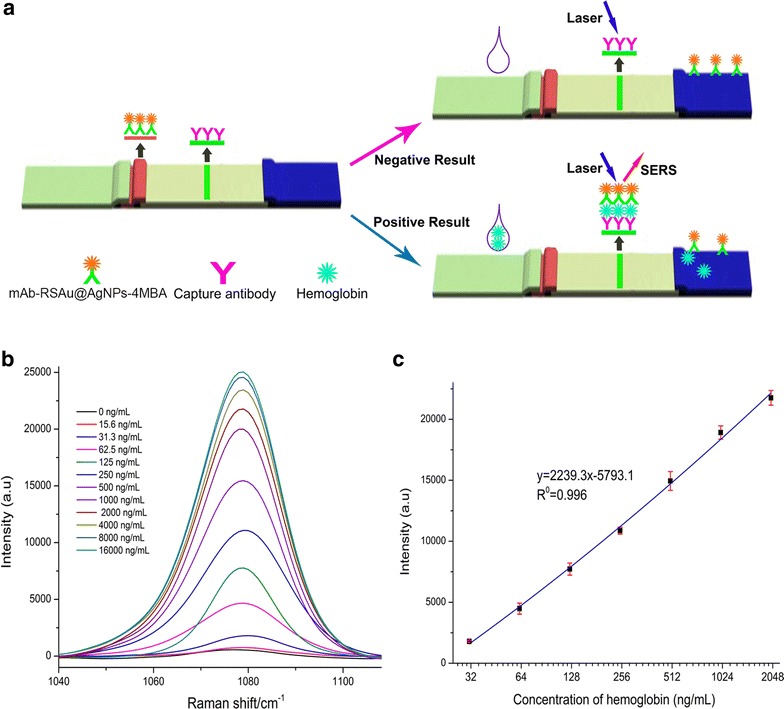
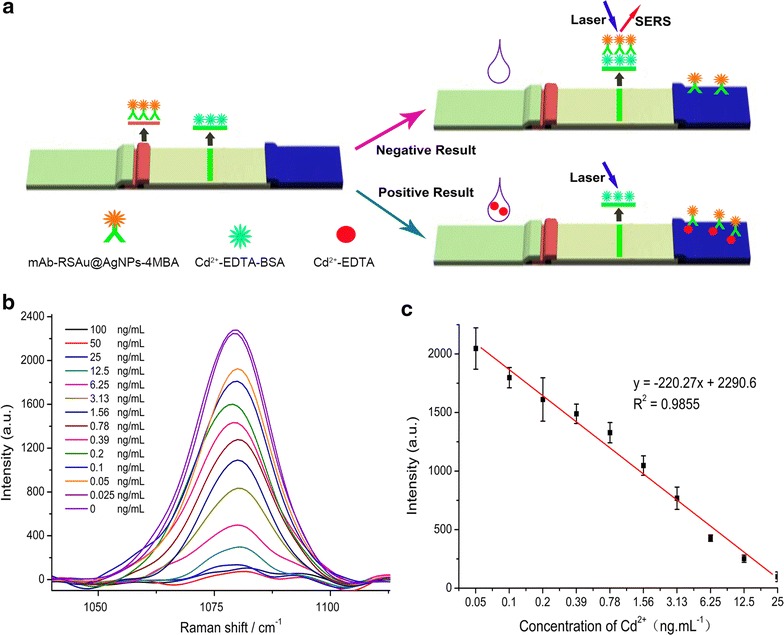
Immunochromatographic sensors (ICSs) are inexpensive, simple, portable, and robust, thus making ICSs commonplace in clinical diagnoses, food testing, and environmental monitoring. However, commonly used gold nanoparticles (AuNPs) ICSs have low sensitivity. Therefore, we developed highly sensitive surface enhanced Raman scattering (SERS) ICSs. To enhance the sensitivity of SERS ICSs, rough surface core-shell Au@Ag nanoparticles (RSAu@AgNPs) were prepared by coating silver on the surface of gold nanoflowers (AuNFs). Then these nanoparticles were used as SERS substrate in the SERS ICSs, after which the SERS ICSs were implemented to detect haemoglobin and heavy metal cadmium ion (Cd(2+)). The limit of detection (LOD) of the SERS ICSs for detecting haemoglobin was 8 ng/mL, and the linear range of the SERS ICSs was from 31.3 to 2000 ng/mL. The LOD of the SERS ICSs for detecting Cd(2+) was 0.05 ng/mL and the linear analysis range was from 0.05 to 25 ng/mL. The cross reactivity of the SERS ICSs was studied and results showed that the SERS ICSs exhibited highly specific for detection of haemoglobin and Cd(2+), respectively. The SERS ICSs were then used to detect haemoglobin (spiked in serum and in stool) and Cd(2+) (spiked in tap water, river water, and soil leaching water), and the results showed high recovery. These characteristics indicated that SERS ICSs were ideal tools for clinical diagnosis and environmental pollution monitoring.
免疫层析传感器(ICSs)价格低廉、操作简单、便于携带且性能稳定,因此在临床诊断、食品检测和环境监测中十分常见。然而,常用的金纳米颗粒(AuNPs)免疫层析传感器灵敏度较低。因此,我们开发了高灵敏度的表面增强拉曼散射(SERS)免疫层析传感器。为提高SERS免疫层析传感器的灵敏度,通过在金纳米花(AuNFs)表面包覆银制备了粗糙表面核壳结构的Au@Ag纳米颗粒(RSAu@AgNPs)。然后将这些纳米颗粒用作SERS免疫层析传感器中的SERS基底,之后利用SERS免疫层析传感器检测血红蛋白和重金属镉离子(Cd(2+))。SERS免疫层析传感器检测血红蛋白的检测限(LOD)为8 ng/mL,线性范围为31.3至2000 ng/mL。SERS免疫层析传感器检测Cd(2+)的LOD为0.05 ng/mL,线性分析范围为0.05至25 ng/mL。研究了SERS免疫层析传感器的交叉反应性,结果表明SERS免疫层析传感器分别对血红蛋白和Cd(2+)的检测具有高度特异性。随后,利用SERS免疫层析传感器检测(添加于血清和粪便中的)血红蛋白以及(添加于自来水、河水和土壤浸出液中的)Cd(2+),结果显示回收率较高。这些特性表明SERS免疫层析传感器是临床诊断和环境污染监测的理想工具。