Peng Xiao-Fang, Chen Ke-Qiu
Institute of Mathematics and Physics, Central South University of Forestry and Technology, Changsha 410004, China.
Department of Applied Physics, School of Physics and Electronics, Hunan University, Changsha 410082, China.
Sci Rep. 2015 Nov 18;5:16215. doi: 10.1038/srep16215.
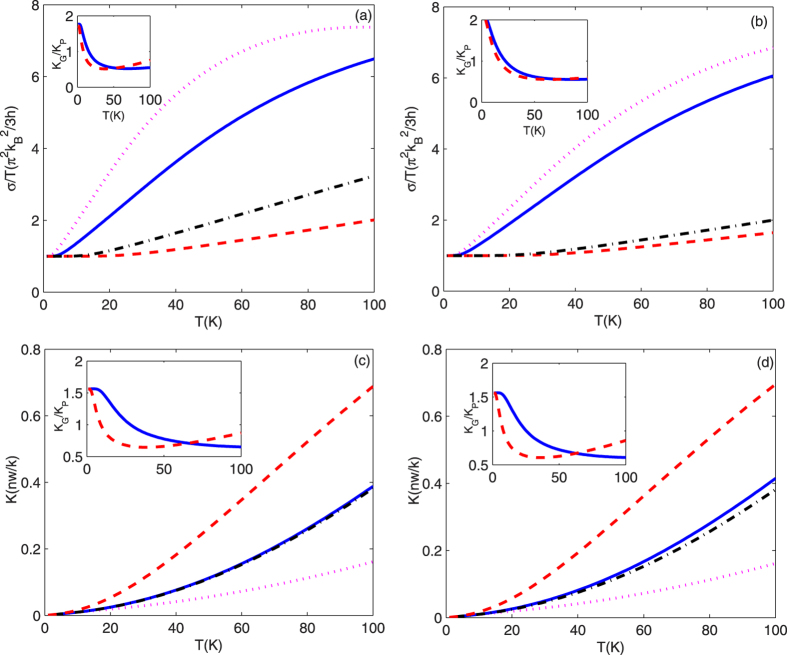
We investigate ballistic thermal transport at low temperatures in graphene and phosphorene nanoribbons (PNRS) modulated with a double-cavity quantum structure. A comparative analysis for thermal transport in these two kinds of nanomaterials is made. The results show that the thermal conductance in PNRS is greater than that in graphene nanoribbons (GNRS). The ratio kG/kP (kG is the thermal conductivity in GNRS and kP is the thermal conductivity in PNRS) decreases with lower temperature or for narrower nanoribbons, and increases with higher temperature or for wider nanoribbons. The greater thermal conductance and thermal conductivity in PNRS originate from the lower cutoff frequencies of the acoustic modes.
我们研究了在双腔量子结构调制下的石墨烯和磷烯纳米带(PNR)在低温下的弹道热输运。对这两种纳米材料中的热输运进行了对比分析。结果表明,PNR中的热导率大于石墨烯纳米带(GNR)中的热导率。比率kG/kP(kG是GNR中的热导率,kP是PNR中的热导率)随温度降低或纳米带变窄而减小,随温度升高或纳米带变宽而增大。PNR中更大的热导率和热导率源于声子模式的较低截止频率。