Houston J Brian, Spialek Matthew L, Stevens Jordan, First Jennifer, Mieseler Vicky L, Pfefferbaum Betty
Disaster and Community Crisis Center, Department of Communication, University of Missouri, Columbia, Missouri, USA.
Department of Psychology, University of Missouri, Columbia, Missouri, USA.
PLoS Curr. 2015 Oct 26;7:ecurrents.dis.18ca227647291525ce3415bec1406aa5. doi: 10.1371/currents.dis.18ca227647291525ce3415bec1406aa5.
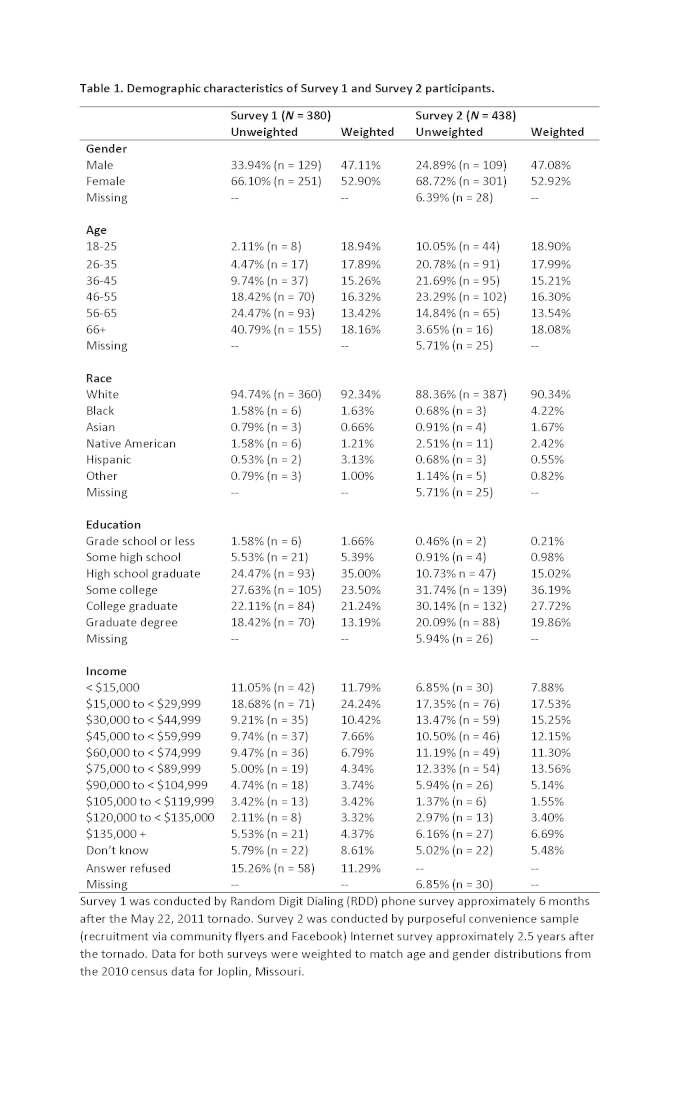
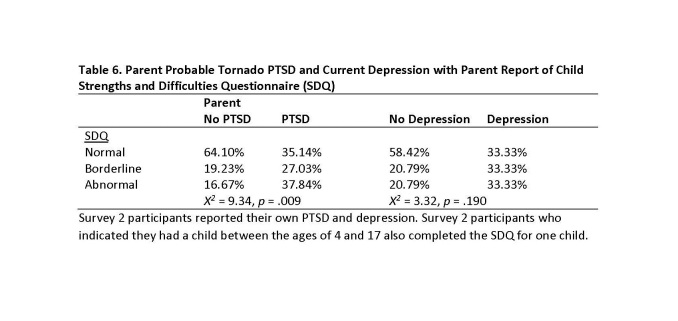
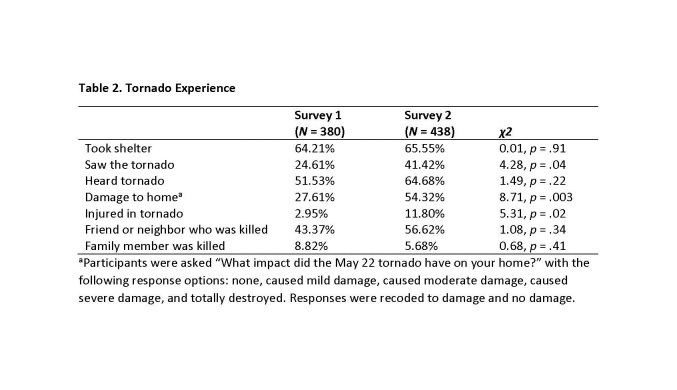
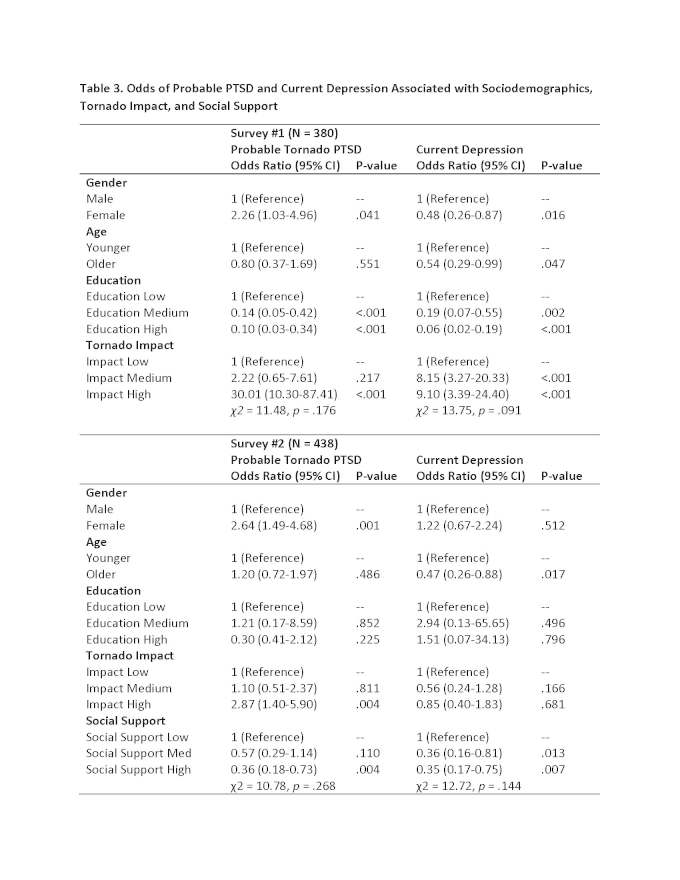
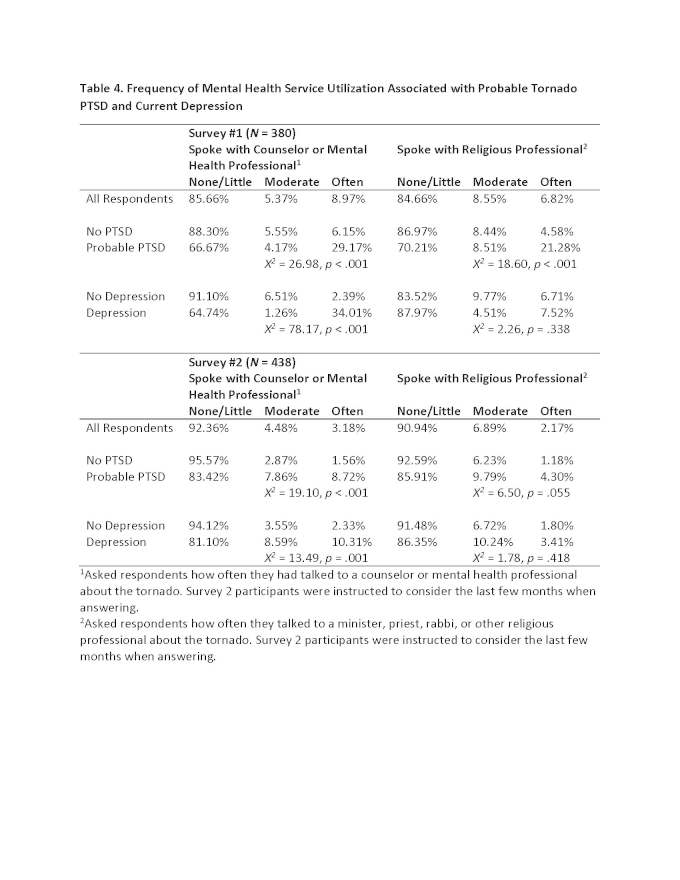
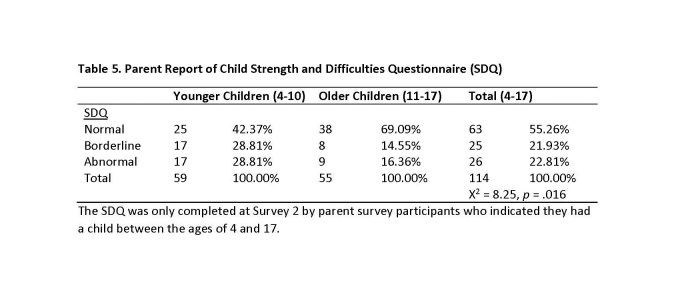
Introduction. On May 22, 2011 the deadliest tornado in the United States since 1947 struck Joplin, Missouri killing 161 people, injuring approximately 1,150 individuals, and causing approximately $2.8 billion in economic losses. Methods. This study examined the mental health effects of this event through a random digit dialing sample (N = 380) of Joplin adults at approximately 6 months post-disaster (Survey 1) and a purposive convenience sample (N = 438) of Joplin adults at approximately 2.5 years post-disaster (Survey 2). For both surveys we assessed tornado experience, posttraumatic stress, depression, mental health service utilization, and sociodemographics. For Survey 2 we also assessed social support and parent report of child strengths and difficulties. Results. Probable PTSD relevance was 12.63% at Survey 1 and 26.74% at Survey 2, while current depression prevalence was 20.82% at Survey 1 and 13.33% at Survey 2. Less education and more tornado experience was generally related to greater likelihood of experiencing probable PTSD and current depression for both surveys. Men and younger participants were more likely to report current depression at Survey 1. Low levels of social support (assessed only at Survey 2) were related to more probable PTSD and current depression. For both surveys, we observed low rates of mental health service utilization, and these rates were also low for participants reporting probable PTSD and current depression. At Survey 2 we assessed parent report of child (ages 4 to 17) strengths and difficulties and found that child difficulties were more frequent for younger children (ages 4 to 10) than older children (ages 11 to 17), and that parents reporting probable PTSD reported a greater frequency of children with borderline or abnormal difficulties. Discussion. Overall our results indicate that long-term (multi-year) community disaster mental health monitoring, assessment, referral, outreach, and services are needed following a major disaster like the 2011 Joplin tornado.
引言。2011年5月22日,美国自1947年以来最致命的龙卷风袭击了密苏里州乔普林市,造成161人死亡,约1150人受伤,经济损失约28亿美元。方法。本研究通过对乔普林市成年人进行随机数字拨号抽样(N = 380),在灾难发生后约6个月(调查1)以及目的便利抽样(N = 438),在灾难发生后约2.5年(调查2),来考察该事件对心理健康的影响。对于这两项调查,我们评估了龙卷风经历、创伤后应激障碍、抑郁症、心理健康服务利用情况以及社会人口统计学特征。对于调查2,我们还评估了社会支持以及家长对孩子优势和困难的报告。结果。在调查1中,可能患有创伤后应激障碍的比例为12.63%,在调查2中为26.74%,而当前抑郁症患病率在调查1中为20.82%,在调查2中为13.33%。在两项调查中,受教育程度较低以及经历更多龙卷风事件通常与更有可能出现可能患有创伤后应激障碍和当前抑郁症相关。在调查1中,男性和年轻参与者更有可能报告当前患有抑郁症。低水平的社会支持(仅在调查2中评估)与更有可能患有创伤后应激障碍和当前抑郁症相关。对于这两项调查,我们观察到心理健康服务利用率较低,对于报告可能患有创伤后应激障碍和当前抑郁症的参与者,这一比例也较低。在调查2中,我们评估了家长对4至17岁孩子优势和困难的报告,发现年幼儿童(4至10岁)比年长儿童(11至17岁)出现孩子困难的情况更频繁,并且报告可能患有创伤后应激障碍的家长报告有边缘或异常困难孩子的频率更高。讨论。总体而言,我们的结果表明,在像2011年乔普林龙卷风这样的重大灾难之后,需要进行长期(多年)的社区灾难心理健康监测、评估、转诊、外展和服务。