Yang Zhiyong, Dong Liming, Zhang Yushun, Yang Chong, Gou Shanmiao, Li Yongfeng, Xiong Jiongxin, Wu Heshui, Wang Chunyou
Pancreatic Disease Institute, Department of General Surgery, Union Hospital, Tongji Medical College, Huazhong University of Science and Technology, Wuhan, Hubei Province, People's Republic of China.
Organ Transplantation Center, Hospital of University of Electronic Science and Technology of China and Sichuan Provincial People's Hospital, Chengdu, Sichuan, People's Republic of China.
PLoS One. 2015 Nov 18;10(11):e0143486. doi: 10.1371/journal.pone.0143486. eCollection 2015.
To develop a model for the early prediction of severe acute pancreatitis based on the revised Atlanta classification of acute pancreatitis.
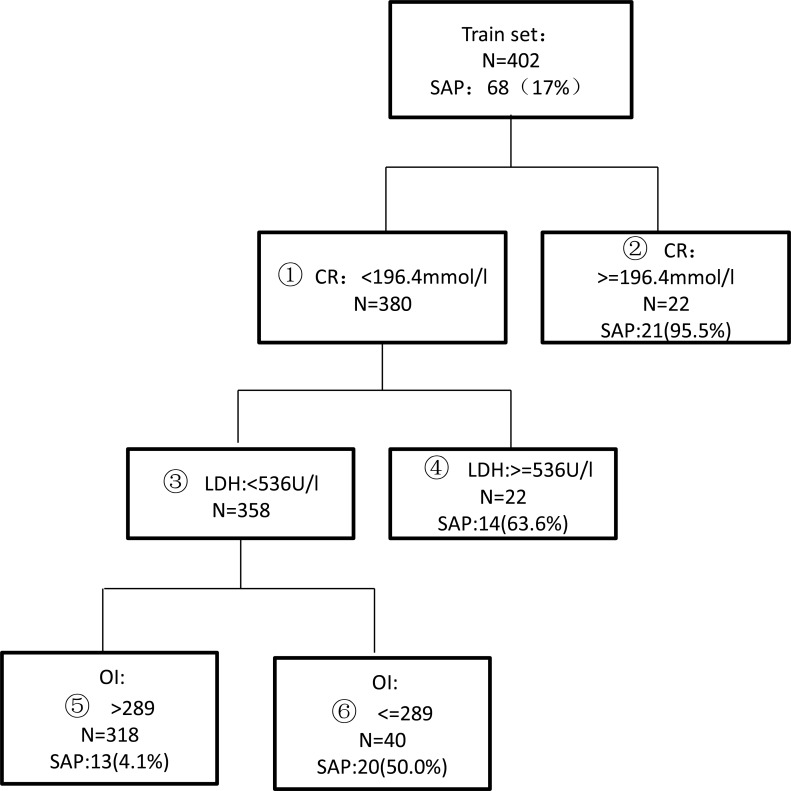
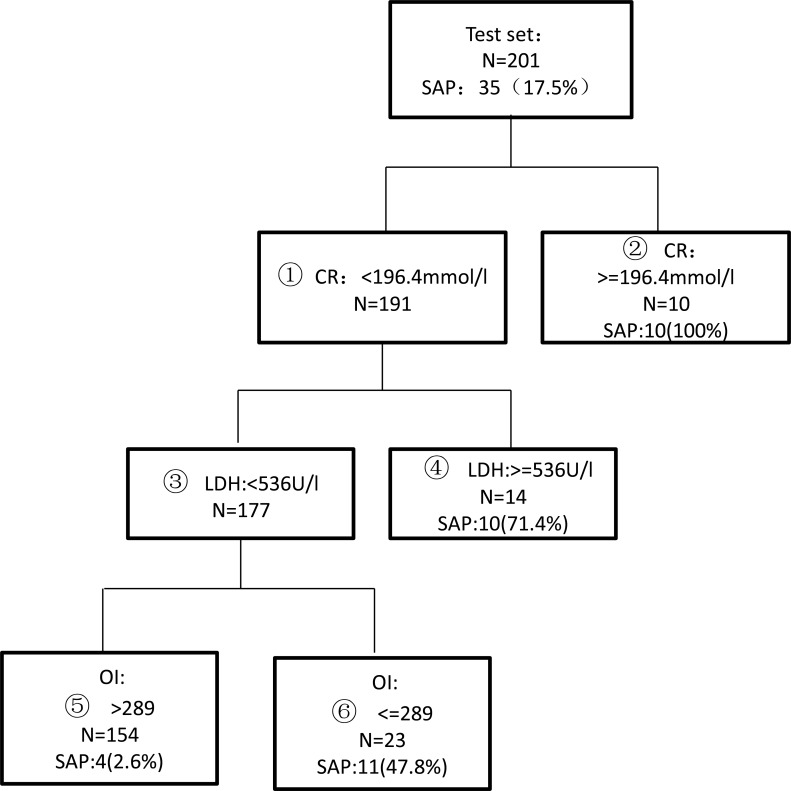
Clinical data of 1308 patients with acute pancreatitis (AP) were included in the retrospective study. A total of 603 patients who were admitted to the hospital within 36 hours of the onset of the disease were included at last according to the inclusion criteria. The clinical data were collected within 12 hours after admission. All the patients were classified as having mild acute pancreatitis (MAP), moderately severe acute pancreatitis (MSAP) and severe acute pancreatitis (SAP) based on the revised Atlanta classification of acute pancreatitis. All the 603 patients were randomly divided into training group (402 cases) and test group (201 cases). Univariate and multiple regression analyses were used to identify the independent risk factors for the development of SAP in the training group. Then the prediction model was constructed using the decision tree method, and this model was applied to the test group to evaluate its validity.
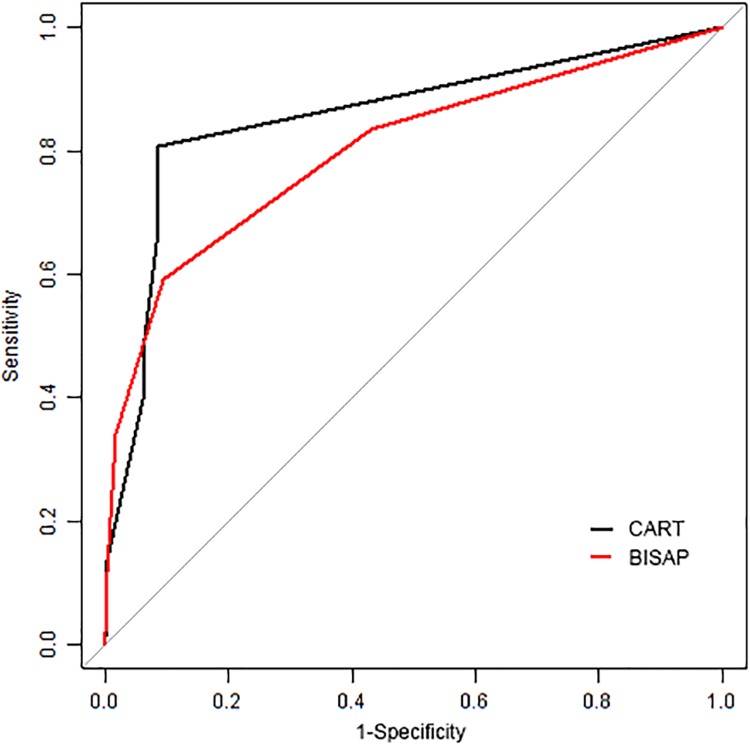
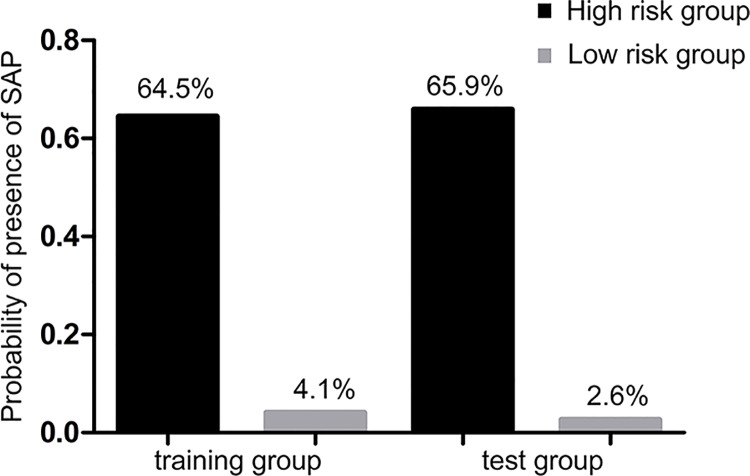
The decision tree model was developed using creatinine, lactate dehydrogenase, and oxygenation index to predict SAP. The diagnostic sensitivity and specificity of SAP in the training group were 80.9% and 90.0%, respectively, and the sensitivity and specificity in the test group were 88.6% and 90.4%, respectively.
The decision tree model based on creatinine, lactate dehydrogenase, and oxygenation index is more likely to predict the occurrence of SAP.
基于修订后的急性胰腺炎亚特兰大分类法,建立一种用于早期预测重症急性胰腺炎的模型。
回顾性研究纳入1308例急性胰腺炎(AP)患者的临床资料。最终根据纳入标准,纳入发病36小时内入院的603例患者。入院后12小时内收集临床资料。根据修订后的急性胰腺炎亚特兰大分类法,将所有患者分为轻症急性胰腺炎(MAP)、中度重症急性胰腺炎(MSAP)和重症急性胰腺炎(SAP)。将603例患者随机分为训练组(402例)和测试组(201例)。采用单因素和多因素回归分析确定训练组中发生SAP的独立危险因素。然后采用决策树方法构建预测模型,并将该模型应用于测试组以评估其有效性。
利用肌酐、乳酸脱氢酶和氧合指数建立决策树模型来预测SAP。训练组中SAP的诊断敏感性和特异性分别为80.9%和90.0%,测试组中的敏感性和特异性分别为88.6%和90.4%。
基于肌酐、乳酸脱氢酶和氧合指数的决策树模型更有可能预测SAP的发生。