Madinga Joule, Linsuke Sylvie, Mpabanzi Liliane, Meurs Lynn, Kanobana Kirezi, Speybroeck Niko, Lutumba Pascal, Polman Katja
Institute of Health and Society, Université Catholique de Louvain, Brussels, Belgium.
Department of Biomedical Sciences, Institute of Tropical Medicine, Antwerp, Belgium.
Parasit Vectors. 2015 Nov 19;8:601. doi: 10.1186/s13071-015-1206-6.
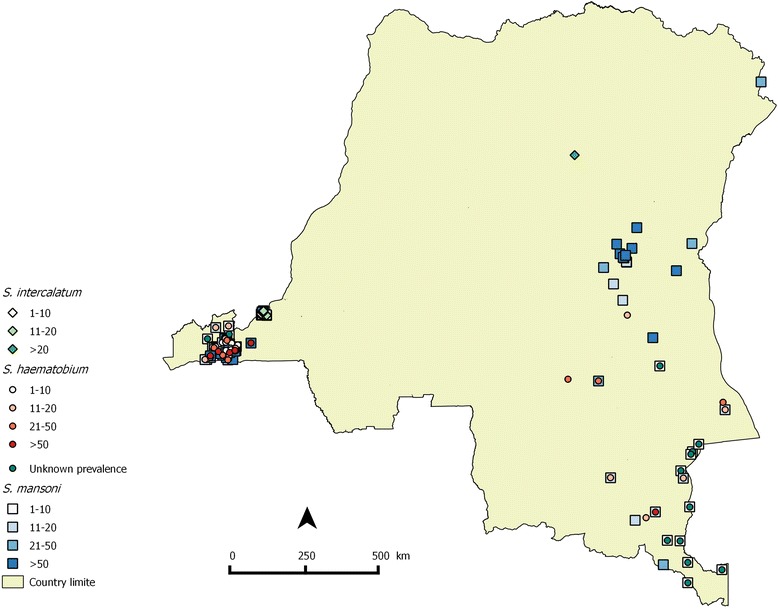
Schistosomiasis is a poverty-related parasitic infection, leading to chronic ill-health. For more than a century, schistosomiasis has been known to be endemic in certain provinces of the Democratic Republic of Congo (DRC). However, a clear overview on the status of the disease within the country is currently lacking, which is seriously hampering control. Here, we review the available information on schistosomiasis in DRC of the past 60 years. Findings and data gaps are discussed in the perspective of upcoming control activities.An electronic literature search via PubMed complemented by manual search of non-peer-reviewed articles was conducted up to January 2015. The search concerned all relevant records related to schistosomiasis in the DRC from January 1955 onwards. A total of 155 records were found, of which 30 met the inclusion criteria. Results were summarized by geographical region, mapped, and compared with those reported sixty years ago. The available data reported schistosomiasis in some areas located in 10 of the 11 provinces of DRC. Three species of Schistosoma were found: S. mansoni, S. haematobium and S. intercalatum. The prevalence of schistosomiasis varied greatly between regions and between villages, with high values of up to 95 % observed in some communities. The overall trend over 60 years points to the spread of schistosomiasis to formerly non-endemic areas. The prevalence of schistosomiasis has increased in rural endemic areas and decreased in urban/peri-urban endemic areas of Kinshasa. Hepatosplenomegaly, urinary tract lesions and anaemia were commonly reported in schistosomiasis endemic areas but not always associated with infection status.The present review confirms that schistosomiasis is still endemic in DRC. However, available data are scattered across time and space and studies lack methodological uniformity, hampering a reliable estimation of the current status of schistosomiasis in DRC. There is a clear need for updated prevalence data and well-designed studies on the epidemiology and transmission of schistosomiasis in DRC. This will aid the national control program to adequately design and implement strategies for sustainable and comprehensive control of schistosomiasis throughout the country.
血吸虫病是一种与贫困相关的寄生虫感染病,会导致长期健康问题。一个多世纪以来,人们一直知道刚果民主共和国(DRC)的某些省份存在血吸虫病地方病。然而,目前该国缺乏对该疾病状况的清晰概述,这严重阻碍了疾病防控工作。在此,我们回顾了过去60年中有关刚果民主共和国血吸虫病的现有信息。从即将开展的防控活动的角度讨论了研究结果和数据缺口。截至2015年1月,通过PubMed进行了电子文献检索,并辅以对非同行评审文章的手工检索。检索涉及1955年1月起所有与刚果民主共和国血吸虫病相关的记录。共找到155条记录,其中30条符合纳入标准。结果按地理区域进行了汇总、绘图,并与六十年前报告的结果进行了比较。现有数据显示,在刚果民主共和国11个省份中的10个省份的部分地区存在血吸虫病。发现了三种血吸虫:曼氏血吸虫、埃及血吸虫和间插血吸虫。血吸虫病的患病率在不同地区和村庄之间差异很大,在一些社区观察到高达95%的高患病率。60年来的总体趋势表明,血吸虫病已蔓延到以前的非流行地区。金沙萨农村流行地区的血吸虫病患病率有所上升,而城市/城郊流行地区的患病率有所下降。在血吸虫病流行地区,肝脾肿大、泌尿系统病变和贫血是常见报告症状,但并不总是与感染状况相关。本综述证实,血吸虫病在刚果民主共和国仍然是地方病。然而,现有数据在时间和空间上分散,且研究缺乏方法上的一致性,这妨碍了对刚果民主共和国血吸虫病现状进行可靠估计。显然需要更新患病率数据,并开展关于刚果民主共和国血吸虫病流行病学和传播的精心设计的研究。这将有助于国家防控计划充分设计和实施在全国可持续、全面控制血吸虫病的策略。