Lee Wang-Soo, Kim Jaetaek
Division of Cardiology, Department of Internal Medicine, College of Medicine, Chung-Ang University, Seoul 06973, Republic of Korea.
Division of Endocrinology and Metabolism, Department of Internal Medicine, College of Medicine, Chung-Ang University, Seoul 06973, Republic of Korea.
PPAR Res. 2015;2015:271983. doi: 10.1155/2015/271983. Epub 2015 Oct 26.
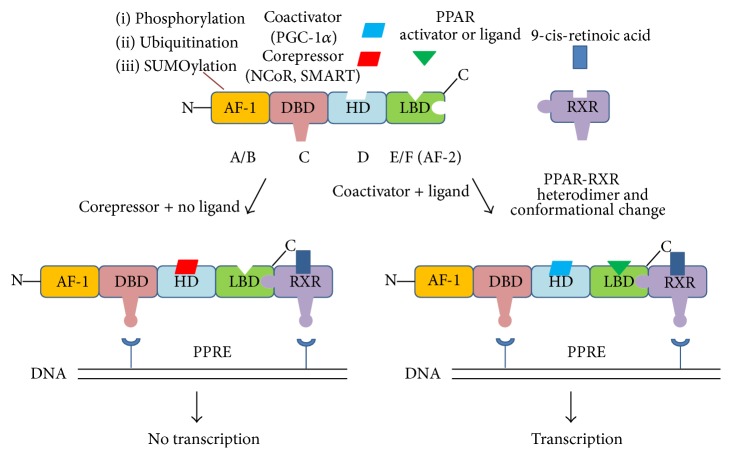
Peroxisome proliferator-activated receptors (PPARs) belong to the nuclear family of ligand activated transcriptional factors and comprise three different isoforms, PPAR-α, PPAR-β/δ, and PPAR-γ. The main role of PPARs is to regulate the expression of genes involved in lipid and glucose metabolism. Several studies have demonstrated that PPAR agonists improve dyslipidemia and glucose control in animals, supporting their potential as a promising therapeutic option to treat diabetes and dyslipidemia. However, substantial differences exist in the therapeutic or adverse effects of specific drug candidates, and clinical studies have yielded inconsistent data on their cardioprotective effects. This review summarizes the current knowledge regarding the molecular function of PPARs and the mechanisms of the PPAR regulation by posttranslational modification in the heart. We also describe the results and lessons learned from important clinical trials on PPAR agonists and discuss the potential future directions for this class of drugs.
过氧化物酶体增殖物激活受体(PPARs)属于配体激活转录因子的核家族,包括三种不同的亚型,即PPAR-α、PPAR-β/δ和PPAR-γ。PPARs的主要作用是调节参与脂质和葡萄糖代谢的基因的表达。多项研究表明,PPAR激动剂可改善动物的血脂异常和血糖控制,支持其作为治疗糖尿病和血脂异常的有前景的治疗选择的潜力。然而,特定候选药物的治疗效果或不良反应存在很大差异,临床研究关于其心脏保护作用的数据也不一致。本综述总结了目前关于PPARs分子功能以及心脏中PPAR通过翻译后修饰进行调节的机制的知识。我们还描述了PPAR激动剂重要临床试验的结果和经验教训,并讨论了这类药物未来潜在的发展方向。