Dama James F, Hocky Glen M, Sun Rui, Voth Gregory A
Department of Chemistry, James Franck Institute, Institute for Biophysical Dynamics, and Computation Institute, The University of Chicago , Chicago, Illinois 60637, United States.
Center for Nonlinear Studies, Theoretical Division, Los Alamos National Laboratory, Los Alamos, New Mexico 87545, United States.
J Chem Theory Comput. 2015 Dec 8;11(12):5638-50. doi: 10.1021/acs.jctc.5b00907. Epub 2015 Nov 20.
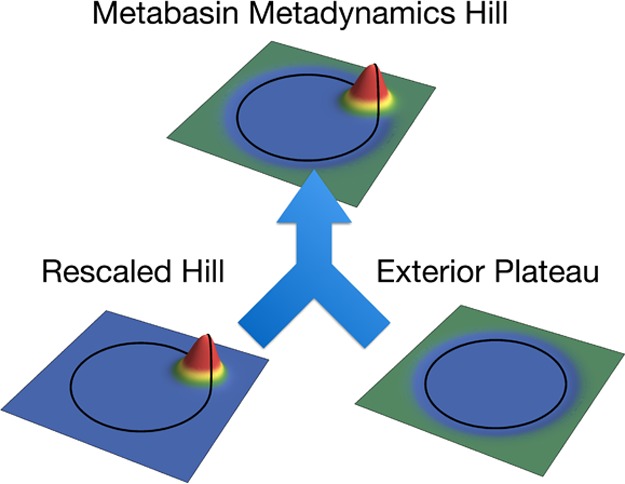
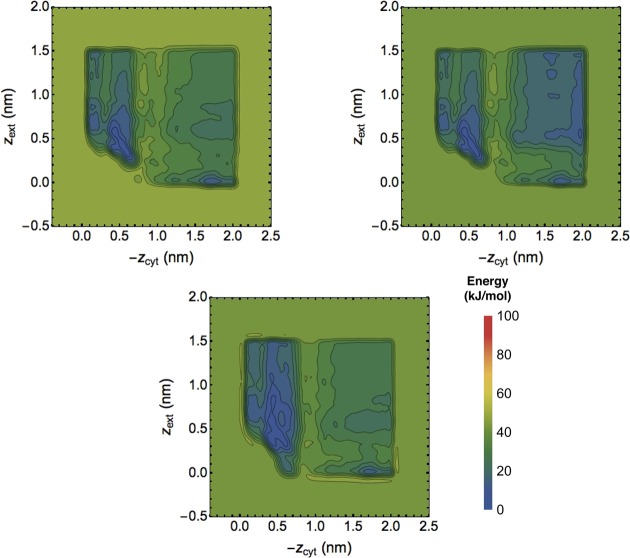
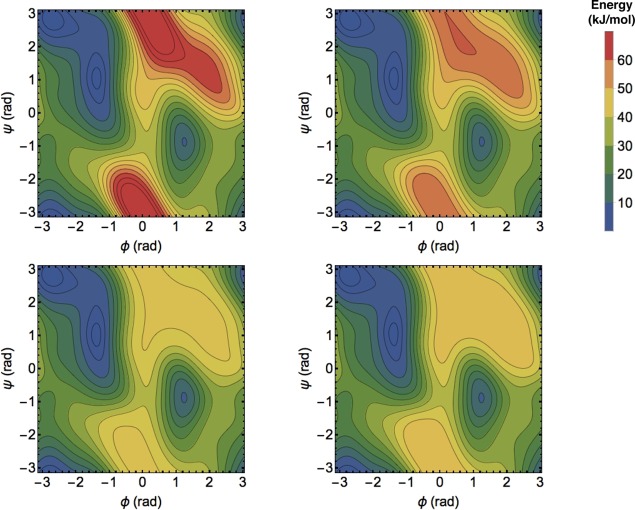
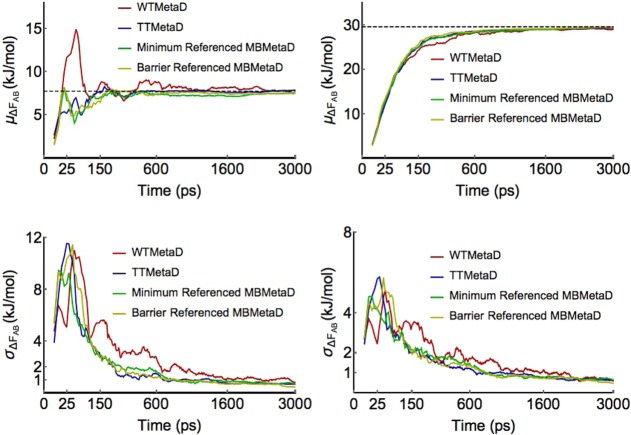
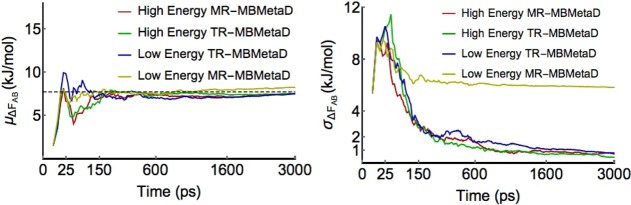
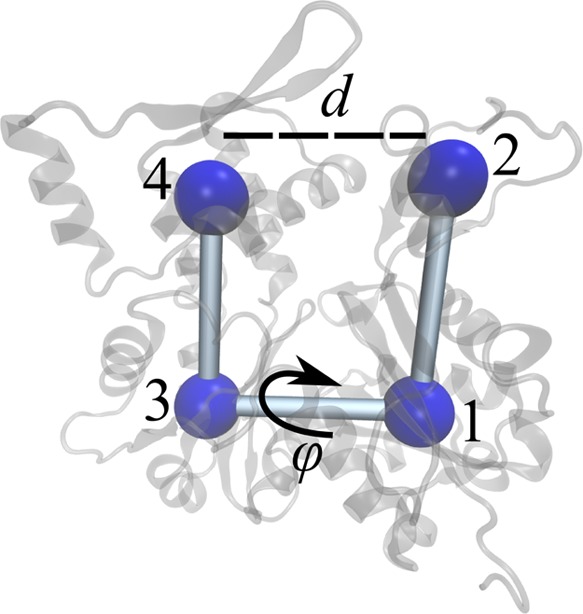
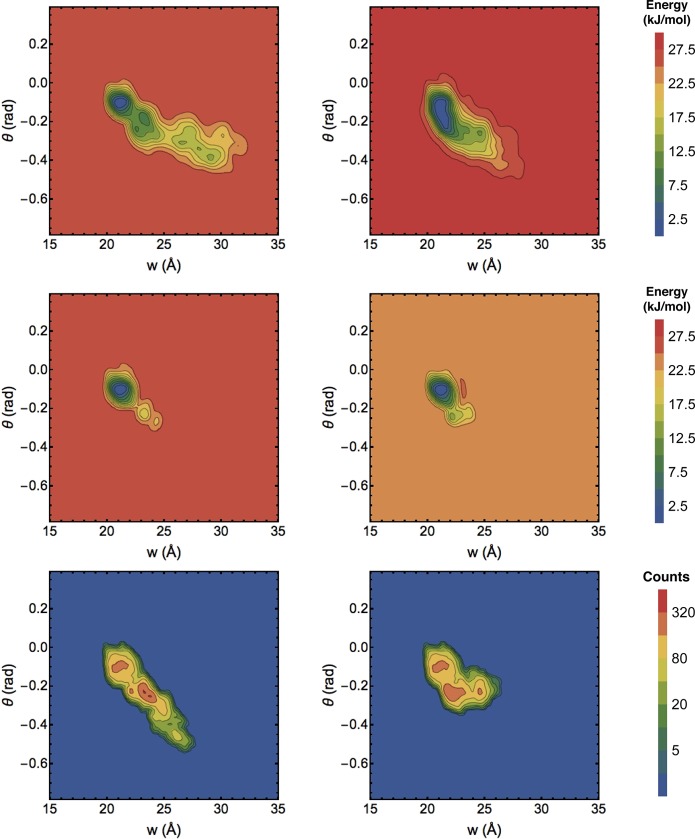
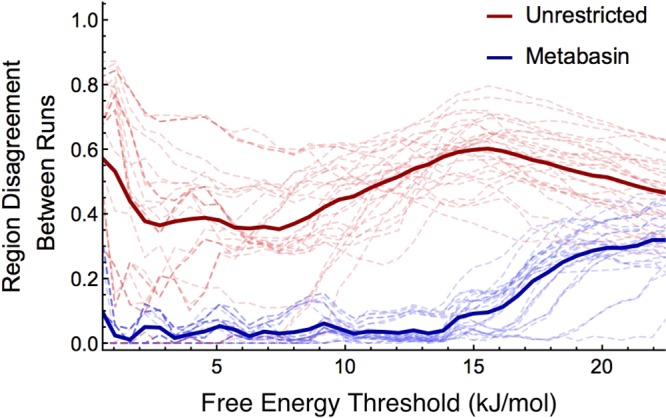
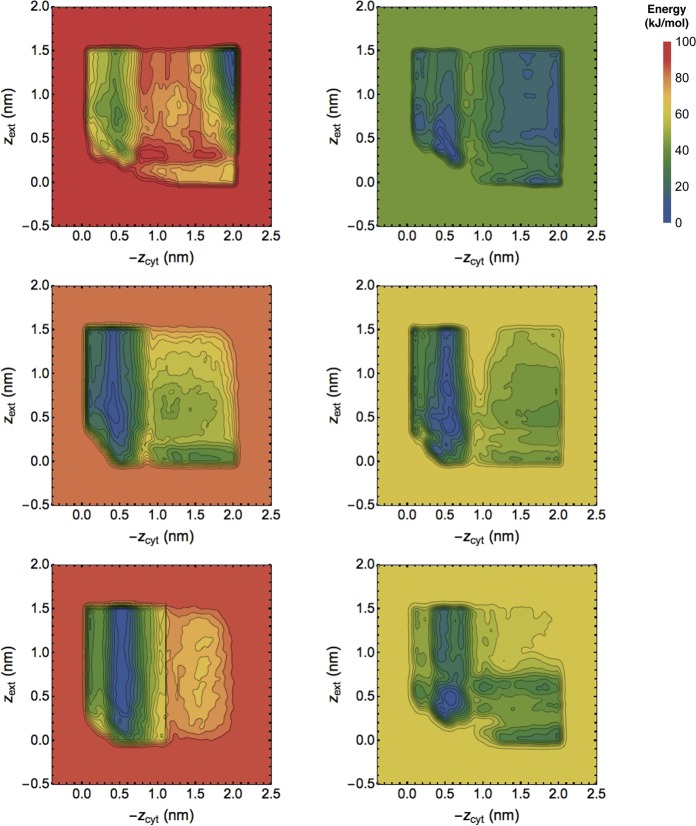
Metadynamics is an enhanced sampling method designed to flatten free energy surfaces uniformly. However, the highest-energy regions are often irrelevant to study and dangerous to explore because systems often change irreversibly in unforeseen ways in response to driving forces in these regions, spoiling the sampling. Introducing an on-the-fly domain restriction allows metadynamics to flatten only up to a specified energy level and no further, improving efficiency and safety while decreasing the pressure on practitioners to design collective variables that are robust to otherwise irrelevant high energy driving. This paper describes a new method that achieves this using sequential on-the-fly estimation of energy wells and redefinition of the metadynamics hill shape, termed metabasin metadynamics. The energy level may be defined a priori or relative to unknown barrier energies estimated on-the-fly. Altering only the hill ensures that the method is compatible with many other advances in metadynamics methodology. The hill shape has a natural interpretation in terms of multiscale dynamics, and the computational overhead in simulation is minimal when studying systems of any reasonable size, for instance proteins or other macromolecules. Three example applications show that the formula is accurate and robust to complex dynamics, making metadynamics significantly more forgiving with respect to CV quality and thus more feasible to apply to the most challenging biomolecular systems.
元动力学是一种增强采样方法,旨在均匀地平坦化自由能面。然而,最高能量区域通常与研究无关且探索起来很危险,因为系统在这些区域中往往会因驱动力而以不可预见的方式发生不可逆变化,从而破坏采样。引入动态域限制可使元动力学仅平坦化至指定能量水平,不再进一步平坦化,提高了效率和安全性,同时减轻了从业者设计对原本无关的高能量驱动具有鲁棒性的集体变量的压力。本文描述了一种新方法,该方法通过对能量阱的动态顺序估计和元动力学山丘形状的重新定义来实现这一点,称为元盆地元动力学。能量水平可以先验定义,也可以相对于动态估计的未知势垒能量来定义。仅改变山丘形状可确保该方法与元动力学方法的许多其他进展兼容。山丘形状在多尺度动力学方面具有自然的解释,并且在研究任何合理规模的系统(例如蛋白质或其他大分子)时,模拟中的计算开销最小。三个示例应用表明,该公式对于复杂动力学是准确且鲁棒的,使得元动力学在集体变量质量方面更具宽容性,因此更适合应用于最具挑战性的生物分子系统。