Hoft D F, Kim K S, Otsu K, Moser D R, Yost W J, Blumin J H, Donelson J E, Kirchhoff L V
Department of Internal Medicine, University of Iowa, Iowa City.
Infect Immun. 1989 Jul;57(7):1959-67. doi: 10.1128/iai.57.7.1959-1967.1989.
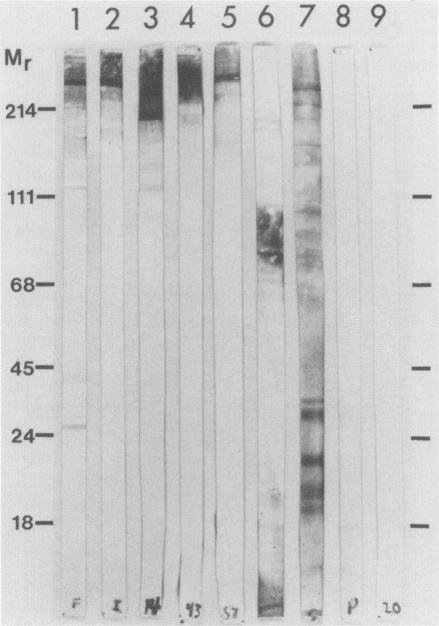
We screened a Trypanosoma cruzi cDNA expression library with human and rabbit anti-T. cruzi sera and identified cDNA clones that encode polypeptides containing tandemly arranged repeats which are 6 to 34 amino acids in length. The peptide repeats encoded by these cDNAs varied markedly in sequence, copy number, and location relative to the polyadenylation site of the mRNAs from which they were derived. The repeats were specific for T. cruzi, but in each case the sizes of the corresponding mRNAs and the total number of repeat copies encoded varied considerably among different isolates of the parasite. Expression of the peptide repeats was not stage specific. One of the peptide repeats occurred in a protein with an Mr of greater than 200,000 and one was in a protein of Mr 75,000 to 105,000. The frequent occurrence and diversity of these peptide repeats suggested that they may play a role in the ability of the parasite to evade immune destruction in its invertebrate and mammalian hosts, but the primary roles of these macromolecules may be unrelated to the host-parasite relationship.
我们用人和兔的抗克氏锥虫血清筛选了克氏锥虫cDNA表达文库,并鉴定出了编码含有串联重复序列多肽的cDNA克隆,这些重复序列长度为6至34个氨基酸。这些cDNA编码的肽重复序列在序列、拷贝数以及相对于其来源mRNA的多聚腺苷酸化位点的位置上有显著差异。这些重复序列是克氏锥虫特有的,但在每种情况下,相应mRNA的大小以及所编码重复拷贝的总数在该寄生虫的不同分离株中差异很大。肽重复序列的表达不是阶段特异性的。其中一个肽重复序列出现在一个分子量大于200,000的蛋白质中,另一个出现在分子量为75,000至105,000的蛋白质中。这些肽重复序列的频繁出现和多样性表明,它们可能在寄生虫逃避其无脊椎动物和哺乳动物宿主免疫破坏的能力中发挥作用,但这些大分子的主要作用可能与宿主 - 寄生虫关系无关。