Monk Catherine, Georgieff Michael K, Xu Dongrong, Hao Xuejun, Bansal Ravi, Gustafsson Hanna, Spicer Julie, Peterson Bradley S
Division of Behavioral Medicine, Department of Psychiatry, Columbia University Medical Center, New York, New York.
Department of Obstetrics and Gynecology, Columbia University Medical Center, New York, New York.
Pediatr Res. 2016 Mar;79(3):482-8. doi: 10.1038/pr.2015.248. Epub 2015 Nov 24.
Children prenatally exposed to inadequate iron have poorer motor and neurocognitive development. No prior study to our knowledge has assessed the influence of maternal prenatal iron intake on newborn brain tissue organization in full-term infants.
Third trimester daily iron intake was obtained using the Automated Self-Administered 24-h Dietary Recall with n = 40 healthy pregnant adolescents (aged 14-19 y). Cord blood ferritin was collected in a subsample (n = 16). Newborn (mean = 39 gestational weeks at birth; range 37-41) magnetic resonance imaging scans were acquired on a 3.0 Tesla MR Scanner. Diffusion Tensor Imaging (DTI) slices were acquired to measure the directional diffusion of water indexed by fractional anisotropy (FA).
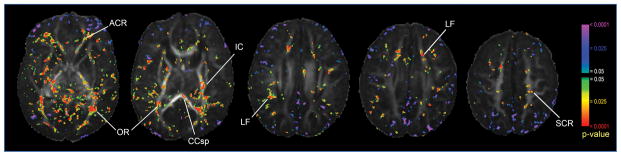
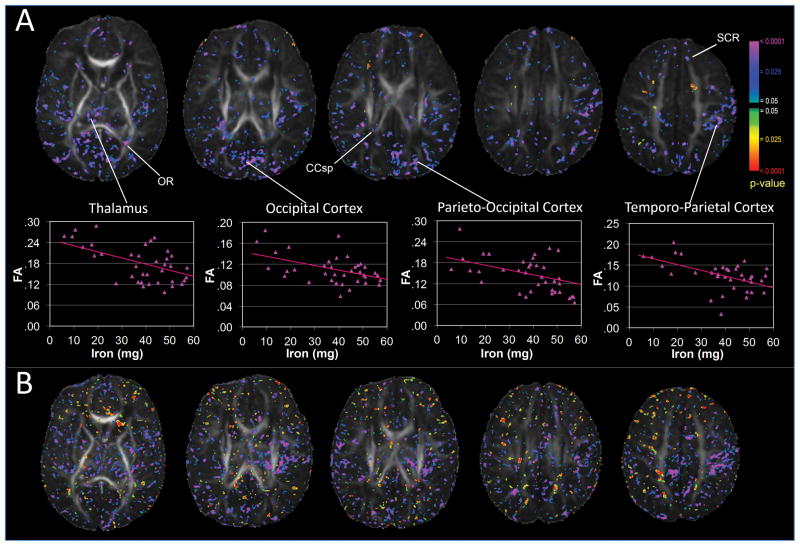
Reported iron intake was inversely associated with newborn FA values (P ≤ 0.0001) predominantly in cortical gray matter. FA findings were similar using cord blood ferritin values.
Higher maternal prenatal iron intake accentuates, and lower intake attenuates, the normal age-related decline in FA values in gray matter, perhaps representing increasing dendritic arborization and synapse formation with higher iron intake. These DTI results suggest that typical variation in maternal iron outside the scope of standard clinical surveillance exerts subtle effects on infant brain development.
产前铁摄入不足的儿童运动和神经认知发育较差。据我们所知,此前尚无研究评估母亲产前铁摄入量对足月儿新生儿脑组织结构的影响。
采用自动自填式24小时饮食回顾法,对40名健康的怀孕青少年(年龄14 - 19岁)获取孕晚期每日铁摄入量。在一个子样本(n = 16)中采集脐血铁蛋白。在3.0特斯拉磁共振扫描仪上对新生儿(出生时平均孕周为39周;范围37 - 41周)进行磁共振成像扫描。采集扩散张量成像(DTI)切片以测量由各向异性分数(FA)指标化的水的定向扩散。
报告的铁摄入量与新生儿FA值呈负相关(P≤0.0001),主要在皮质灰质中。使用脐血铁蛋白值时,FA结果相似。
母亲产前铁摄入量较高会加剧,而摄入量较低会减弱灰质中FA值与年龄相关的正常下降,这可能代表着铁摄入量较高时树突分支和突触形成增加。这些DTI结果表明,在标准临床监测范围之外,母亲铁含量的典型变化对婴儿大脑发育有微妙影响。