Laucht Arne, Muhonen Juha T, Mohiyaddin Fahd A, Kalra Rachpon, Dehollain Juan P, Freer Solomon, Hudson Fay E, Veldhorst Menno, Rahman Rajib, Klimeck Gerhard, Itoh Kohei M, Jamieson David N, McCallum Jeffrey C, Dzurak Andrew S, Morello Andrea
Centre for Quantum Computation and Communication Technology, School of Electrical Engineering and Telecommunications, University of New South Wales, Sydney, New South Wales 2052, Australia.
Network for Computational Nanotechnology, Purdue University, West Lafayette, IN 47907, USA.
Sci Adv. 2015 Apr 10;1(3):e1500022. doi: 10.1126/sciadv.1500022. eCollection 2015 Apr.
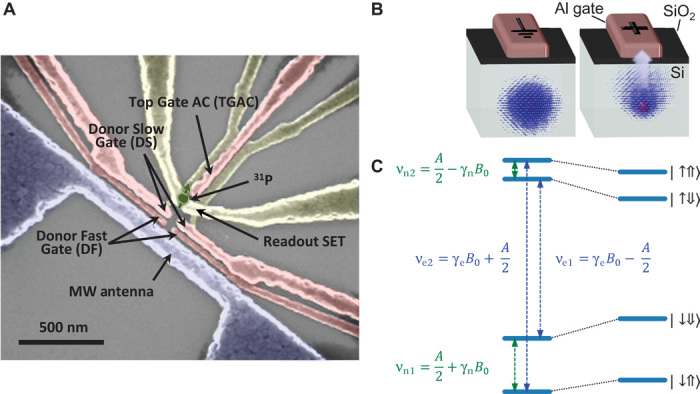
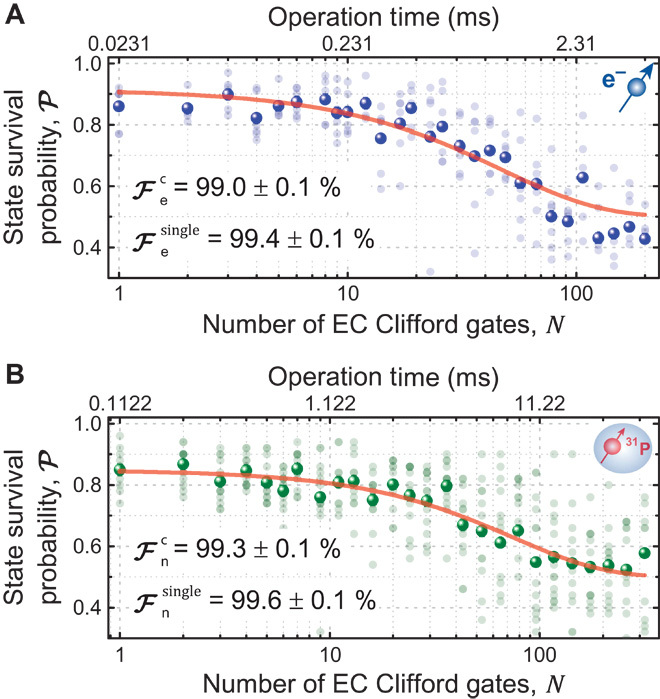
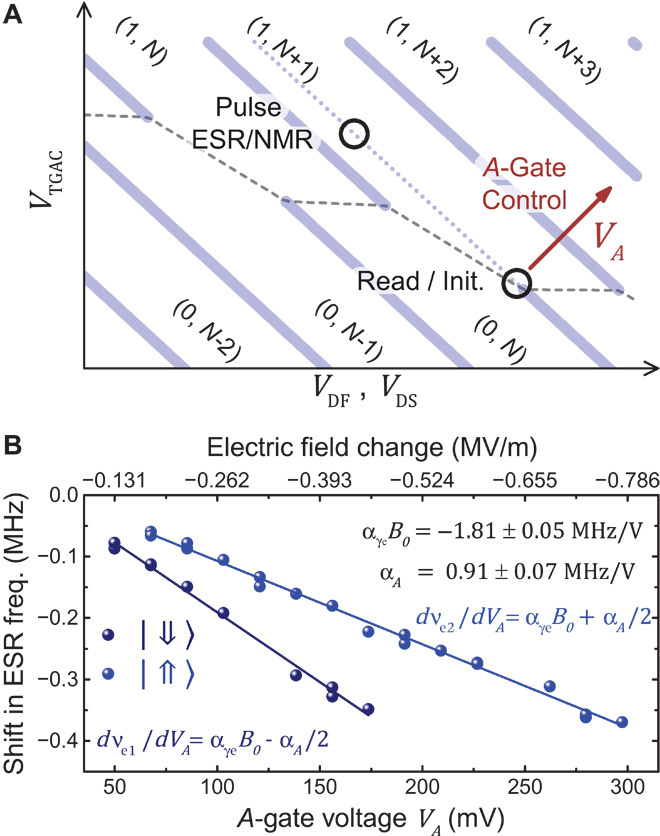
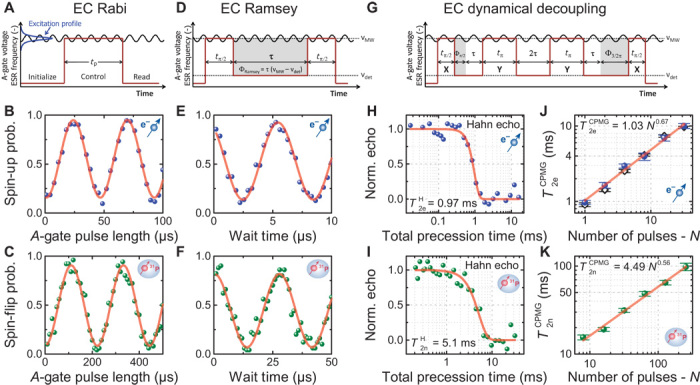
Large-scale quantum computers must be built upon quantum bits that are both highly coherent and locally controllable. We demonstrate the quantum control of the electron and the nuclear spin of a single (31)P atom in silicon, using a continuous microwave magnetic field together with nanoscale electrostatic gates. The qubits are tuned into resonance with the microwave field by a local change in electric field, which induces a Stark shift of the qubit energies. This method, known as A-gate control, preserves the excellent coherence times and gate fidelities of isolated spins, and can be extended to arbitrarily many qubits without requiring multiple microwave sources.
大规模量子计算机必须基于具有高度相干性且可局部控制的量子比特构建。我们利用连续微波磁场和纳米级静电门,展示了对硅中单个(31)P原子的电子和核自旋的量子控制。通过局部电场变化将量子比特调谐至与微波场共振,这会引起量子比特能量的斯塔克位移。这种方法称为A门控制,它保留了孤立自旋出色的相干时间和门保真度,并且无需多个微波源即可扩展到任意数量的量子比特。