Wilting Andreas, Courtiol Alexandre, Christiansen Per, Niedballa Jürgen, Scharf Anne K, Orlando Ludovic, Balkenhol Niko, Hofer Heribert, Kramer-Schadt Stephanie, Fickel Jörns, Kitchener Andrew C
Leibniz Institute for Zoo and Wildlife Research (IZW), Alfred-Kowalke-Straße 17, 10315 Berlin, Germany.
Selandia College, Bredahlsgade 1B, 4200 Slagelse, Denmark.
Sci Adv. 2015 Jun 26;1(5):e1400175. doi: 10.1126/sciadv.1400175. eCollection 2015 Jun.
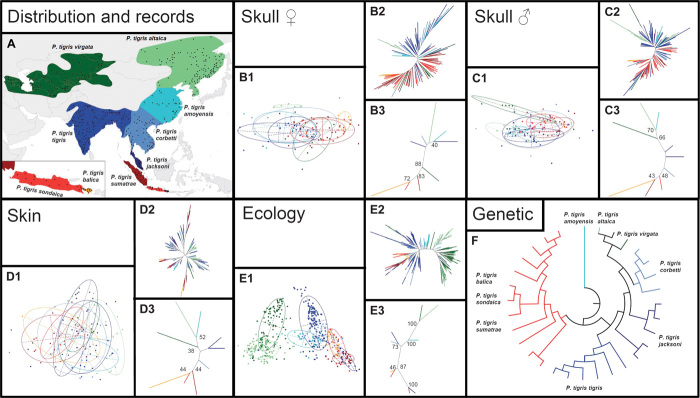
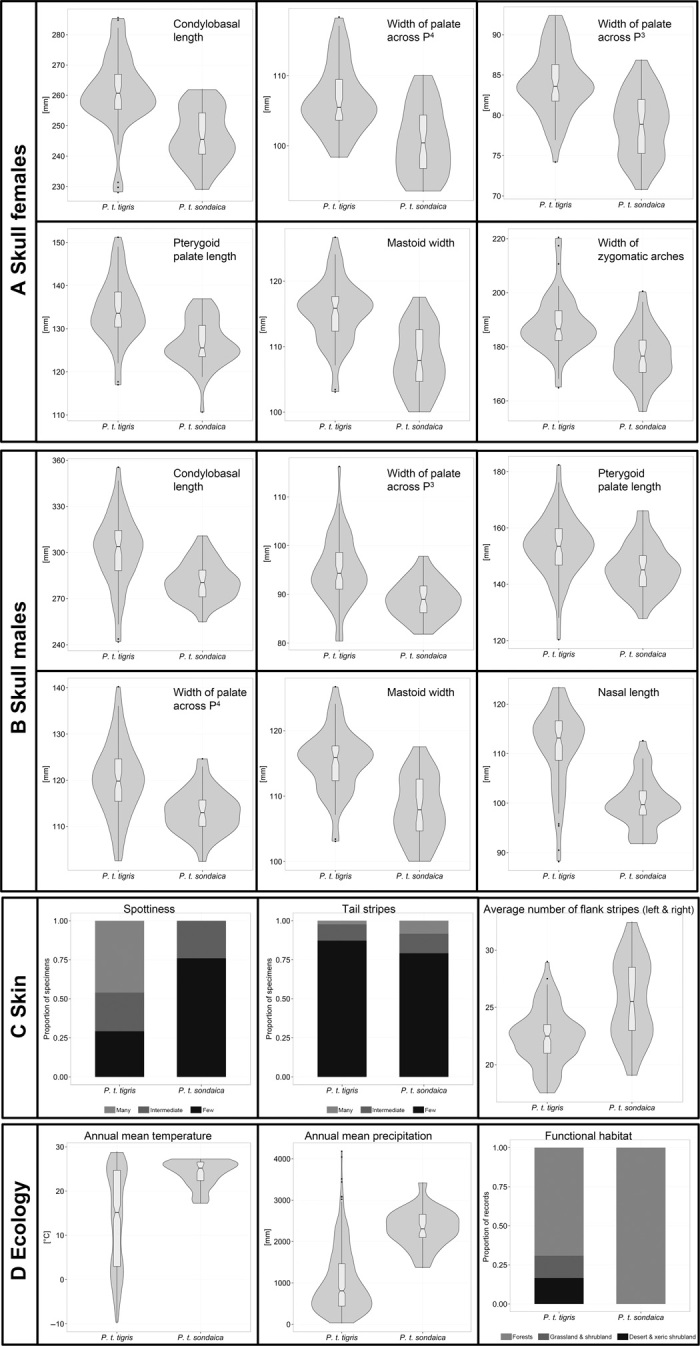
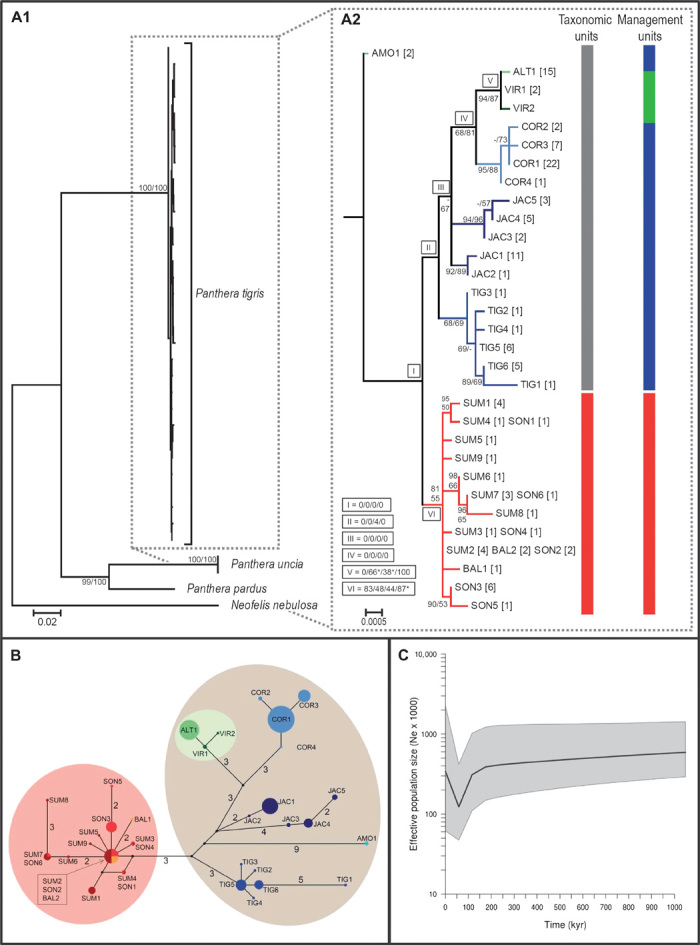
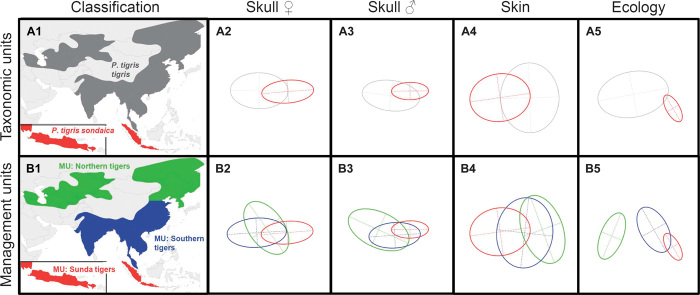
Although significantly more money is spent on the conservation of tigers than on any other threatened species, today only 3200 to 3600 tigers roam the forests of Asia, occupying only 7% of their historical range. Despite the global significance of and interest in tiger conservation, global approaches to plan tiger recovery are partly impeded by the lack of a consensus on the number of tiger subspecies or management units, because a comprehensive analysis of tiger variation is lacking. We analyzed variation among all nine putative tiger subspecies, using extensive data sets of several traits [morphological (craniodental and pelage), ecological, molecular]. Our analyses revealed little variation and large overlaps in each trait among putative subspecies, and molecular data showed extremely low diversity because of a severe Late Pleistocene population decline. Our results support recognition of only two subspecies: the Sunda tiger, Panthera tigris sondaica, and the continental tiger, Panthera tigris tigris, which consists of two (northern and southern) management units. Conservation management programs, such as captive breeding, reintroduction initiatives, or trans-boundary projects, rely on a durable, consistent characterization of subspecies as taxonomic units, defined by robust multiple lines of scientific evidence rather than single traits or ad hoc descriptions of one or few specimens. Our multiple-trait data set supports a fundamental rethinking of the conventional tiger taxonomy paradigm, which will have profound implications for the management of in situ and ex situ tiger populations and boost conservation efforts by facilitating a pragmatic approach to tiger conservation management worldwide.
尽管在老虎保护方面投入的资金比在其他任何濒危物种上投入的都要多得多,但如今亚洲森林中仅存3200至3600只老虎,其活动范围仅占历史范围的7%。尽管老虎保护具有全球意义且备受关注,但全球范围内规划老虎种群恢复的方法在一定程度上受到阻碍,原因是对于老虎亚种或管理单元的数量缺乏共识,因为缺乏对老虎变异的全面分析。我们利用多个性状(形态学性状(颅骨牙齿和皮毛)、生态学性状、分子性状)的大量数据集,分析了所有九个假定老虎亚种之间的变异情况。我们的分析表明,假定亚种之间在每个性状上的变异很小且重叠很大,分子数据显示由于晚更新世时期种群严重减少,多样性极低。我们的结果支持仅识别两个亚种:巽他虎(Panthera tigris sondaica)和大陆虎(Panthera tigris tigris),后者由两个(北部和南部)管理单元组成。保护管理计划,如圈养繁殖、重新引入计划或跨境项目,依赖于将亚种作为分类单元进行持久、一致的特征描述,这应由多条有力的科学证据来界定,而非单一性状或对一两个标本的临时描述。我们的多性状数据集支持对传统老虎分类范式进行根本性的重新思考,这将对老虎种群的就地和迁地管理产生深远影响,并通过推动全球范围内务实的老虎保护管理方法来加强保护工作。