• 文献检索
  • 文档翻译
  • 深度研究
  • 学术资讯
  • Suppr Zotero 插件Zotero 插件
  • 邀请有礼
  • 套餐&价格
  • 历史记录
应用&插件
Suppr Zotero 插件Zotero 插件浏览器插件Mac 客户端Windows 客户端微信小程序
定价
高级版会员购买积分包购买API积分包
服务
文献检索文档翻译深度研究API 文档MCP 服务
关于我们
关于 Suppr公司介绍联系我们用户协议隐私条款
关注我们

Suppr 超能文献

核心技术专利:CN118964589B侵权必究
粤ICP备2023148730 号-1Suppr @ 2026

文献检索

告别复杂PubMed语法,用中文像聊天一样搜索,搜遍4000万医学文献。AI智能推荐,让科研检索更轻松。

立即免费搜索

文件翻译

保留排版,准确专业,支持PDF/Word/PPT等文件格式,支持 12+语言互译。

免费翻译文档

深度研究

AI帮你快速写综述,25分钟生成高质量综述,智能提取关键信息,辅助科研写作。

立即免费体验

重症医学中谵妄、镇痛与镇静管理的循证及共识指南。2015年修订版(DAS指南2015)-简版

Evidence and consensus based guideline for the management of delirium, analgesia, and sedation in intensive care medicine. Revision 2015 (DAS-Guideline 2015) - short version.

作者信息

Baron Ralf, Binder Andreas, Biniek Rolf, Braune Stephan, Buerkle Hartmut, Dall Peter, Demirakca Sueha, Eckardt Rahel, Eggers Verena, Eichler Ingolf, Fietze Ingo, Freys Stephan, Fründ Andreas, Garten Lars, Gohrbandt Bernhard, Harth Irene, Hartl Wolfgang, Heppner Hans-Jürgen, Horter Johannes, Huth Ralf, Janssens Uwe, Jungk Christine, Kaeuper Kristin Maria, Kessler Paul, Kleinschmidt Stefan, Kochanek Matthias, Kumpf Matthias, Meiser Andreas, Mueller Anika, Orth Maritta, Putensen Christian, Roth Bernd, Schaefer Michael, Schaefers Rainhild, Schellongowski Peter, Schindler Monika, Schmitt Reinhard, Scholz Jens, Schroeder Stefan, Schwarzmann Gerhard, Spies Claudia, Stingele Robert, Tonner Peter, Trieschmann Uwe, Tryba Michael, Wappler Frank, Waydhas Christian, Weiss Bjoern, Weisshaar Guido

机构信息

German Society of Neurology (DGN).

German Society of Internal Medicine Intensive Care (DGIIN).

出版信息

Ger Med Sci. 2015 Nov 12;13:Doc19. doi: 10.3205/000223. eCollection 2015.

DOI:10.3205/000223
PMID:26609286
原文链接:
https://pmc.ncbi.nlm.nih.gov/articles/PMC4645746/
Abstract

In 2010, under the guidance of the DGAI (German Society of Anaesthesiology and Intensive Care Medicine) and DIVI (German Interdisciplinary Association for Intensive Care and Emergency Medicine), twelve German medical societies published the "Evidence- and Consensus-based Guidelines on the Management of Analgesia, Sedation and Delirium in Intensive Care". Since then, several new studies and publications have considerably increased the body of evidence, including the new recommendations from the American College of Critical Care Medicine (ACCM) in conjunction with Society of Critical Care Medicine (SCCM) and American Society of Health-System Pharmacists (ASHP) from 2013. For this update, a major restructuring and extension of the guidelines were needed in order to cover new aspects of treatment, such as sleep and anxiety management. The literature was systematically searched and evaluated using the criteria of the Oxford Center of Evidence Based Medicine. The body of evidence used to formulate these recommendations was reviewed and approved by representatives of 17 national societies. Three grades of recommendation were used as follows: Grade "A" (strong recommendation), Grade "B" (recommendation) and Grade "0" (open recommendation). The result is a comprehensive, interdisciplinary, evidence and consensus-based set of level 3 guidelines. This publication was designed for all ICU professionals, and takes into account all critically ill patient populations. It represents a guide to symptom-oriented prevention, diagnosis, and treatment of delirium, anxiety, stress, and protocol-based analgesia, sedation, and sleep-management in intensive care medicine.

摘要

2010年,在德国麻醉与重症医学学会(DGAI)和德国重症与急诊医学跨学科协会(DIVI)的指导下,德国12个医学协会发表了《重症监护中镇痛、镇静和谵妄管理的循证与共识指南》。自那时以来,多项新研究和出版物大幅增加了证据量,包括美国危重病医学会(ACCM)联合危重病医学学会(SCCM)及美国卫生系统药师协会(ASHP)于2013年提出的新建议。为了此次更新,需要对指南进行重大重组和扩充,以涵盖治疗的新方面,如睡眠和焦虑管理。使用牛津循证医学中心的标准对文献进行了系统检索和评估。用于制定这些建议的证据由17个国家协会的代表进行了审查和批准。采用了以下三个推荐等级:“A”级(强烈推荐)、“B”级(推荐)和“0”级(开放性推荐)。结果是一套全面、跨学科、基于证据和共识的3级指南。本出版物是为所有重症监护专业人员设计的,并考虑了所有重症患者群体。它代表了重症医学中以症状为导向的谵妄、焦虑、应激预防、诊断和治疗以及基于方案的镇痛、镇静和睡眠管理指南。

https://cdn.ncbi.nlm.nih.gov/pmc/blobs/0760/4645746/599fd8927e8a/GMS-13-19-g-002.jpg
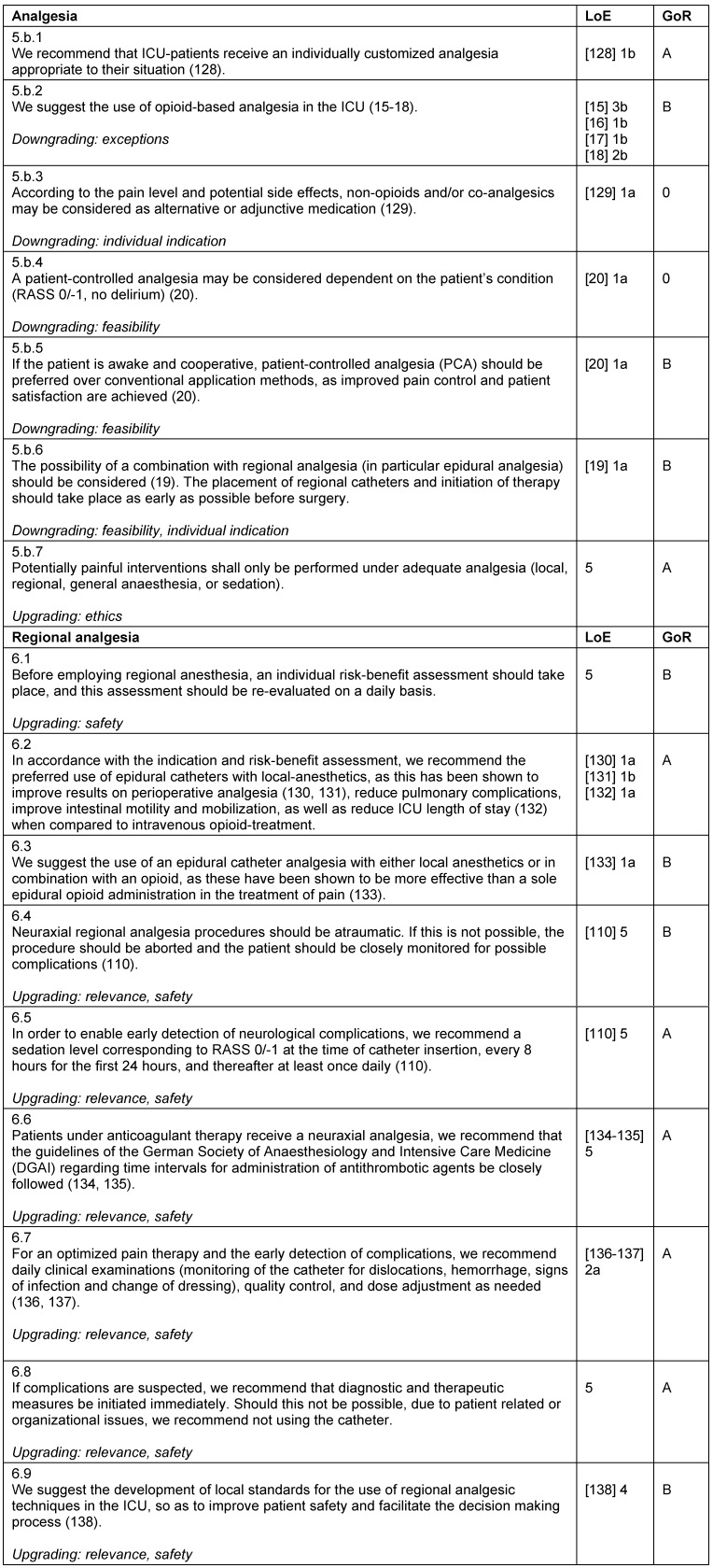
https://cdn.ncbi.nlm.nih.gov/pmc/blobs/0760/4645746/572ee0965f52/GMS-13-19-t-001.jpg
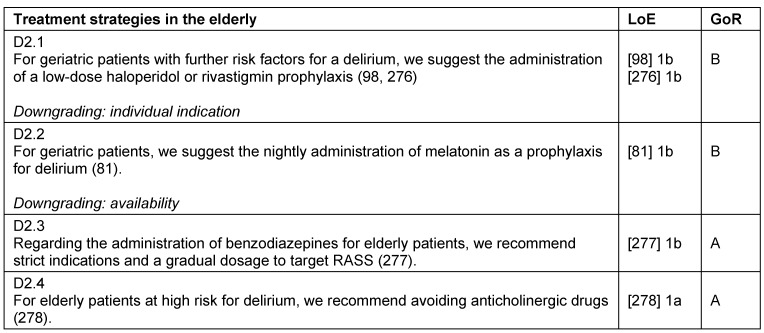
https://cdn.ncbi.nlm.nih.gov/pmc/blobs/0760/4645746/d5d0a6bef11f/GMS-13-19-t-002.jpg
https://cdn.ncbi.nlm.nih.gov/pmc/blobs/0760/4645746/a8621a373ed8/GMS-13-19-t-003.jpg
https://cdn.ncbi.nlm.nih.gov/pmc/blobs/0760/4645746/69c9f6aa8db5/GMS-13-19-t-004.jpg
https://cdn.ncbi.nlm.nih.gov/pmc/blobs/0760/4645746/3f7e002db9f5/GMS-13-19-t-005.jpg
https://cdn.ncbi.nlm.nih.gov/pmc/blobs/0760/4645746/c1fe890b8a26/GMS-13-19-t-006.jpg
https://cdn.ncbi.nlm.nih.gov/pmc/blobs/0760/4645746/dff424b7ff90/GMS-13-19-t-007.jpg
https://cdn.ncbi.nlm.nih.gov/pmc/blobs/0760/4645746/8eaa72b20852/GMS-13-19-t-008.jpg
https://cdn.ncbi.nlm.nih.gov/pmc/blobs/0760/4645746/3e475c88c6ab/GMS-13-19-t-009.jpg
https://cdn.ncbi.nlm.nih.gov/pmc/blobs/0760/4645746/9a873f86e22a/GMS-13-19-t-010.jpg
https://cdn.ncbi.nlm.nih.gov/pmc/blobs/0760/4645746/822cca10b946/GMS-13-19-t-011.jpg
https://cdn.ncbi.nlm.nih.gov/pmc/blobs/0760/4645746/d2940f759b10/GMS-13-19-t-012.jpg
https://cdn.ncbi.nlm.nih.gov/pmc/blobs/0760/4645746/6a9e1cd8c6fb/GMS-13-19-t-013.jpg
https://cdn.ncbi.nlm.nih.gov/pmc/blobs/0760/4645746/f30bd9ac1235/GMS-13-19-t-014.jpg
https://cdn.ncbi.nlm.nih.gov/pmc/blobs/0760/4645746/c1a042e280f5/GMS-13-19-t-015.jpg
https://cdn.ncbi.nlm.nih.gov/pmc/blobs/0760/4645746/96768b1cf400/GMS-13-19-t-016.jpg
https://cdn.ncbi.nlm.nih.gov/pmc/blobs/0760/4645746/eb9a872b65dc/GMS-13-19-t-017.jpg
https://cdn.ncbi.nlm.nih.gov/pmc/blobs/0760/4645746/4ecc81afe0ba/GMS-13-19-t-018.jpg
https://cdn.ncbi.nlm.nih.gov/pmc/blobs/0760/4645746/8c1628f1d997/GMS-13-19-t-019.jpg
https://cdn.ncbi.nlm.nih.gov/pmc/blobs/0760/4645746/568f15cd6547/GMS-13-19-t-020.jpg
https://cdn.ncbi.nlm.nih.gov/pmc/blobs/0760/4645746/9698f5f37bdb/GMS-13-19-t-021.jpg
https://cdn.ncbi.nlm.nih.gov/pmc/blobs/0760/4645746/4c5ef7df3f7d/GMS-13-19-t-022.jpg
https://cdn.ncbi.nlm.nih.gov/pmc/blobs/0760/4645746/6a310f3da472/GMS-13-19-t-023.jpg
https://cdn.ncbi.nlm.nih.gov/pmc/blobs/0760/4645746/3677d23fd0e4/GMS-13-19-t-024.jpg
https://cdn.ncbi.nlm.nih.gov/pmc/blobs/0760/4645746/3cebcea1ee23/GMS-13-19-t-025.jpg
https://cdn.ncbi.nlm.nih.gov/pmc/blobs/0760/4645746/5d723937b5ac/GMS-13-19-t-026.jpg
https://cdn.ncbi.nlm.nih.gov/pmc/blobs/0760/4645746/d858bdcf0bc1/GMS-13-19-t-027.jpg
https://cdn.ncbi.nlm.nih.gov/pmc/blobs/0760/4645746/1e415721f5ff/GMS-13-19-t-028.jpg
https://cdn.ncbi.nlm.nih.gov/pmc/blobs/0760/4645746/a3ca81544f18/GMS-13-19-t-029.jpg
https://cdn.ncbi.nlm.nih.gov/pmc/blobs/0760/4645746/917b2c348cc7/GMS-13-19-t-030.jpg
https://cdn.ncbi.nlm.nih.gov/pmc/blobs/0760/4645746/42546406557a/GMS-13-19-t-031.jpg
https://cdn.ncbi.nlm.nih.gov/pmc/blobs/0760/4645746/5fe8dca1c955/GMS-13-19-t-032.jpg
https://cdn.ncbi.nlm.nih.gov/pmc/blobs/0760/4645746/b75cbd48ffb7/GMS-13-19-t-033.jpg
https://cdn.ncbi.nlm.nih.gov/pmc/blobs/0760/4645746/a5715710af13/GMS-13-19-t-034.jpg
https://cdn.ncbi.nlm.nih.gov/pmc/blobs/0760/4645746/fa96811a6f2f/GMS-13-19-t-035.jpg
https://cdn.ncbi.nlm.nih.gov/pmc/blobs/0760/4645746/31bf91995f7b/GMS-13-19-t-036.jpg
https://cdn.ncbi.nlm.nih.gov/pmc/blobs/0760/4645746/95b173ba4659/GMS-13-19-g-001.jpg
https://cdn.ncbi.nlm.nih.gov/pmc/blobs/0760/4645746/599fd8927e8a/GMS-13-19-g-002.jpg
https://cdn.ncbi.nlm.nih.gov/pmc/blobs/0760/4645746/572ee0965f52/GMS-13-19-t-001.jpg
https://cdn.ncbi.nlm.nih.gov/pmc/blobs/0760/4645746/d5d0a6bef11f/GMS-13-19-t-002.jpg
https://cdn.ncbi.nlm.nih.gov/pmc/blobs/0760/4645746/a8621a373ed8/GMS-13-19-t-003.jpg
https://cdn.ncbi.nlm.nih.gov/pmc/blobs/0760/4645746/69c9f6aa8db5/GMS-13-19-t-004.jpg
https://cdn.ncbi.nlm.nih.gov/pmc/blobs/0760/4645746/3f7e002db9f5/GMS-13-19-t-005.jpg
https://cdn.ncbi.nlm.nih.gov/pmc/blobs/0760/4645746/c1fe890b8a26/GMS-13-19-t-006.jpg
https://cdn.ncbi.nlm.nih.gov/pmc/blobs/0760/4645746/dff424b7ff90/GMS-13-19-t-007.jpg
https://cdn.ncbi.nlm.nih.gov/pmc/blobs/0760/4645746/8eaa72b20852/GMS-13-19-t-008.jpg
https://cdn.ncbi.nlm.nih.gov/pmc/blobs/0760/4645746/3e475c88c6ab/GMS-13-19-t-009.jpg
https://cdn.ncbi.nlm.nih.gov/pmc/blobs/0760/4645746/9a873f86e22a/GMS-13-19-t-010.jpg
https://cdn.ncbi.nlm.nih.gov/pmc/blobs/0760/4645746/822cca10b946/GMS-13-19-t-011.jpg
https://cdn.ncbi.nlm.nih.gov/pmc/blobs/0760/4645746/d2940f759b10/GMS-13-19-t-012.jpg
https://cdn.ncbi.nlm.nih.gov/pmc/blobs/0760/4645746/6a9e1cd8c6fb/GMS-13-19-t-013.jpg
https://cdn.ncbi.nlm.nih.gov/pmc/blobs/0760/4645746/f30bd9ac1235/GMS-13-19-t-014.jpg
https://cdn.ncbi.nlm.nih.gov/pmc/blobs/0760/4645746/c1a042e280f5/GMS-13-19-t-015.jpg
https://cdn.ncbi.nlm.nih.gov/pmc/blobs/0760/4645746/96768b1cf400/GMS-13-19-t-016.jpg
https://cdn.ncbi.nlm.nih.gov/pmc/blobs/0760/4645746/eb9a872b65dc/GMS-13-19-t-017.jpg
https://cdn.ncbi.nlm.nih.gov/pmc/blobs/0760/4645746/4ecc81afe0ba/GMS-13-19-t-018.jpg
https://cdn.ncbi.nlm.nih.gov/pmc/blobs/0760/4645746/8c1628f1d997/GMS-13-19-t-019.jpg
https://cdn.ncbi.nlm.nih.gov/pmc/blobs/0760/4645746/568f15cd6547/GMS-13-19-t-020.jpg
https://cdn.ncbi.nlm.nih.gov/pmc/blobs/0760/4645746/9698f5f37bdb/GMS-13-19-t-021.jpg
https://cdn.ncbi.nlm.nih.gov/pmc/blobs/0760/4645746/4c5ef7df3f7d/GMS-13-19-t-022.jpg
https://cdn.ncbi.nlm.nih.gov/pmc/blobs/0760/4645746/6a310f3da472/GMS-13-19-t-023.jpg
https://cdn.ncbi.nlm.nih.gov/pmc/blobs/0760/4645746/3677d23fd0e4/GMS-13-19-t-024.jpg
https://cdn.ncbi.nlm.nih.gov/pmc/blobs/0760/4645746/3cebcea1ee23/GMS-13-19-t-025.jpg
https://cdn.ncbi.nlm.nih.gov/pmc/blobs/0760/4645746/5d723937b5ac/GMS-13-19-t-026.jpg
https://cdn.ncbi.nlm.nih.gov/pmc/blobs/0760/4645746/d858bdcf0bc1/GMS-13-19-t-027.jpg
https://cdn.ncbi.nlm.nih.gov/pmc/blobs/0760/4645746/1e415721f5ff/GMS-13-19-t-028.jpg
https://cdn.ncbi.nlm.nih.gov/pmc/blobs/0760/4645746/a3ca81544f18/GMS-13-19-t-029.jpg
https://cdn.ncbi.nlm.nih.gov/pmc/blobs/0760/4645746/917b2c348cc7/GMS-13-19-t-030.jpg
https://cdn.ncbi.nlm.nih.gov/pmc/blobs/0760/4645746/42546406557a/GMS-13-19-t-031.jpg
https://cdn.ncbi.nlm.nih.gov/pmc/blobs/0760/4645746/5fe8dca1c955/GMS-13-19-t-032.jpg
https://cdn.ncbi.nlm.nih.gov/pmc/blobs/0760/4645746/b75cbd48ffb7/GMS-13-19-t-033.jpg
https://cdn.ncbi.nlm.nih.gov/pmc/blobs/0760/4645746/a5715710af13/GMS-13-19-t-034.jpg
https://cdn.ncbi.nlm.nih.gov/pmc/blobs/0760/4645746/fa96811a6f2f/GMS-13-19-t-035.jpg
https://cdn.ncbi.nlm.nih.gov/pmc/blobs/0760/4645746/31bf91995f7b/GMS-13-19-t-036.jpg
https://cdn.ncbi.nlm.nih.gov/pmc/blobs/0760/4645746/95b173ba4659/GMS-13-19-g-001.jpg
https://cdn.ncbi.nlm.nih.gov/pmc/blobs/0760/4645746/599fd8927e8a/GMS-13-19-g-002.jpg

相似文献

1
Evidence and consensus based guideline for the management of delirium, analgesia, and sedation in intensive care medicine. Revision 2015 (DAS-Guideline 2015) - short version.重症医学中谵妄、镇痛与镇静管理的循证及共识指南。2015年修订版(DAS指南2015)-简版
Ger Med Sci. 2015 Nov 12;13:Doc19. doi: 10.3205/000223. eCollection 2015.
2
Evidence and consensus-based German guidelines for the management of analgesia, sedation and delirium in intensive care--short version.基于证据和共识的德国重症监护镇痛、镇静和谵妄管理指南——简版
Ger Med Sci. 2010 Feb 2;8:Doc02. doi: 10.3205/000091.
3
["Symptomatic Treatment of Delirium, Anxiety and Stress, and Protocol Based Analgesia, Sedation and Management of Sleep in Intensive Care Patients"].["重症监护患者谵妄、焦虑和应激的对症治疗以及基于方案的镇痛、镇静和睡眠管理"]
Anasthesiol Intensivmed Notfallmed Schmerzther. 2015 Nov;50(11-12):698-703. doi: 10.1055/s-0041-107321. Epub 2015 Dec 9.
4
Clinical practice guidelines for evidence-based management of sedoanalgesia in critically ill adult patients.成人危重症患者镇静镇痛管理的循证临床实践指南。
Med Intensiva. 2013 Nov;37(8):519-74. doi: 10.1016/j.medin.2013.04.001. Epub 2013 Jun 14.
5
[ICU delirium: Consequences for management of analgesia and sedation in the critically ill].[ICU谵妄:对危重症患者镇痛与镇静管理的影响]
Anasthesiol Intensivmed Notfallmed Schmerzther. 2011 Sep;46(9):568-72. doi: 10.1055/s-0031-1286607. Epub 2011 Sep 5.
6
Evidence-based clinical practice guidelines for the management of sedoanalgesia and delirium in critically ill adult patients.重症成年患者镇静镇痛和谵妄管理的循证临床实践指南。
Med Intensiva (Engl Ed). 2020 Apr;44(3):171-184. doi: 10.1016/j.medin.2019.07.013. Epub 2019 Sep 3.
7
The methodological approach used to develop the 2013 Pain, Agitation, and Delirium Clinical Practice Guidelines for adult ICU patients.2013 年成人 ICU 患者疼痛、躁动和谵妄临床实践指南的制定方法。
Crit Care Med. 2013 Sep;41(9 Suppl 1):S1-15. doi: 10.1097/CCM.0b013e3182a167d7.
8
Clinical Practice Guidelines for the Prevention and Management of Pain, Agitation/Sedation, Delirium, Immobility, and Sleep Disruption in Adult Patients in the ICU.成人 ICU 患者疼痛、躁动/镇静、谵妄、活动减少、睡眠障碍预防与管理临床实践指南。
Crit Care Med. 2018 Sep;46(9):e825-e873. doi: 10.1097/CCM.0000000000003299.
9
Practice parameters for intravenous analgesia and sedation for adult patients in the intensive care unit: an executive summary. Society of Critical Care Medicine.重症监护病房成年患者静脉镇痛与镇静的实践参数:执行摘要。危重病医学会。
Crit Care Med. 1995 Sep;23(9):1596-600. doi: 10.1097/00003246-199509000-00021.
10
The sedation of critically ill adults: Part 1: Assessment. The first in a two-part series focuses on assessing sedated patients in the ICU.危重症成年患者的镇静:第1部分:评估。这个两部分系列的第一部分重点关注重症监护病房中接受镇静治疗患者的评估。
Am J Nurs. 2007 Jul;107(7):40-8; quiz 49. doi: 10.1097/01.NAJ.0000279265.66906.2f.

引用本文的文献

1
Prioritizing delirium risk factors in nursing: a cross-sectional study using the analytic hierarchy process.护理中谵妄风险因素的优先级排序:一项使用层次分析法的横断面研究。
BMC Nurs. 2025 Jul 30;24(1):996. doi: 10.1186/s12912-025-03454-6.
2
Sedation and analgesia in post-cardiac arrest care: a post hoc analysis of the TTM2 trial.心脏骤停后护理中的镇静与镇痛:TTM2试验的事后分析
Crit Care. 2025 Jun 17;29(1):247. doi: 10.1186/s13054-025-05461-0.
3
Continuous deep sedation versus minimal sedation after cardiac arrest and resuscitation (SED-CARE): A protocol for a randomized clinical trial.

本文引用的文献

1
Early deep sedation is associated with decreased in-hospital and two-year follow-up survival.早期深度镇静与住院期间及两年随访期生存率降低相关。
Crit Care. 2015 Apr 28;19(1):197. doi: 10.1186/s13054-015-0929-2.
2
A systematic review of implementation strategies for assessment, prevention, and management of ICU delirium and their effect on clinical outcomes.对重症监护病房谵妄评估、预防和管理的实施策略及其对临床结局影响的系统评价。
Crit Care. 2015 Apr 9;19(1):157. doi: 10.1186/s13054-015-0886-9.
3
Ketamine for continuous sedation of mechanically ventilated patients.
心脏骤停与复苏后持续深度镇静与最小镇静效果比较(SED-CARE):一项随机临床试验方案
Acta Anaesthesiol Scand. 2025 May;69(5):e70022. doi: 10.1111/aas.70022.
4
Isoflurane vs. Propofol Sedation in Patients with Severe Stroke: A Clinical Proof-of-Concept-Study.异氟烷与丙泊酚用于重度中风患者镇静的临床概念验证研究
J Clin Med. 2025 Feb 26;14(5):1594. doi: 10.3390/jcm14051594.
5
The effectiveness of postoperative delirium prevention, diagnosis, and intervention protocol in patients monitored in the intensive care unit after cardiac surgery: a quasi-experimental study.心脏手术后在重症监护病房接受监测的患者中,术后谵妄预防、诊断及干预方案的有效性:一项准实验研究。
BMC Nurs. 2024 Dec 18;23(1):904. doi: 10.1186/s12912-024-02547-y.
6
[Post-Intensive Care Syndrome: functional impairments of critical illness survivors].[重症监护后综合征:危重症幸存者的功能障碍]
Anaesthesiologie. 2025 Jan;74(1):3-14. doi: 10.1007/s00101-024-01483-5. Epub 2024 Dec 16.
7
Delirium in the ICU: how much do we know? A narrative review.ICU 相关性谵妄:我们了解多少?一篇综述。
Ann Med. 2024 Dec;56(1):2405072. doi: 10.1080/07853890.2024.2405072. Epub 2024 Sep 23.
8
Planning for implementation success: insights from conducting an implementation needs assessment.为实施成功做规划:开展实施需求评估的见解
JBI Evid Implement. 2025 Jan 1;23(1):90-102. doi: 10.1097/XEB.0000000000000458.
9
[Remimazolam-Update on basic pharmacologic principles and clinical potential].[瑞马唑仑——基本药理原理及临床潜力的最新进展]
Anaesthesiologie. 2024 Sep;73(9):617-626. doi: 10.1007/s00101-024-01450-0.
10
Effect of occupational therapy on the occurrence of delirium in critically ill patients: a systematic review and meta-analysis.职业治疗对危重症患者谵妄发生的影响:一项系统评价和荟萃分析。
Front Neurol. 2024 Jul 22;15:1391993. doi: 10.3389/fneur.2024.1391993. eCollection 2024.
氯胺酮用于机械通气患者的持续镇静。
J Emerg Trauma Shock. 2015 Jan-Mar;8(1):11-5. doi: 10.4103/0974-2700.145414.
4
Under-recognition of delirium in older adults by nurses in the intensive care unit setting.重症监护病房的护士对老年患者谵妄的识别不足。
Aging Clin Exp Res. 2015 Oct;27(5):735-40. doi: 10.1007/s40520-015-0323-6. Epub 2015 Feb 12.
5
Cardiac awake extracorporeal life support-bridge to decision?心脏清醒体外生命支持——通向决策的桥梁?
Artif Organs. 2015 May;39(5):400-8. doi: 10.1111/aor.12396. Epub 2015 Jan 16.
6
Single induction dose of etomidate versus other induction agents for endotracheal intubation in critically ill patients.在危重症患者中,依托咪酯单次诱导剂量与其他诱导剂用于气管插管的比较。
Cochrane Database Syst Rev. 2015 Jan 8;1(1):CD010225. doi: 10.1002/14651858.CD010225.pub2.
7
Prevalence, risk factors, and outcomes of delirium in mechanically ventilated adults.机械通气成年患者谵妄的患病率、危险因素及转归
Crit Care Med. 2015 Mar;43(3):557-66. doi: 10.1097/CCM.0000000000000727.
8
Baseline EEG pattern on continuous ICU EEG monitoring and incidence of seizures.重症监护病房(ICU)持续脑电图(EEG)监测的基线脑电图模式及癫痫发作发生率。
J Clin Neurophysiol. 2015 Apr;32(2):147-51. doi: 10.1097/WNP.0000000000000157.
9
Extracorporeal CO2 removal as bridge to lung transplantation in life-threatening hypercapnia.体外二氧化碳清除作为危及生命的高碳酸血症患者肺移植的桥梁。
Transpl Int. 2015 Mar;28(3):297-304. doi: 10.1111/tri.12486. Epub 2014 Dec 5.
10
Extracorporeal Co2 removal in hypercapnic patients at risk of noninvasive ventilation failure: a matched cohort study with historical control.高碳酸血症患者无创通气失败风险的体外二氧化碳清除:一项采用历史对照的匹配队列研究
Crit Care Med. 2015 Jan;43(1):120-7. doi: 10.1097/CCM.0000000000000607.