Dias Desirrê Morais, de Castro Moreira Maria Eliza, Gomes Mariana Juste Contin, Lopes Toledo Renata Celi, Nutti Marilia Regini, Pinheiro Sant'Ana Helena Maria, Martino Hércia Stampini Duarte
Department of Nutrition and Health, Federal University of Viçosa, Viçosa 36570-000, Minas Gerais, Brazil.
EMBRAPA Food Technology, Rio de Janeiro 23020-470, Brazil.
Nutrients. 2015 Nov 23;7(11):9683-96. doi: 10.3390/nu7115488.
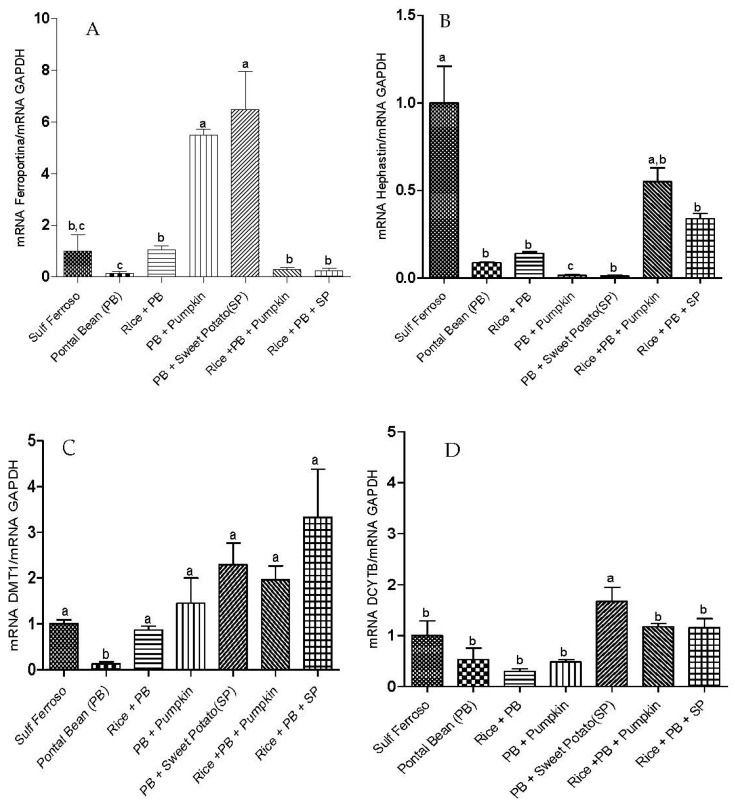
Iron deficiency affects thousands of people worldwide. Biofortification of staple food crops aims to support the reduction of this deficiency. This study evaluates the effect of combinations of common beans and rice, targets for biofortification, with high carotenoid content crops on the iron bioavailability, protein gene expression, and antioxidant effect. Iron bioavailability was measured by the depletion/repletion method. Seven groups were tested (n = 7): Pontal bean (PB); rice + Pontal bean (R + BP); Pontal bean + sweet potato (PB + SP); Pontal bean + pumpkin (PB + P); Pontal bean + rice + sweet potato (PB + R + P); Pontal bean + rice + sweet potato (PB + R + SP); positive control (Ferrous Sulfate). The evaluations included: hemoglobin gain, hemoglobin regeneration efficiency (HRE), gene expression of divalente metal transporter 1 (DMT-1), duodenal citocromo B (DcytB), ferroportin, hephaestin, transferrin and ferritin and total plasma antioxidant capacity (TAC). The test groups, except the PB, showed higher HRE (p < 0.05) than the control. Gene expression of DMT-1, DcytB and ferroportin increased (p < 0.05) in the groups fed with high content carotenoid crops (sweet potato or pumpkin). The PB group presented lower (p < 0.05) TAC than the other groups. The combination of rice and common beans, and those with high carotenoid content crops increased protein gene expression, increasing the iron bioavailability and antioxidant capacity.
缺铁影响着全球数以千计的人。主食作物的生物强化旨在帮助减少这种缺铁情况。本研究评估了作为生物强化目标的普通豆类和大米与高类胡萝卜素含量作物的组合对铁生物利用度、蛋白质基因表达和抗氧化作用的影响。通过耗竭/补充法测量铁生物利用度。测试了七组(n = 7):庞塔尔豆(PB);大米 + 庞塔尔豆(R + BP);庞塔尔豆 + 红薯(PB + SP);庞塔尔豆 + 南瓜(PB + P);庞塔尔豆 + 大米 + 红薯(PB + R + P);庞塔尔豆 + 大米 + 红薯(PB + R + SP);阳性对照(硫酸亚铁)。评估内容包括:血红蛋白增加量、血红蛋白再生效率(HRE)、二价金属转运蛋白1(DMT - 1)、十二指肠细胞色素B(DcytB)、铁转运蛋白、血浆铜蓝蛋白、转铁蛋白和铁蛋白的基因表达以及总血浆抗氧化能力(TAC)。除PB组外,测试组的HRE均高于对照组(p < 0.05)。在喂食高类胡萝卜素含量作物(红薯或南瓜)的组中,DMT - 1、DcytB和铁转运蛋白的基因表达增加(p < 0.05)。PB组的TAC低于其他组(p < 0.05)。大米和普通豆类的组合以及与高类胡萝卜素含量作物的组合增加了蛋白质基因表达,提高了铁生物利用度和抗氧化能力。