Ubalde-Lopez Monica, Delclos George L, Benavides Fernando G, Calvo-Bonacho Eva, Gimeno David
CISAL-Center for Research in Occupational Health, Universitat Pompeu Fabra, Av Dr Aiguader, 88, PRBB building, 1st floor, Barcelona, Spain.
CIBERESP, CIBER in Epidemiology and Public Health, Madrid, Spain.
Int Arch Occup Environ Health. 2016 May;89(4):667-78. doi: 10.1007/s00420-015-1104-4. Epub 2015 Nov 28.
Multimorbidity research typically focuses on chronic and common diseases in patient and/or older populations. We propose a multidimensional multimorbidity score (MDMS) which incorporates chronic conditions, symptoms, and health behaviors for use in younger, presumably healthier, working populations.
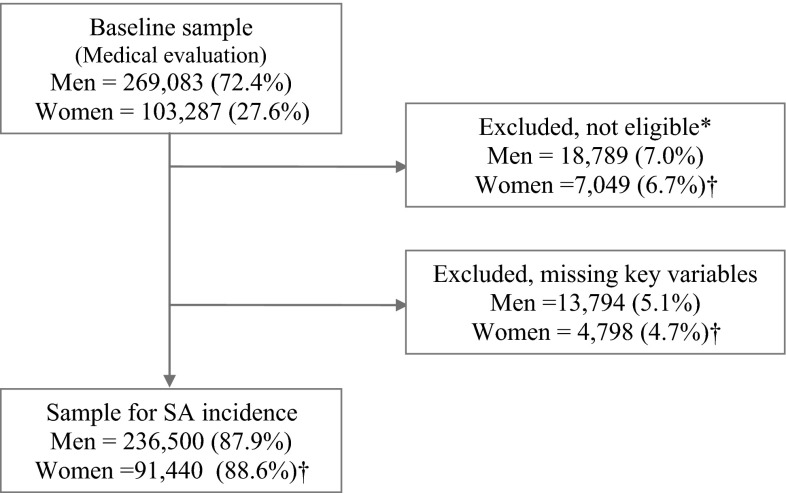
Cross-sectional study of 372,370 Spanish workers who underwent a standardized medical evaluation in 2006. We computed a MDMS (range 0-100) based on the sex-specific results of a multicorrespondence analysis (MCA). We then used Cox regression models to assess the predictive validity of this MDMS on incident sickness absence (SA) episodes.
Two dimensions in the MCA explained about 80% of the variability in both sexes: (1) chronic cardiovascular conditions and health behaviors, and (2) pain symptoms, in addition to sleep disturbances in women. More men than women had at least one condition (40 vs 15%) and two or more (i.e., multimorbidity) (12 vs 2%). The MDMS among those with multimorbidity ranged from 16.8 (SD 2.4) to 51.7 (SD 9.9) in men and 18.5 (SD 5.8) to 43.8 (SD 7.8) in women. We found that the greater the number of health conditions, the higher the risk of SA. A higher MDMS was also a risk factor for incident SA, even after adjusting for prior SA and other covariates. In women, this trend was less evident.
A score incorporating chronic health conditions, behaviors, and symptoms provides a more holistic approach to multimorbidity and may be useful for defining health status in working populations and for predicting key occupational outcomes.
多病共存研究通常聚焦于患者群体和/或老年人群体中的慢性常见疾病。我们提出了一种多维多病共存评分(MDMS),该评分纳入了慢性疾病、症状和健康行为,用于年轻的、可能更健康的工作人群。
对2006年接受标准化医学评估的372370名西班牙工人进行横断面研究。我们基于多对应分析(MCA)的性别特异性结果计算了MDMS(范围为0至100)。然后,我们使用Cox回归模型评估该MDMS对新发病假(SA)事件的预测效度。
MCA中的两个维度解释了两性中约80%的变异性:(1)慢性心血管疾病和健康行为,以及(2)疼痛症状,此外女性还包括睡眠障碍。患有至少一种疾病的男性多于女性(40%对15%),患有两种或更多种疾病(即多病共存)的男性也多于女性(12%对2%)。多病共存者的MDMS在男性中为16.8(标准差2.4)至51.7(标准差9.9),在女性中为18.5(标准差5.8)至43.8(标准差7.8)。我们发现健康问题的数量越多,患SA的风险越高。即使在调整了既往SA和其他协变量之后,较高的MDMS也是新发SA的一个风险因素。在女性中,这种趋势不太明显。
一个纳入慢性健康状况、行为和症状的评分提供了一种更全面的多病共存研究方法,可能有助于界定工作人群的健康状况并预测关键的职业结局。