Yehl Kevin, Mugler Andrew, Vivek Skanda, Liu Yang, Zhang Yun, Fan Mengzhen, Weeks Eric R, Salaita Khalid
Department of Chemistry, Emory University, 1515 Dickey Drive, Atlanta, Georgia 30322, USA.
Department of Physics, Emory University, 400 Dowman Drive, Atlanta, Georgia 30322, USA.
Nat Nanotechnol. 2016 Feb;11(2):184-90. doi: 10.1038/nnano.2015.259. Epub 2015 Nov 30.
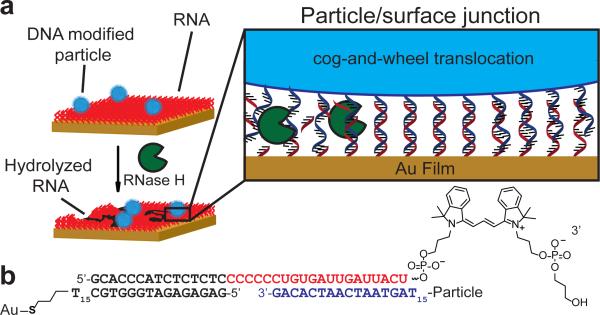
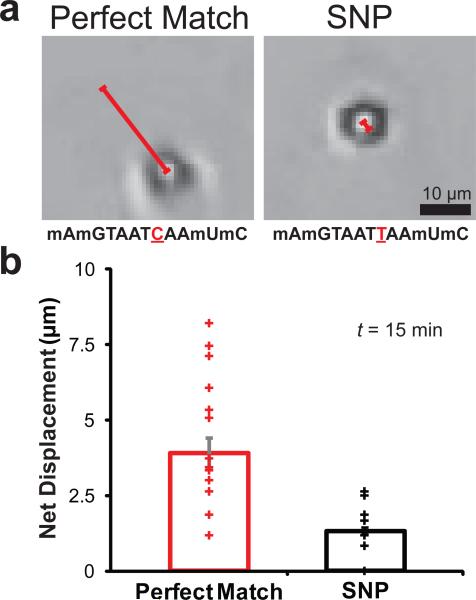
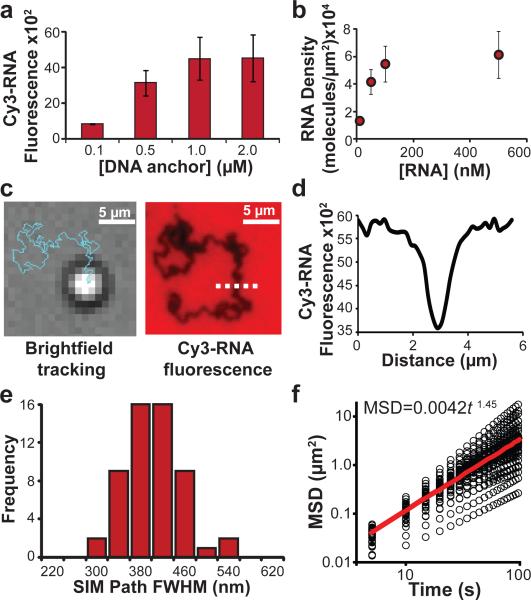
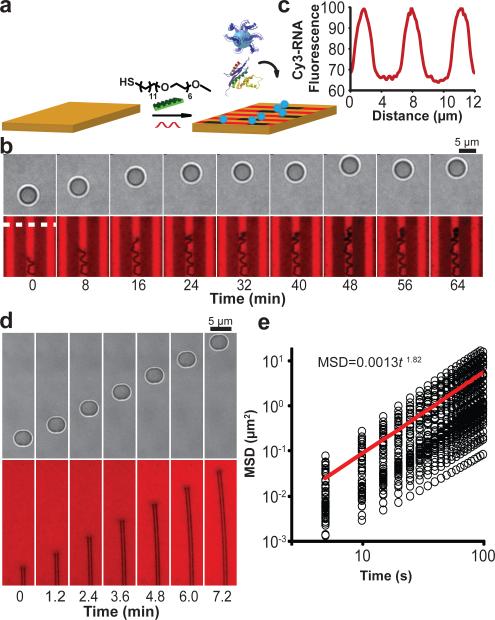
DNA-based machines that walk by converting chemical energy into controlled motion could be of use in applications such as next-generation sensors, drug-delivery platforms and biological computing. Despite their exquisite programmability, DNA-based walkers are challenging to work with because of their low fidelity and slow rates (∼1 nm min(-1)). Here we report DNA-based machines that roll rather than walk, and consequently have a maximum speed and processivity that is three orders of magnitude greater than the maximum for conventional DNA motors. The motors are made from DNA-coated spherical particles that hybridize to a surface modified with complementary RNA; the motion is achieved through the addition of RNase H, which selectively hydrolyses the hybridized RNA. The spherical motors can move in a self-avoiding manner, and anisotropic particles, such as dimerized or rod-shaped particles, can travel linearly without a track or external force. We also show that the motors can be used to detect single nucleotide polymorphism by measuring particle displacement using a smartphone camera.
通过将化学能转化为可控运动来移动的基于DNA的机器可用于下一代传感器、药物递送平台和生物计算等应用。尽管基于DNA的行走器具有出色的可编程性,但由于其低保真度和低速率(约1 nm min(-1)),使用起来具有挑战性。在此,我们报告了基于DNA的滚动而非行走的机器,因此其最大速度和持续合成能力比传统DNA马达的最大值高出三个数量级。这些马达由涂有DNA的球形颗粒制成,这些颗粒与用互补RNA修饰的表面杂交;通过添加RNase H实现运动,RNase H可选择性地水解杂交的RNA。球形马达可以以自我避免的方式移动,而二聚化或棒状等各向异性颗粒可以在没有轨道或外力的情况下直线移动。我们还表明,这些马达可通过使用智能手机摄像头测量颗粒位移来检测单核苷酸多态性。