Hamooya Benson M, Chongwe Gershom, Sitali Lungowe, Halwindi Hikabasa
Ministry of Health, P.O Box 30205, Lusaka, Zambia ; Department of Public Health, The University of Zambia, School of Medicine, P.O. Box 50110, Lusaka, Zambia.
Department of Public Health, The University of Zambia, School of Medicine, P.O. Box 50110, Lusaka, Zambia.
Arch Public Health. 2015 Nov 30;73:46. doi: 10.1186/s13690-015-0097-5. eCollection 2015.
Childhood fever is the most common clinical sign of Plasmodium falciparum infection. It is used as a measure of burden of the disease and the effectiveness of control programs for malaria. This study aimed to determine the incidence of fever in under-5 children of Magoye and Chivuna rural areas of Mazabuka district, Zambia.
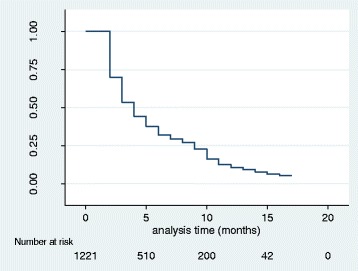
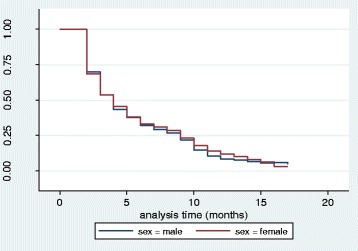
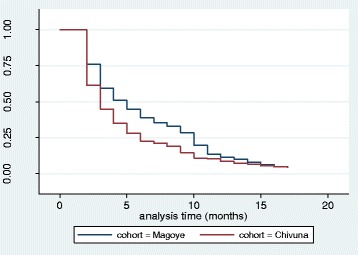
Incidence of fever was evaluated longitudinally over a period of 16 months (July 2006 and November 2007) among children aged 12-59 months in Magoye and Chivuna rural communities. The data was collected for a study on community directed treatment of soil-transmitted helminth infections in under-five children. Data from caretakers of 1221 children were collected using a structured interviewer-administered questionnaire. Cox proportion hazard regression was used to determine predictors of multiple episodes of fever and Kaplan-Meier survival curves was used to compare survival between two groups.
A total of 1221 under-5 children [median age 32 months; IQR 12-58] participated in the study and 696 (57 %) were from Magoye and 525 (43 %) from Chivuna. The incidence rate of fever was 162.4 per month per 1000 children for the 16 months period. The proportion of fever was not statistically related to children' age [p = 0.779] and sex [p = 0.546]. Predictors of multiple episodes of fever were: age (37-48 vs. 12-24 months) [HR 0.81; 95 % CI 0.67, 0.98; p = 0.030]; location (Chivuna vs. Magoye) [HR 1.35; 95 % CI 1.17, 1.56; p < 0.001]; and season (dry vs. rainy) [HR 0.17; 95 % CI 0.12, 0.23; p < 0.001].
The study has shown that the incidence of fever was high in the study areas. Febrile illnesses like malaria still have a significant effect on the health of under-5 children in the study population. There still exists the need for interventions aimed at reducing the incidence of fever in under five children, more especially in rural areas.
儿童发热是恶性疟原虫感染最常见的临床症状。它被用作衡量疾病负担以及疟疾控制项目成效的指标。本研究旨在确定赞比亚马扎布卡区马戈耶(Magoye)和奇武纳(Chivuna)农村地区5岁以下儿童的发热发病率。
在16个月期间(2006年7月至2007年11月),对马戈耶和奇武纳农村社区12 - 59个月大的儿童进行纵向发热发病率评估。数据收集用于一项关于5岁以下儿童社区定向治疗土壤传播蠕虫感染的研究。使用结构化访谈问卷收集了1221名儿童照料者的数据。采用Cox比例风险回归确定发热多发作的预测因素,并使用Kaplan - Meier生存曲线比较两组之间的生存情况。
共有1221名5岁以下儿童[中位年龄32个月;四分位间距12 - 58]参与了研究,其中696名(57%)来自马戈耶,525名(43%)来自奇武纳。在这16个月期间,发热发病率为每1000名儿童每月162.4例。发热比例与儿童年龄[p = 0.779]和性别[p = 0.546]无统计学关联。发热多发作的预测因素为:年龄(37 - 48个月与12 - 24个月)[风险比0.81;95%置信区间0.67, 0.98;p = 0.030];地点(奇武纳与马戈耶)[风险比1.35;95%置信区间1.17, 1.56;p < 0.001];以及季节(旱季与雨季)[风险比0.17;95%置信区间0.12, 0.23;p < 0.001]。
该研究表明,研究地区的发热发病率较高。像疟疾这样的发热性疾病对研究人群中5岁以下儿童的健康仍有显著影响。仍然需要采取干预措施来降低5岁以下儿童的发热发病率,尤其是在农村地区。