Basak Jolly, Nithin Chandran
Department of Biotechnology, Visva-Bharati University Santiniketan, India.
Computational Structural Biology Lab, Department of Biotechnology, Indian Institute of Technology Kharagpur Kharagpur, India.
Front Plant Sci. 2015 Nov 19;6:1001. doi: 10.3389/fpls.2015.01001. eCollection 2015.
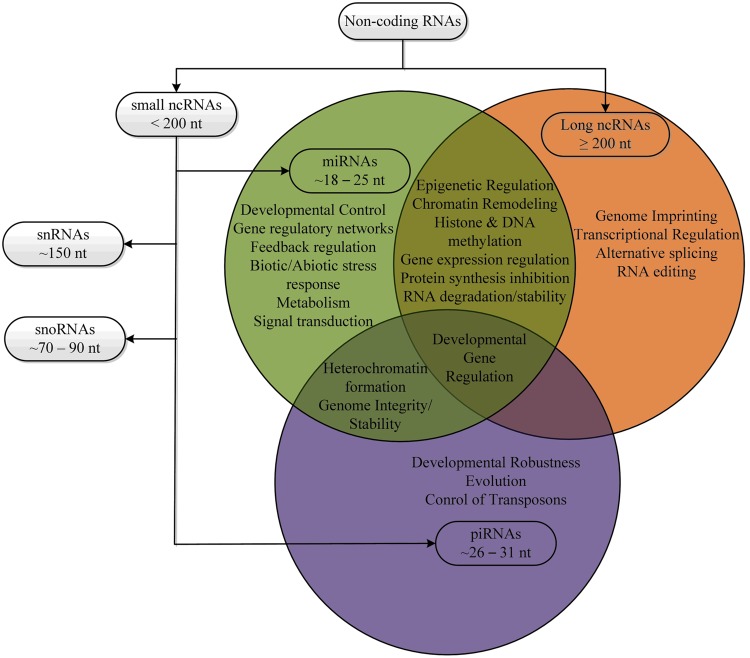
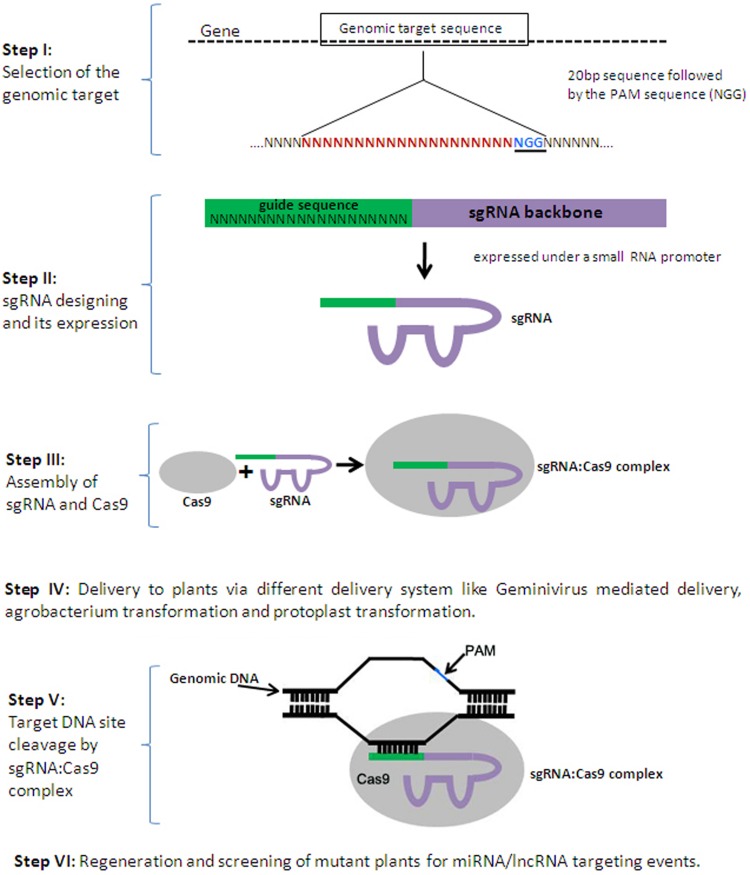
Non-coding RNAs (ncRNAs) have emerged as versatile master regulator of biological functions in recent years. MicroRNAs (miRNAs) are small endogenous ncRNAs of 18-24 nucleotides in length that originates from long self-complementary precursors. Besides their direct involvement in developmental processes, plant miRNAs play key roles in gene regulatory networks and varied biological processes. Alternatively, long ncRNAs (lncRNAs) are a large and diverse class of transcribed ncRNAs whose length exceed that of 200 nucleotides. Plant lncRNAs are transcribed by different RNA polymerases, showing diverse structural features. Plant lncRNAs also are important regulators of gene expression in diverse biological processes. There has been a breakthrough in the technology of genome editing, the CRISPR-Cas9 (clustered regulatory interspaced short palindromic repeats/CRISPR-associated protein 9) technology, in the last decade. CRISPR loci are transcribed into ncRNA and eventually form a functional complex with Cas9 and further guide the complex to cleave complementary invading DNA. The CRISPR-Cas technology has been successfully applied in model plants such as Arabidopsis and tobacco and important crops like wheat, maize, and rice. However, all these studies are focused on protein coding genes. Information about targeting non-coding genes is scarce. Hitherto, the CRISPR-Cas technology has been exclusively used in vertebrate systems to engineer miRNA/lncRNAs, but it is still relatively unexplored in plants. While briefing miRNAs, lncRNAs and applications of the CRISPR-Cas technology in human and animals, this review essentially elaborates several strategies to overcome the challenges of applying the CRISPR-Cas technology in editing ncRNAs in plants and the future perspective of this field.
近年来,非编码RNA(ncRNAs)已成为生物功能的多功能主调节器。微小RNA(miRNAs)是长度为18 - 24个核苷酸的小型内源性ncRNAs,其来源于长的自我互补前体。除了直接参与发育过程外,植物miRNAs在基因调控网络和各种生物过程中发挥关键作用。另外,长链非编码RNA(lncRNAs)是一大类转录的ncRNAs,其长度超过200个核苷酸。植物lncRNAs由不同的RNA聚合酶转录,呈现出多样的结构特征。植物lncRNAs在各种生物过程中也是基因表达的重要调节因子。在过去十年中,基因组编辑技术取得了突破,即CRISPR - Cas9(成簇规律间隔短回文重复序列/CRISPR相关蛋白9)技术。CRISPR位点被转录成ncRNA,并最终与Cas9形成功能复合物,进一步引导该复合物切割互补的入侵DNA。CRISPR - Cas技术已成功应用于拟南芥和烟草等模式植物以及小麦、玉米和水稻等重要作物。然而,所有这些研究都集中在蛋白质编码基因上。关于靶向非编码基因的信息很少。迄今为止,CRISPR - Cas技术仅在脊椎动物系统中用于改造miRNA/lncRNAs,但在植物中仍相对未被探索。在简要介绍miRNAs、lncRNAs以及CRISPR - Cas技术在人和动物中的应用的同时,本综述主要阐述了几种策略,以克服在植物中应用CRISPR - Cas技术编辑ncRNAs所面临的挑战以及该领域的未来前景。