Lange Florian, Seer Caroline, Müller Dorothea, Kopp Bruno
Department of Neurology, Hannover Medical School, Hannover, Germany.
Sci Rep. 2015 Dec 8;5:17502. doi: 10.1038/srep17502.
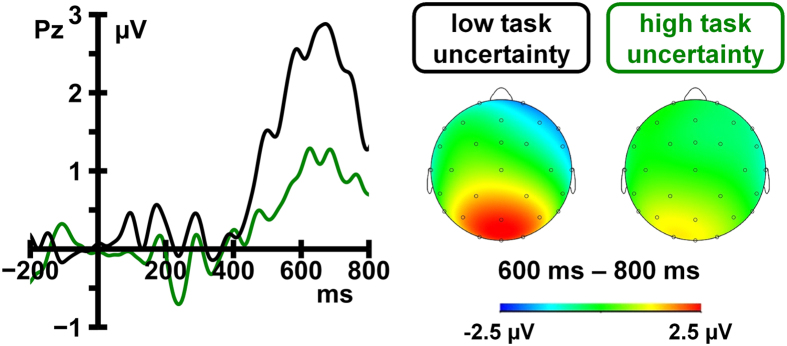
Time-consuming processes of task-set reconfiguration have been shown to contribute to the costs of switching between cognitive tasks. We describe and probe a novel mechanism serving to reduce the costs of task-set reconfiguration. We propose that when individuals are uncertain about the currently valid task, one task set is activated for execution while other task sets are maintained at a pre-active state in cognitive cache. We tested this idea by assessing an event-related potential (ERP) index of task-set reconfiguration in a three-rule task-switching paradigm involving varying degrees of task uncertainty. In high-uncertainty conditions, two viable tasks were equally likely to be correct whereas in low-uncertainty conditions, one task was more likely than the other. ERP and performance measures indicated substantial costs of task-set reconfiguration when participants were required to switch away from a task that had been likely to be correct. In contrast, task-set-reconfiguration costs were markedly reduced when the previous task set was chosen under high task uncertainty. These results suggest that cognitive caching of alternative task sets adds to human cognitive flexibility under high task uncertainty.
任务集重新配置的耗时过程已被证明会导致认知任务切换的成本增加。我们描述并探究了一种有助于降低任务集重新配置成本的新机制。我们提出,当个体对当前有效的任务不确定时,一个任务集被激活以执行,而其他任务集则在认知缓存中保持预激活状态。我们通过在一个涉及不同程度任务不确定性的三规则任务切换范式中评估任务集重新配置的事件相关电位(ERP)指标来检验这一想法。在高不确定性条件下,两个可行任务正确的可能性相同,而在低不确定性条件下,一个任务比另一个任务更有可能正确。ERP和绩效指标表明,当参与者被要求从一个可能正确的任务切换时,任务集重新配置的成本很高。相比之下,当在高任务不确定性下选择先前的任务集时,任务集重新配置成本显著降低。这些结果表明,在高任务不确定性下,替代任务集的认知缓存增加了人类认知灵活性。