Ma Wentao, Yu Chunwu, Zhang Wentao, Wu Sanmao, Feng Yu
College of Life Sciences, Wuhan University, Wuhan, 430072, P.R.China.
College of Computer Sciences, Wuhan University, Wuhan, 430072, P.R.China.
BMC Evol Biol. 2015 Dec 7;15:272. doi: 10.1186/s12862-015-0548-1.
It is now popularly accepted that there was an "RNA world" in early evolution of life. This idea has a direct consequence that later on there should have been a takeover of genetic material - RNA by DNA. However, since genetic material carries genetic information, the "source code" of all living activities, it is actually reasonable to question the plausibility of such a "revolutionary" transition. Due to our inability to model relevant "primitive living systems" in reality, it is as yet impossible to explore the plausibility and mechanisms of the "genetic takeover" by experiments.
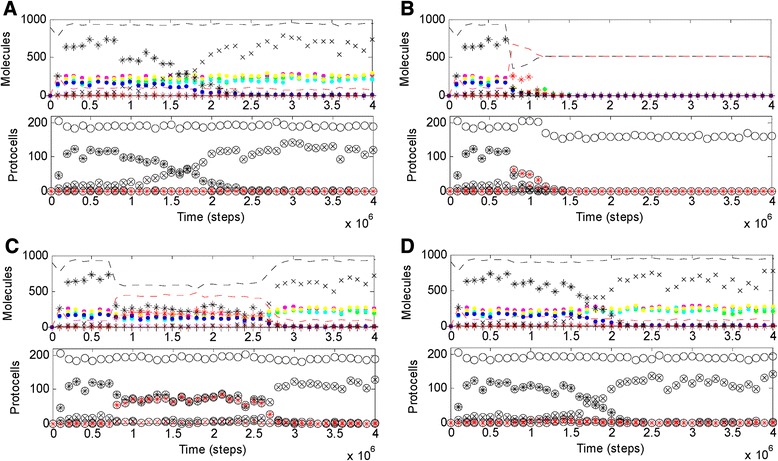
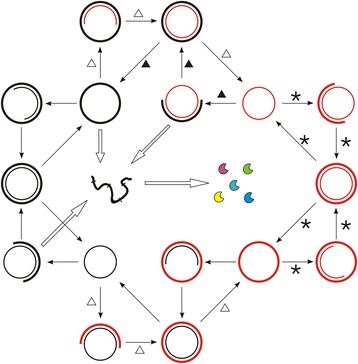
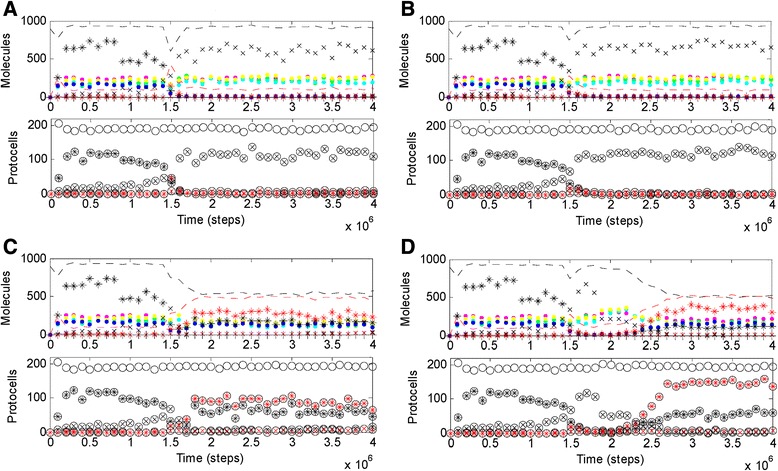
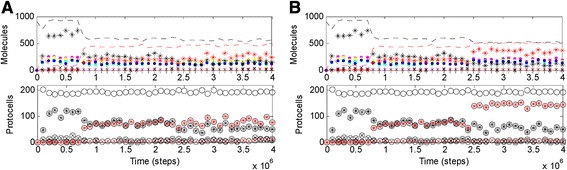
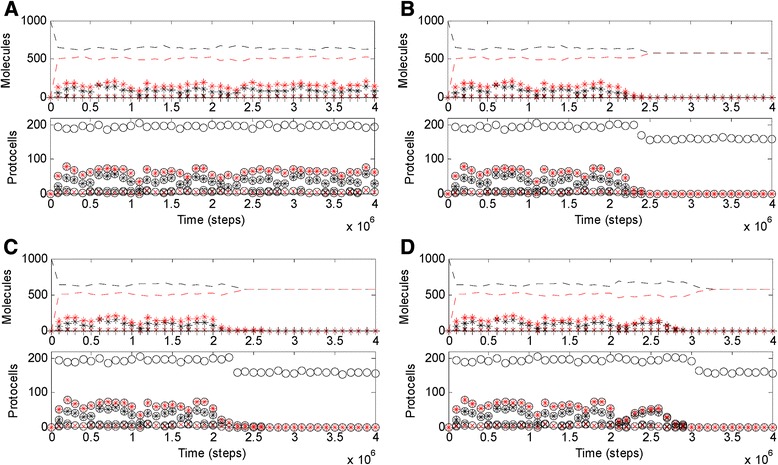
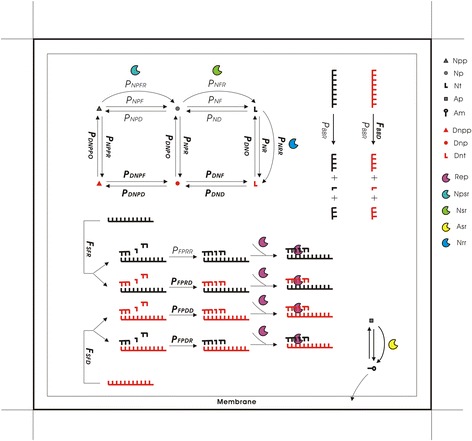
Here we investigated this issue by computer simulation using a Monte-Carlo method. It shows that an RNA-by-DNA genetic takeover may be triggered by the emergence of a nucleotide reductase ribozyme with a moderate activity in a pure RNA system. The transition is unstable and limited in scale (i.e., cannot spread in the population), but can get strengthened and globalized if certain parameters are changed against RNA (i.e., in favor of DNA). In relation to the subsequent evolution, an advanced system with a larger genome, which uses DNA as genetic material and RNA as functional material, is modeled - the system cannot sustain if the nucleotide reductase ribozyme is "turned off" (thus, DNA cannot be synthesized). Moreover, the advanced system cannot sustain if only DNA's stability, template suitability or replication fidelity (any of the three) is turned down to the level of RNA's.
Genetic takeover should be plausible. In the RNA world, such a takeover may have been triggered by the emergence of some ribozyme favoring the formation of deoxynucleotides. The transition may initially have been "weak", but could have been reinforced by environmental changes unfavorable to RNA (such as temperature or pH rise), and would have ultimately become irreversible accompanying the genome's enlargement. Several virtues of DNA (versus RNA) - higher stability against hydrolysis, greater suitability as template and higher fidelity in replication, should have, each in its own way, all been significant for the genetic takeover in evolution. This study enhances our understandings of the relationship between information and material in the living world.
如今人们普遍认为,在生命早期进化过程中存在一个“RNA世界”。这一观点直接导致后来遗传物质应由RNA被DNA所取代。然而,由于遗传物质携带遗传信息,即所有生命活动的“源代码”,因此质疑这种“革命性”转变的合理性实际上是合理的。由于我们无法在现实中对相关“原始生命系统”进行建模,目前还不可能通过实验来探究“遗传物质取代”的合理性及机制。
在此,我们使用蒙特卡洛方法通过计算机模拟对这个问题进行了研究。结果表明,在纯RNA系统中,具有适度活性的核苷酸还原酶核酶的出现可能引发由RNA向DNA的遗传物质取代。这种转变是不稳定的,且规模有限(即无法在种群中传播),但如果某些参数针对RNA发生变化(即有利于DNA),则可以得到强化并扩展至全局。关于后续进化,构建了一个以DNA作为遗传物质、RNA作为功能物质的具有更大基因组的高级系统——如果核苷酸还原酶核酶“关闭”(因此无法合成DNA),该系统将无法维持。此外,如果仅将DNA的稳定性、模板适用性或复制保真度(三者中的任何一个)降低到RNA的水平,该高级系统也无法维持。
遗传物质取代应该是合理的。在RNA世界中,这种取代可能是由一些有利于脱氧核苷酸形成的核酶的出现所引发的。这种转变最初可能是“微弱的”,但可能会因不利于RNA的环境变化(如温度或pH值升高)而得到加强,并最终随着基因组的扩大而变得不可逆转。DNA(相对于RNA)的几个优点——更高的抗水解稳定性、作为模板的更佳适用性以及更高的复制保真度,都应该以各自的方式对进化中的遗传物质取代具有重要意义。这项研究增进了我们对生物世界中信息与物质之间关系的理解。