Timmermans Martijn J T N, Barton Christopher, Haran Julien, Ahrens Dirk, Culverwell C Lorna, Ollikainen Alison, Dodsworth Steven, Foster Peter G, Bocak Ladislav, Vogler Alfried P
Department of Life Sciences, Natural History Museum, London, United Kingdom Department of Life Sciences, Imperial College London - Silwood Park Campus, Ascot, United Kingdom Department of Natural Sciences, Middlesex University, Hendon Campus, London, United Kingdom
Department of Life Sciences, Natural History Museum, London, United Kingdom.
Genome Biol Evol. 2015 Dec 8;8(1):161-75. doi: 10.1093/gbe/evv241.
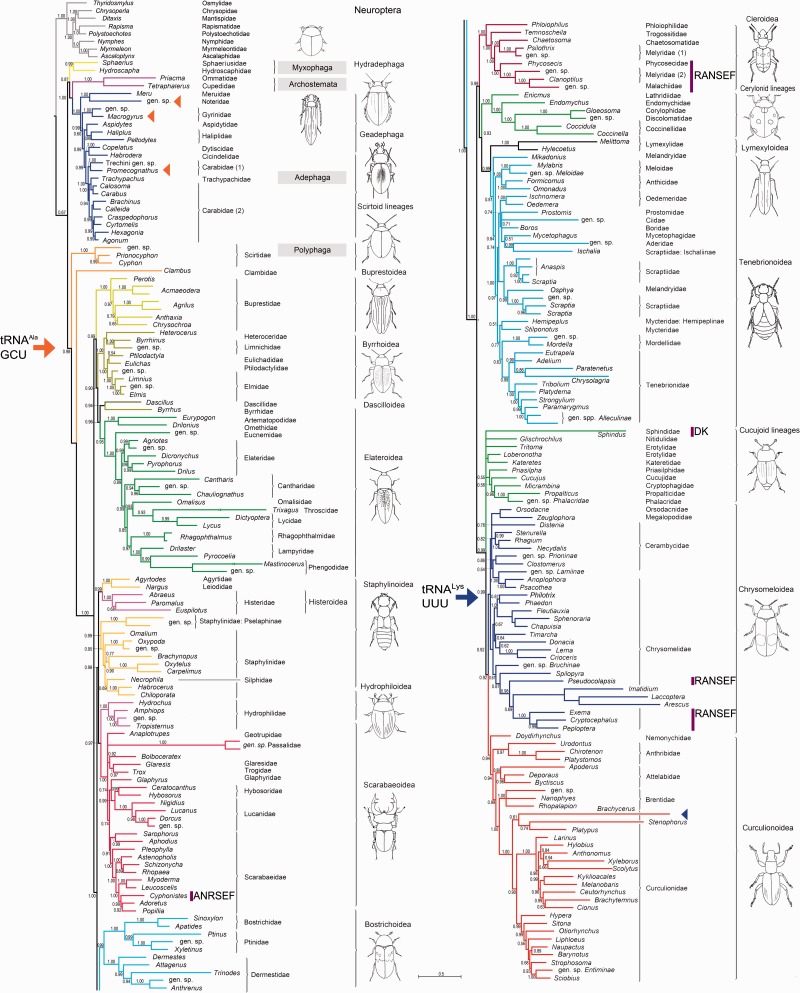
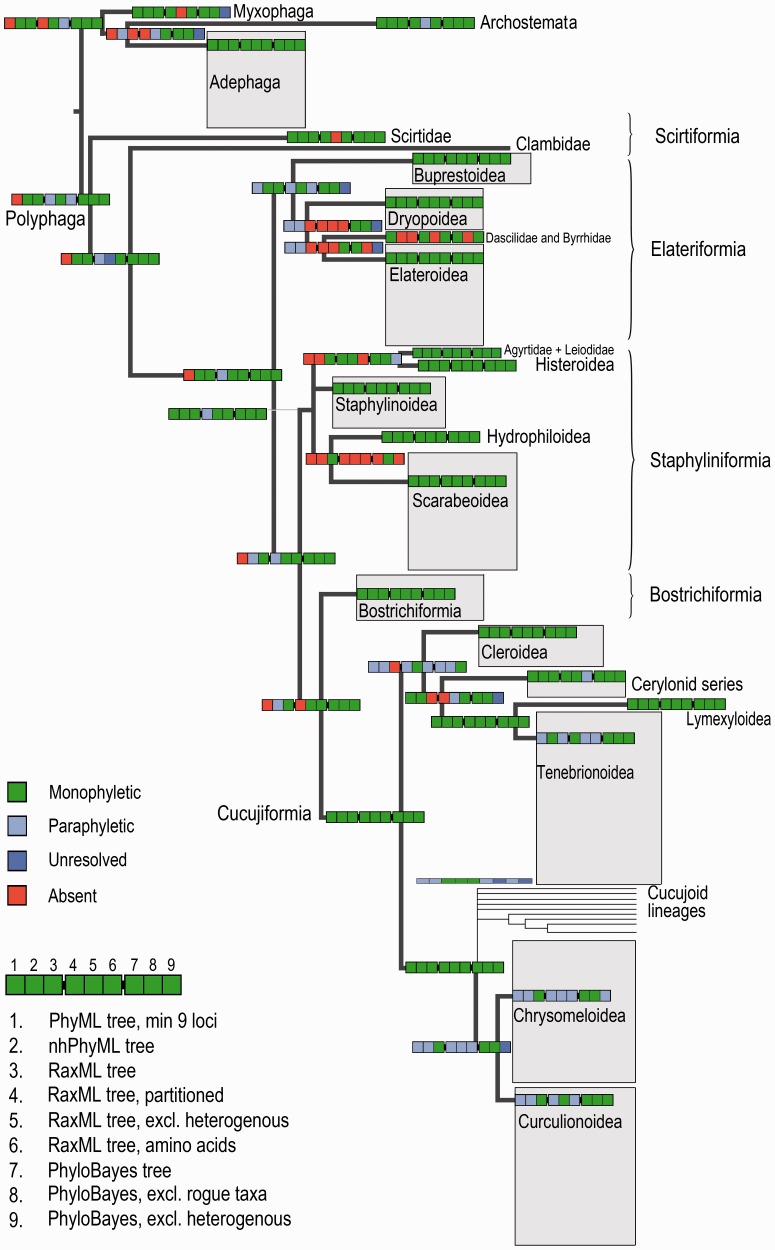
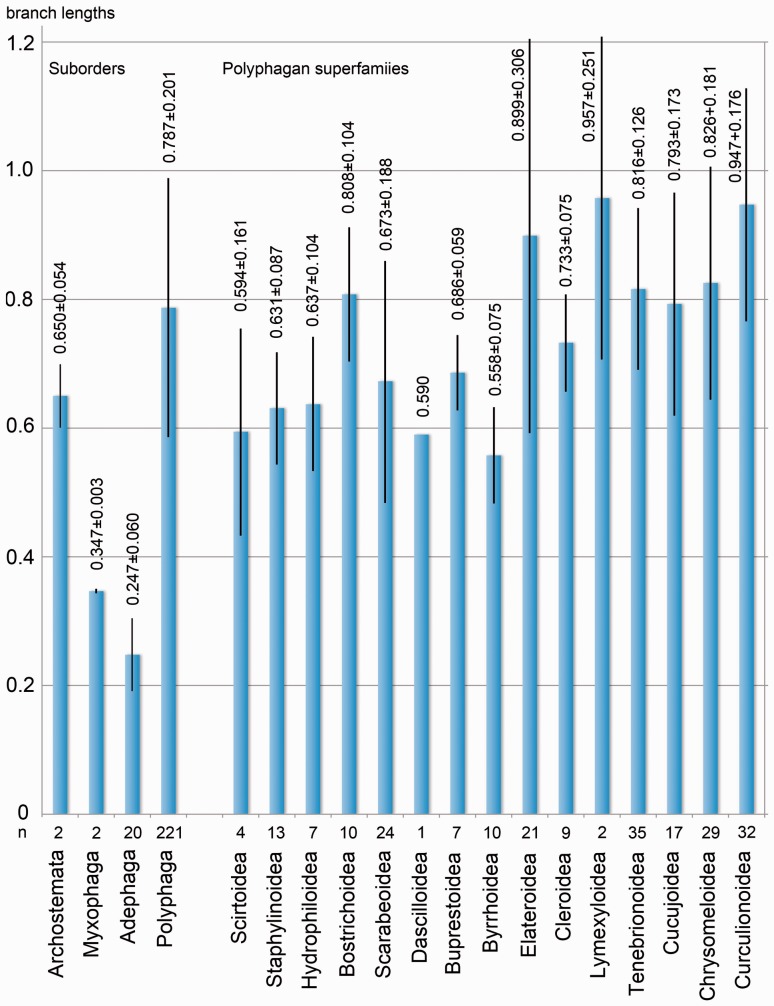
Mitochondrial genomes are readily sequenced with recent technology and thus evolutionary lineages can be densely sampled. This permits better phylogenetic estimates and assessment of potential biases resulting from heterogeneity in nucleotide composition and rate of change. We gathered 245 mitochondrial sequences for the Coleoptera representing all 4 suborders, 15 superfamilies of Polyphaga, and altogether 97 families, including 159 newly sequenced full or partial mitogenomes. Compositional heterogeneity greatly affected 3rd codon positions, and to a lesser extent the 1st and 2nd positions, even after RY coding. Heterogeneity also affected the encoded protein sequence, in particular in the nad2, nad4, nad5, and nad6 genes. Credible tree topologies were obtained with the nhPhyML ("nonhomogeneous") algorithm implementing a model for branch-specific equilibrium frequencies. Likelihood searches using RAxML were improved by data partitioning by gene and codon position. Finally, the PhyloBayes software, which allows different substitution processes for amino acid replacement at various sites, produced a tree that best matched known higher level taxa and defined basal relationships in Coleoptera. After rooting with Neuropterida outgroups, suborder relationships were resolved as (Polyphaga (Myxophaga (Archostemata + Adephaga))). The infraorder relationships in Polyphaga were (Scirtiformia (Elateriformia ((Staphyliniformia + Scarabaeiformia) (Bostrichiformia (Cucujiformia))))). Polyphagan superfamilies were recovered as monophyla except Staphylinoidea (paraphyletic for Scarabaeiformia) and Cucujoidea, which can no longer be considered a valid taxon. The study shows that, although compositional heterogeneity is not universal, it cannot be eliminated for some mitochondrial genes, but dense taxon sampling and the use of appropriate Bayesian analyses can still produce robust phylogenetic trees.
利用现代技术,线粒体基因组很容易被测序,因此进化谱系可以得到密集采样。这有助于进行更好的系统发育估计,并评估由核苷酸组成和变化速率的异质性所导致的潜在偏差。我们收集了245条鞘翅目线粒体序列,它们代表了所有4个亚目、多食亚目的15个总科,总共97个科,其中包括159条新测序的完整或部分线粒体基因组。即使经过RY编码,组成异质性对第三密码子位置仍有很大影响,对第一和第二密码子位置的影响较小。异质性也影响编码的蛋白质序列,特别是在nad2、nad4、nad5和nad6基因中。使用实现分支特定平衡频率模型的nhPhyML(“非均匀”)算法获得了可靠的树形拓扑结构。通过按基因和密码子位置对数据进行划分,使用RAxML进行的似然搜索得到了改进。最后,PhyloBayes软件允许在不同位点对氨基酸替换采用不同的替换过程,生成了一棵与已知高级分类单元最匹配的树,并确定了鞘翅目中的基部关系。以脉翅目类群为外类群进行定根后,亚目关系解析为(多食亚目(粘食亚目(原鞘亚目 + 肉食亚目)))。多食亚目的下目关系为(沼甲形下目(叩头虫形下目((隐翅虫形下目 + 金龟子形下目)(长蠹形下目(扁甲形下目)))))。除了隐翅虫总科(对金龟子形下目而言是并系的)和扁甲总科(不再被视为一个有效的分类单元)外,多食亚目的总科被恢复为单系类群。该研究表明,虽然组成异质性并非普遍存在,但对于某些线粒体基因无法消除这种异质性,但密集的分类单元采样和使用适当的贝叶斯分析仍然可以产生可靠的系统发育树。