Biller Olivia Masi, Adler Lynn S, Irwin Rebecca E, McAllister Caitlin, Palmer-Young Evan C
Department of Biology, University of Massachusetts at Amherst, Amherst, Massachusetts, United States of America.
Department of Biology, Dartmouth College, Hanover, New Hampshire, United States of America.
PLoS One. 2015 Dec 10;10(12):e0144668. doi: 10.1371/journal.pone.0144668. eCollection 2015.
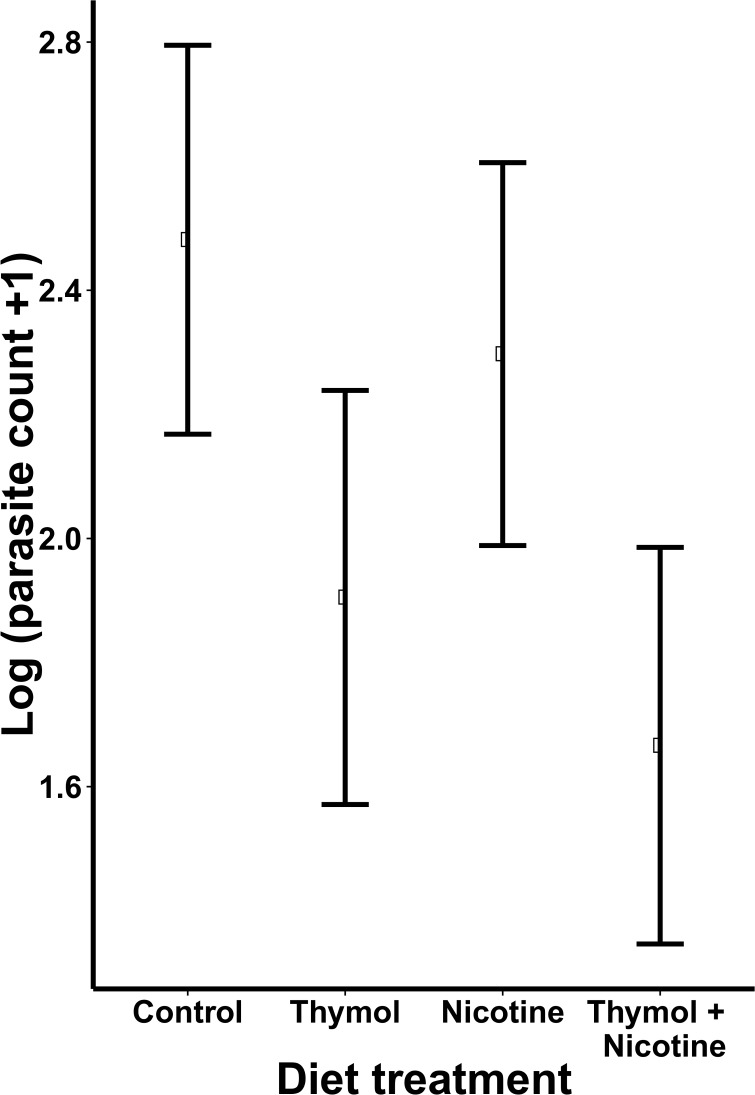
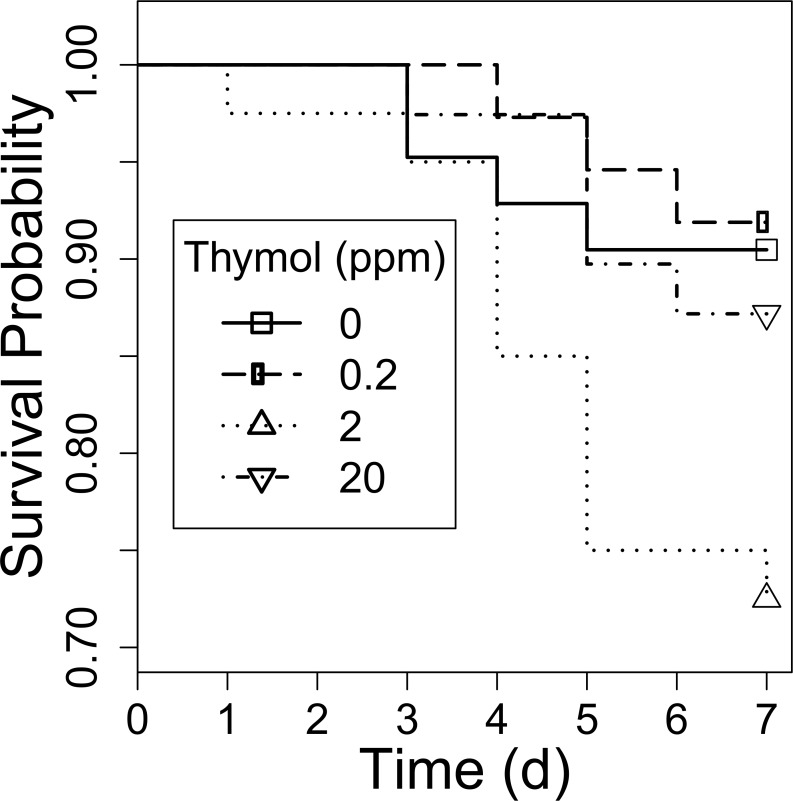
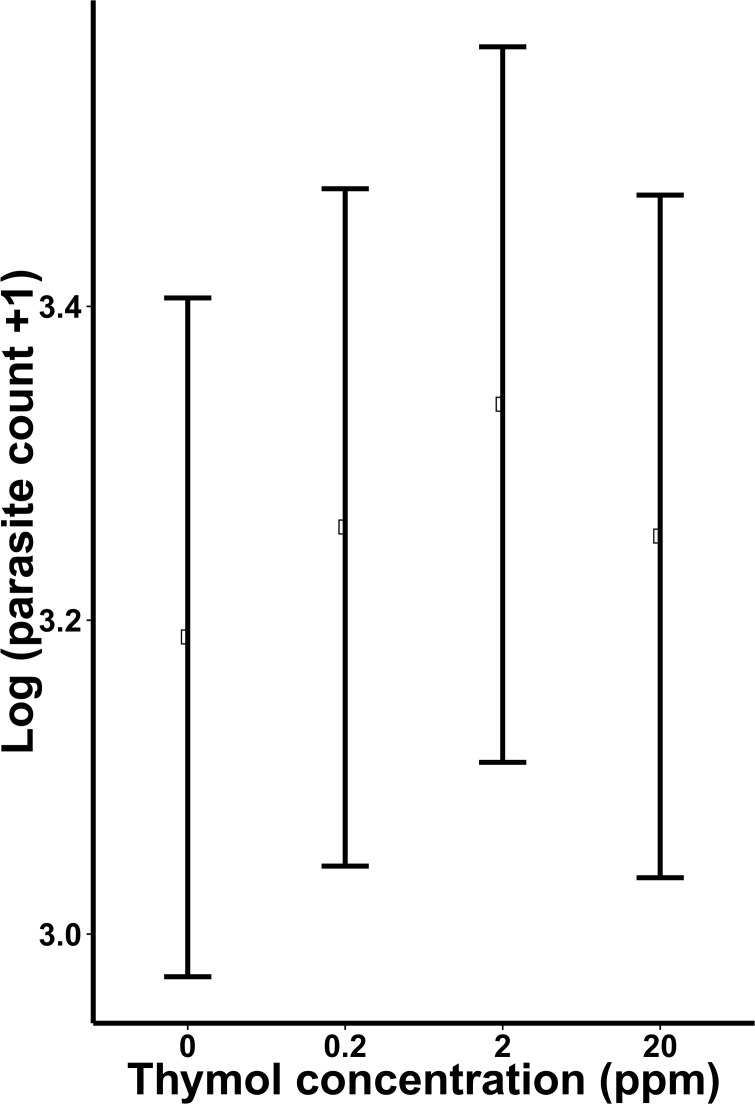
Floral nectar contains secondary compounds with antimicrobial properties that can affect not only plant-pollinator interactions, but also interactions between pollinators and their parasites. Although recent work has shown that consumption of plant secondary compounds can reduce pollinator parasite loads, little is known about the effects of dosage or compound combinations. We used the generalist pollinator Bombus impatiens and its obligate gut parasite Crithidia bombi to study the effects of nectar chemistry on host-parasite interactions. In two experiments we tested (1) whether the secondary compounds thymol and nicotine act synergistically to reduce parasitism, and (2) whether dietary thymol concentration affects parasite resistance. In both experiments, uninfected Bombus impatiens were inoculated with Crithidia and then fed particular diet treatments for 7 days, after which infection levels were assessed. In the synergism experiment, thymol and nicotine alone and in combination did not significantly affect parasite load or host mortality. However, the thymol-nicotine combination treatment reduced log-transformed parasite counts by 30% relative to the control group (P = 0.08). For the experiment in which we manipulated thymol concentration, we found no significant effect of any thymol concentration on Crithidia load, but moderate (2 ppm) thymol concentrations incurred a near-significant increase in mortality (P = 0.054). Our results tentatively suggest the value of a mixed diet for host immunity, yet contrast with research on the antimicrobial activity of dietary thymol and nicotine in vertebrate and other invertebrate systems. We suggest that future research evaluate genetic variation in Crithidia virulence, multi-strain competition, and Crithidia interactions with the gut microbe community that may mediate antimicrobial activities of secondary compounds.
花蜜中含有具有抗菌特性的次生化合物,这些化合物不仅会影响植物与传粉者之间的相互作用,还会影响传粉者与其寄生虫之间的相互作用。尽管最近的研究表明,食用植物次生化合物可以降低传粉者的寄生虫负荷,但对于剂量或化合物组合的影响却知之甚少。我们利用多食性传粉者熊蜂及其专性肠道寄生虫熊蜂短膜虫,来研究花蜜化学成分对宿主-寄生虫相互作用的影响。在两个实验中,我们测试了:(1)百里香酚和尼古丁这两种次生化合物是否协同作用以降低寄生虫感染率;(2)饮食中百里香酚的浓度是否会影响寄生虫抗性。在这两个实验中,未感染的熊蜂被接种熊蜂短膜虫,然后接受特定的饮食处理7天,之后评估感染水平。在协同作用实验中,单独使用百里香酚和尼古丁以及两者组合使用,均未对寄生虫负荷或宿主死亡率产生显著影响。然而,与对照组相比,百里香酚-尼古丁组合处理使经对数转换后的寄生虫数量减少了30%(P = 0.08)。在我们操纵百里香酚浓度的实验中,我们发现任何百里香酚浓度对熊蜂短膜虫负荷均无显著影响,但中等浓度(2 ppm)的百里香酚会使死亡率有接近显著的增加(P = 0.054)。我们的结果初步表明混合饮食对宿主免疫力的价值,但与脊椎动物和其他无脊椎动物系统中饮食中百里香酚和尼古丁的抗菌活性研究结果形成对比。我们建议未来的研究评估熊蜂短膜虫毒力的遗传变异、多菌株竞争以及熊蜂短膜虫与可能介导次生化合物抗菌活性的肠道微生物群落之间的相互作用。