Li Haiyan, Xu Yuping, Qiu Weifeng, Zhao Danni, Zhang Yuanzhen
Department of Gynecology and Obstetrics, Zhongnan Hospital of Wuhan University, Wuhan, Hubei, China (mainland).
Department of Gynecology and Obstetrics, Third hospital in Shijiazhuang, Shijiazhuang, Hebei, China (mainland).
Med Sci Monit. 2015 Dec 16;21:3929-34. doi: 10.12659/msm.895407.
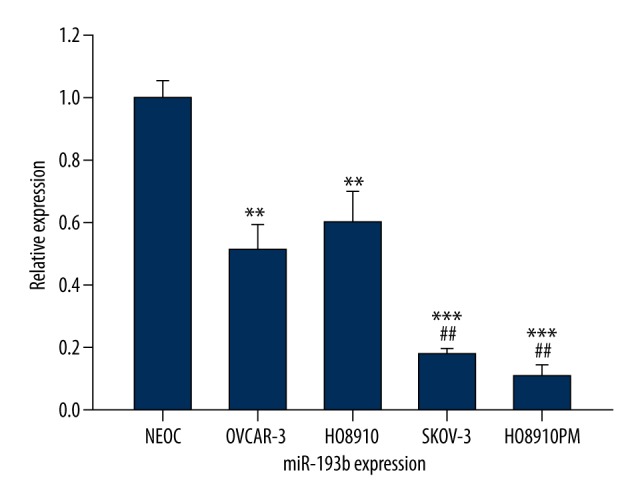
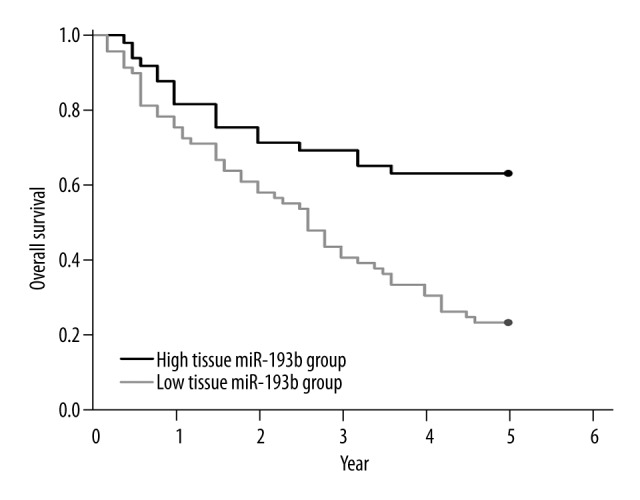
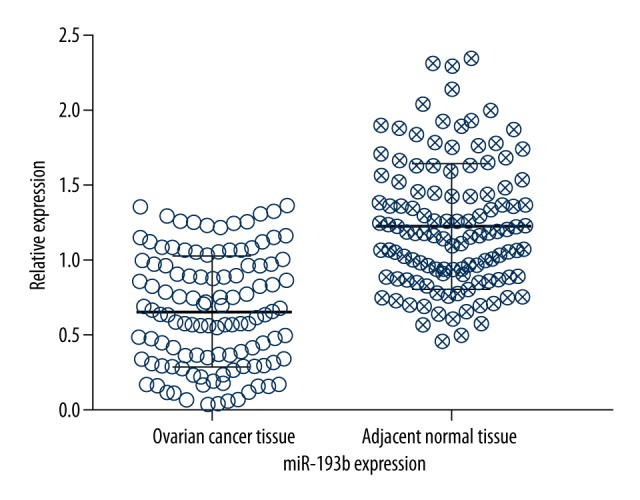
BACKGROUND MiRNAs play important roles in regulating many fundamental biological processes. Deregulation of miRNAs is involved in the initiation and progression of cancer. MiR-193b is regarded as tumor suppressor in many types of cancers. However, the role of miR-193b in ovarian cancer is poorly understood. MATERIAL AND METHODS The expression level of miR-193b in ovarian cancer cell lines and ovarian cancer samples was evaluated using quantitative real-time reverse transcription-PCR (qRT-PCR). The ovarian cancer patients were categorized into a high miR-193b expression group and a low miR-193b expression group according to the median miR-193b expression level. The correlation between tissue miR-193b expression and the patients' clinicopathological factors, as well as survival, was also analyzed. RESULTS The results showed that the miR-193b expression was significantly down-regulated in ovarian cancer cell lines and tumor tissues compared with normal controls. In addition, tissue miR-193b expression was positively correlated with FIGO stage (P=0.001), histological grade (P=0.032), ascites (P=0.019), lymph node metastasis (P=0.003), and tumor size (P=0.041). Among 116 patients with ovarian cancer examined, the 5-year overall survival (OS) rates were 62.5% and 22.01% in patients with high and low miR-193b expression, respectively (P=0.003). Multivariate analysis showed that tissue miR-193b is an independent prognostic factor in patients with ovarian cancer (HR=4.219; P=0.015). CONCLUSIONS Reduction of miR-193b was found in ovarian cancer and its lower expression was associated with poorer prognosis. Tissue miR-193b showed potential as novel biomarker for ovarian cancer.
微小RNA(miRNAs)在调控许多基本生物学过程中发挥重要作用。miRNAs失调与癌症的发生和发展有关。miR-193b在多种癌症中被视为肿瘤抑制因子。然而,miR-193b在卵巢癌中的作用尚不清楚。
采用定量实时逆转录PCR(qRT-PCR)评估miR-193b在卵巢癌细胞系和卵巢癌样本中的表达水平。根据miR-193b表达水平中位数,将卵巢癌患者分为高miR-193b表达组和低miR-193b表达组。分析组织miR-193b表达与患者临床病理因素以及生存率之间的相关性。
结果显示,与正常对照相比,miR-193b在卵巢癌细胞系和肿瘤组织中的表达显著下调。此外,组织miR-193b表达与国际妇产科联盟(FIGO)分期(P = 0.001)、组织学分级(P = 0.032)、腹水(P = 0.019)、淋巴结转移(P = 0.003)和肿瘤大小(P = 0.041)呈正相关。在116例接受检查的卵巢癌患者中,miR-193b高表达和低表达患者的5年总生存率(OS)分别为62.5%和22.01%(P = 0.003)。多因素分析表明,组织miR-193b是卵巢癌患者的独立预后因素(风险比[HR]=4.219;P = 0.015)。
在卵巢癌中发现miR-193b表达降低,其低表达与较差的预后相关。组织miR-193b显示出作为卵巢癌新型生物标志物的潜力。