Helliwell John F, Wang Shun
Vancouver School of Economics, University of British Columbia, Vancouver, British Columbia, Canada.
Canadian Institute for Advanced Research (CIFAR), Toronto, Ontario, Canada.
PLoS One. 2015 Dec 23;10(12):e0145123. doi: 10.1371/journal.pone.0145123. eCollection 2015.
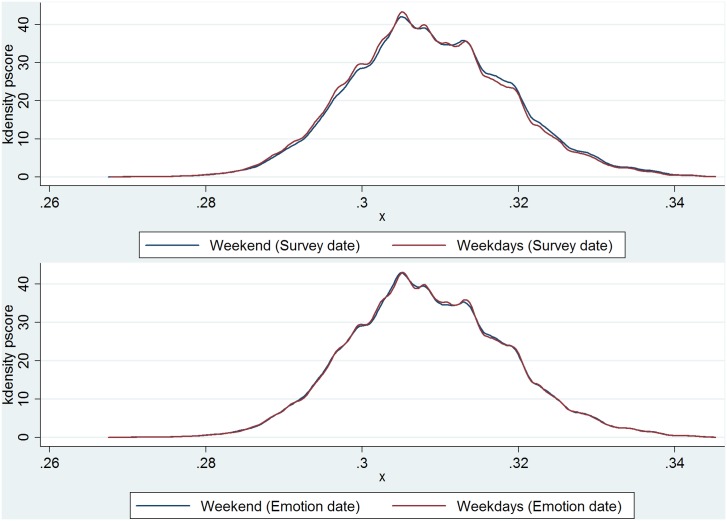
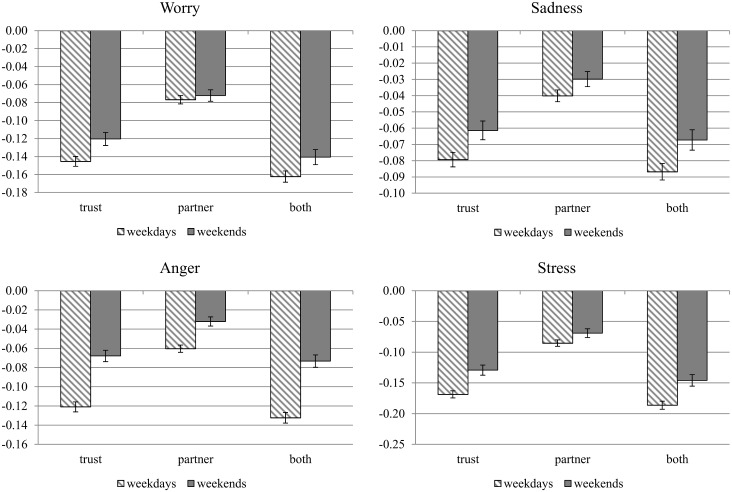
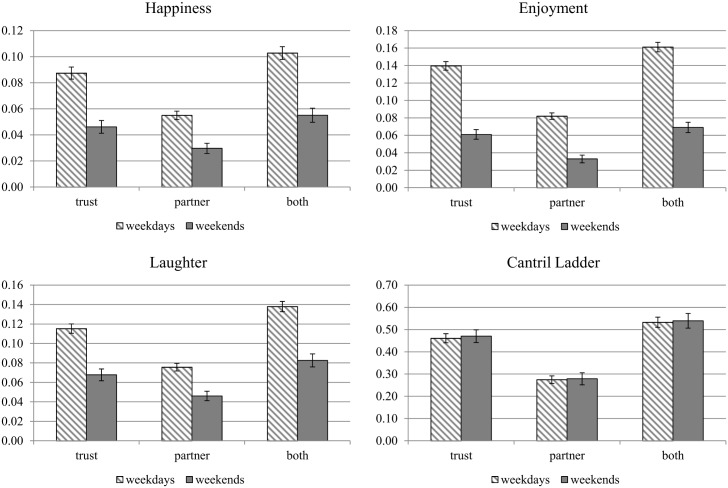
In this paper we estimate the size of weekend effects for seven emotions and then explore their main determinants for the working population in the United States, using the Gallup/Healthways US Daily Poll 2008-2012. We first find that weekend effects exist for all emotions, and that these effects are not explained by sample selection bias. Full-time workers have larger weekend effects than do part-time workers. We then explore the sources of weekend effects and find that workplace trust and workplace social relations, combined with differences in social time spent with family and friends, together almost fully explain the weekend effects for happiness, laughter, enjoyment and sadness, for both full-time and part-time workers, with significant but smaller proportions explained for the remaining three emotions-worry, anger and stress. Finally, we show that workplace trust and social relations significantly improve emotions and life evaluations on both weekends and weekdays for all workers.
在本文中,我们利用盖洛普/健康之路美国每日民意调查(2008 - 2012年),估算了七种情绪的周末效应大小,然后探究了美国在职人口这些效应的主要决定因素。我们首先发现,所有情绪都存在周末效应,且这些效应无法用样本选择偏差来解释。全职工作者的周末效应比兼职工作者更大。接着我们探究周末效应的来源,发现职场信任和职场社会关系,再加上与家人和朋友共度社交时光的差异,几乎能完全解释全职和兼职工作者在幸福、欢笑、愉悦和悲伤方面的周末效应,对其余三种情绪——担忧、愤怒和压力而言,能解释的比例虽显著但较小。最后,我们表明,职场信任和社会关系对所有工作者在周末和工作日的情绪及生活评价都有显著改善作用。