Yang Jing, Lv Xing, Chen Jinna, Xie Changqing, Xia Weixiong, Jiang Chen, Zeng Tingting, Ye Yanfang, Ke Liangru, Yu Yahui, Liang Hu, Guan Xin-Yuan, Guo Xiang, Xiang Yanqun
State Key Laboratory of Oncology in South China, Sun Yat-Sen University Cancer Center, Guangzhou, China.
Department of Nasopharyngeal Carcinoma, Sun Yat-Sen University Cancer Center, Guangzhou, China.
Oncotarget. 2016 Mar 29;7(13):15632-47. doi: 10.18632/oncotarget.6695.
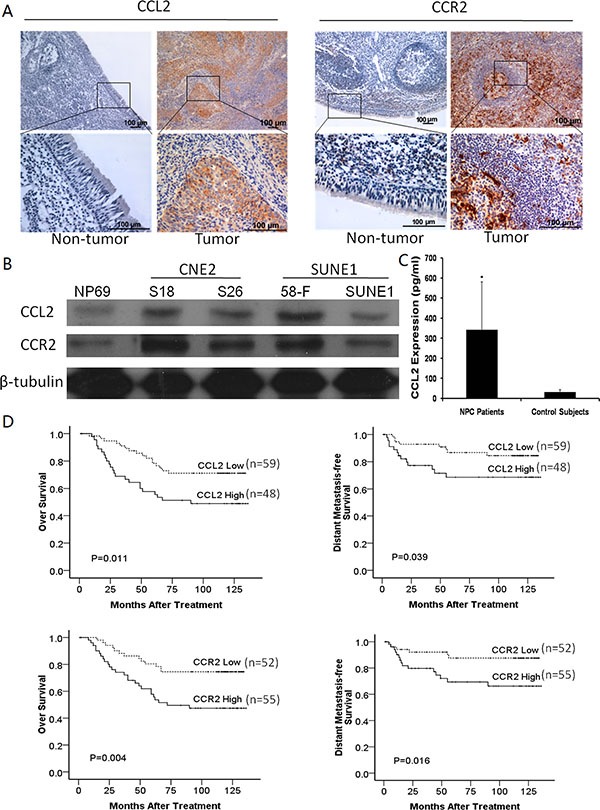
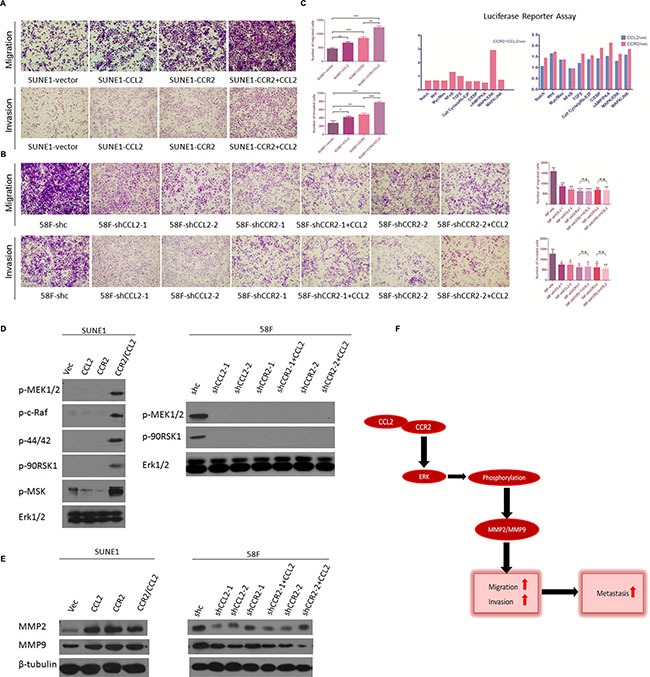
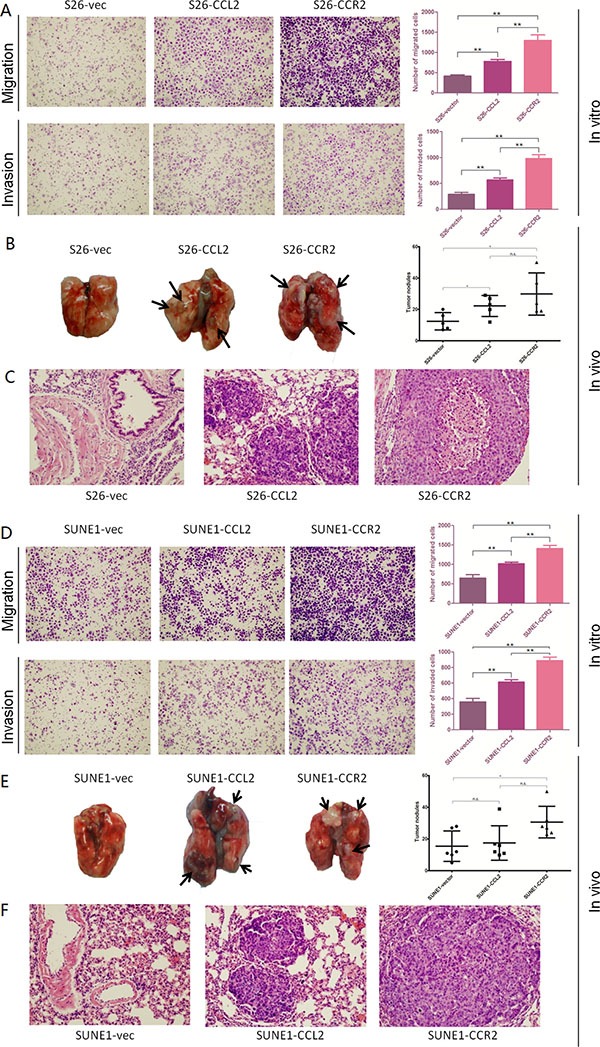
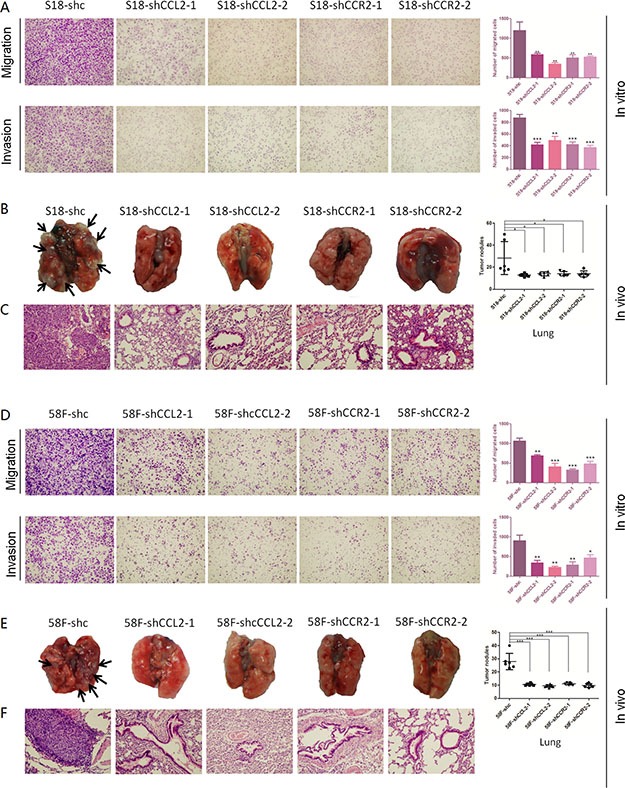
Distant metastasis remains the major failure of nasopharyngeal carcinoma (NPC). In this study, the roles of chemokine C-C motif ligand 2 (CCL2), and its receptor chemokine C-C motif receptor type 2 (CCR2) on NPC metastasis were investigated. Serum CCL2 and CCL2/CCR2 expression level were remarkably increased in NPC patients compared to non-tumor patients by ELISA and IHC analyses. High expressions of CCL2/CCR2 were significantly associated with NPC metastasis and poor overall survival (OS). High expression of CCR2 is an independent adverse prognostic factor of OS and distant metastasis free survival (DMFS). Overexpressions of CCL2 and CCR2 were detected in high-metastatic NPC cell lines. Upregulating CCL2 and CCR2 respectively in low-metastatic NPC cell lines could promote cell migration and invasion, and exogenous CCL2 enhanced the motility in CCR2-overexpressing cells. On the other hand, downregulating CCL2 and CCR2 respectively in high-metastatic NPC cell lines by shRNA could decrease cell migration and invasion. However, exogenous CCL2 could not rescue the weaken ability of motility of CCR2-silencing cells. In nude mouse model, distant metastasis was significantly facilitated in either CCL2-overexpressing or CCR2-overexpressing groups, which was more obvious in CCR2-overexpressing group. Also, distant metastasis was considerably inhibited in either CCL2-silencing or CCR2-silencing groups. Dual overexpression of CCL2/CCR2 could activate extracellular signal-regulated kinase (ERK1/2) signaling pathway, which sequentially induced matrix metalloproteinase (MMP) 2 and 9 upregulations in the downstream. In conclusion, CCL2-CCR2 axis could promote NPC metastasis by activating ERK1/2-MMP2/9 pathway. This study helps to develop novel therapeutic targets for distant metastasis in NPC.
远处转移仍然是鼻咽癌(NPC)治疗失败的主要原因。在本研究中,探讨了趋化因子C-C基序配体2(CCL2)及其受体C-C基序受体2型(CCR2)在鼻咽癌转移中的作用。通过酶联免疫吸附测定(ELISA)和免疫组化(IHC)分析发现,与非肿瘤患者相比,NPC患者血清中CCL2以及CCL2/CCR2的表达水平显著升高。CCL2/CCR2的高表达与NPC转移及较差的总生存期(OS)显著相关。CCR2的高表达是OS和无远处转移生存期(DMFS)的独立不良预后因素。在高转移NPC细胞系中检测到CCL2和CCR2的过表达。分别在低转移NPC细胞系中上调CCL2和CCR2可促进细胞迁移和侵袭,外源性CCL2可增强CCR2过表达细胞的运动能力。另一方面,通过短发夹RNA(shRNA)分别在高转移NPC细胞系中下调CCL2和CCR2可降低细胞迁移和侵袭能力。然而,外源性CCL2无法挽救CCR2沉默细胞减弱的运动能力。在裸鼠模型中,CCL2过表达组或CCR2过表达组均显著促进远处转移,其中CCR2过表达组更明显。此外,CCL2沉默组或CCR2沉默组均显著抑制远处转移。CCL2/CCR2的双重过表达可激活细胞外信号调节激酶(ERK1/2)信号通路,进而在下游依次诱导基质金属蛋白酶(MMP)2和9的上调。总之,CCL2-CCR2轴可通过激活ERK1/2-MMP2/9通路促进NPC转移。本研究有助于开发针对NPC远处转移的新型治疗靶点。