Arun Gayatri, Diermeier Sarah, Akerman Martin, Chang Kung-Chi, Wilkinson J Erby, Hearn Stephen, Kim Youngsoo, MacLeod A Robert, Krainer Adrian R, Norton Larry, Brogi Edi, Egeblad Mikala, Spector David L
Cold Spring Harbor Laboratory, Cold Spring Harbor, New York 11724, USA;
Cold Spring Harbor Laboratory, Cold Spring Harbor, New York 11724, USA; Molecular and Cellular Biology Program, Stony Brook University, Stony Brook, New York 11790, USA;
Genes Dev. 2016 Jan 1;30(1):34-51. doi: 10.1101/gad.270959.115. Epub 2015 Dec 23.
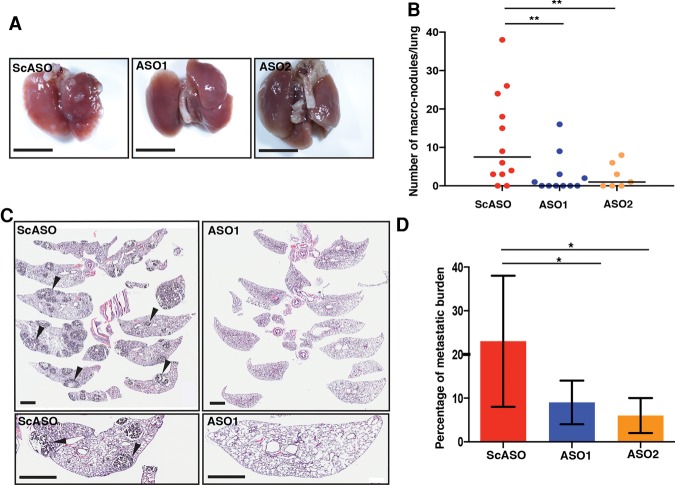
Genome-wide analyses have identified thousands of long noncoding RNAs (lncRNAs). Malat1 (metastasis-associated lung adenocarcinoma transcript 1) is among the most abundant lncRNAs whose expression is altered in numerous cancers. Here we report that genetic loss or systemic knockdown of Malat1 using antisense oligonucleotides (ASOs) in the MMTV (mouse mammary tumor virus)-PyMT mouse mammary carcinoma model results in slower tumor growth accompanied by significant differentiation into cystic tumors and a reduction in metastasis. Furthermore, Malat1 loss results in a reduction of branching morphogenesis in MMTV-PyMT- and Her2/neu-amplified tumor organoids, increased cell adhesion, and loss of migration. At the molecular level, Malat1 knockdown results in alterations in gene expression and changes in splicing patterns of genes involved in differentiation and protumorigenic signaling pathways. Together, these data demonstrate for the first time a functional role of Malat1 in regulating critical processes in mammary cancer pathogenesis. Thus, Malat1 represents an exciting therapeutic target, and Malat1 ASOs represent a potential therapy for inhibiting breast cancer progression.
全基因组分析已鉴定出数千种长链非编码RNA(lncRNA)。Malat1(转移相关的肺腺癌转录本1)是表达在众多癌症中发生改变的最丰富的lncRNA之一。在此我们报告,在MMTV(小鼠乳腺肿瘤病毒)-PyMT小鼠乳腺癌模型中,使用反义寡核苷酸(ASO)对Malat1进行基因敲除或全身敲低会导致肿瘤生长减缓,同时显著分化为囊性肿瘤并减少转移。此外,Malat1缺失会导致MMTV-PyMT和Her2/neu扩增的肿瘤类器官的分支形态发生减少、细胞黏附增加以及迁移能力丧失。在分子水平上,Malat1敲低会导致基因表达改变以及参与分化和促肿瘤信号通路的基因剪接模式变化。总之,这些数据首次证明了Malat1在调节乳腺癌发病机制中的关键过程中具有功能作用。因此,Malat1是一个令人兴奋的治疗靶点,而Malat1 ASO是一种抑制乳腺癌进展的潜在疗法。