Adams Heather M, Eberman Lindsey E, Yeargin Susan W, Niemann Andrew J, Mata Heather L, Dziedzicki David J
Department of Applied Medicine and Rehabilitation, Indiana State University, Terre Haute, Indiana, USA.
University of South Carolina, South Carolina, USA.
Asian J Sports Med. 2015 Dec;6(4):e24041. doi: 10.5812/asjsm.24041. Epub 2015 Dec 1.
Hypohydration can have significant implications on normal physiological functions of the body.
This study aimed to determine the impact of agitation, storage temperature, and storage time on urine osmolality compared to the criterion control.
We used a descriptive diagnostic validity test design. To investigate agitation, we recruited 75 healthy individuals (males = 41, females = 34; mean age = 22 ± 5 years; mean self-reported height = 172 ± 23 cm and mass = 77 ± 17 kg) who provided one or more samples (total = 81). The independent variables were agitation (vortex, hand shaken, no agitation) and temperature (room temperature, freezer, and refrigerator) type. Participants completed informed consent, a health questionnaire and were asked to provide a urine sample, which was split and labeled according to agitation type or storage temperature. Urine osmolality was used to determine hydration status at two time points (within 2 hours [control], 48 hours). We used t-tests to determine the difference between each condition and the control and calculated percent error for each condition.
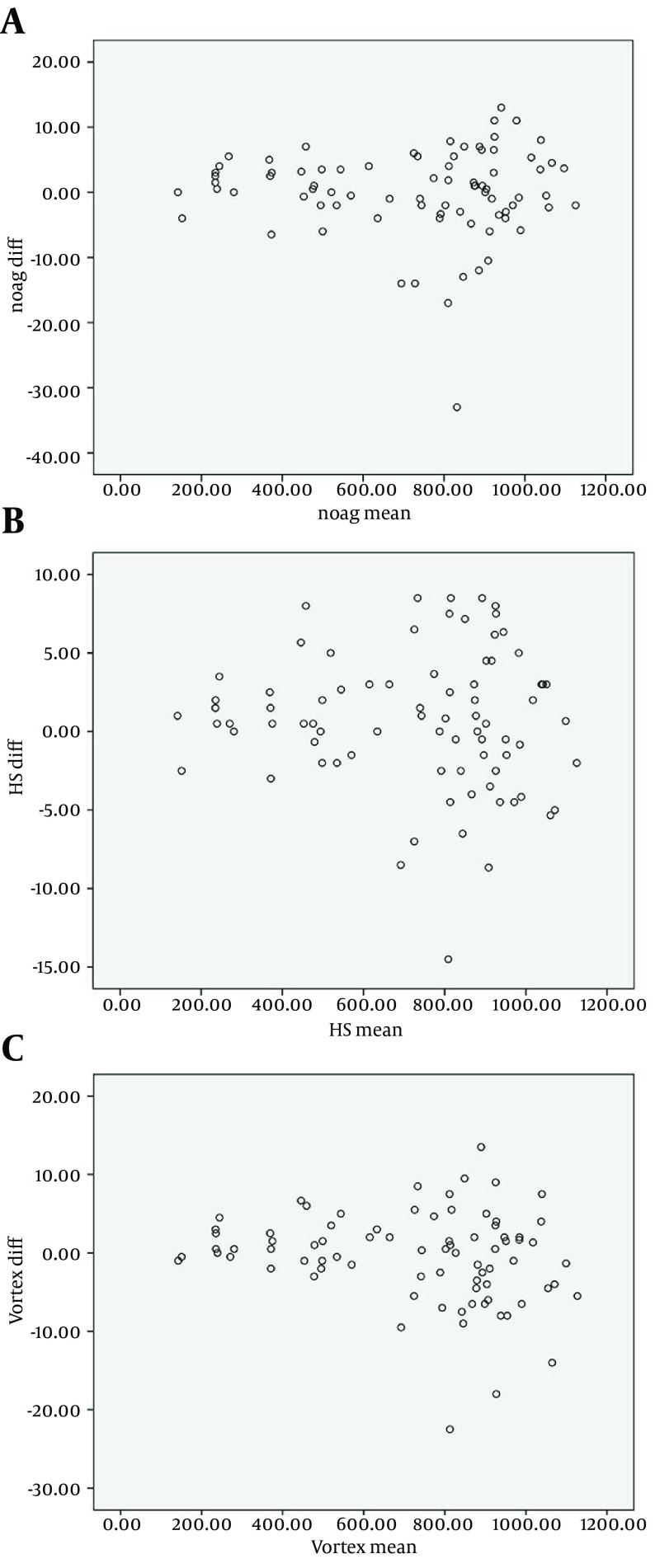
No significant differences for no agitation (t79 = -0.079, P = 0.937), hand shaken (t79 = 1.395, P = 0.167) or vortex mixed (t79 = -0.753, P = 0.453) were identified when compared to the criterion control. No significant differences for room temperature (t82 = -0.720, P = 0.474), refrigerator (t82 = -2.697, P = 0.008) or freezer (t82 = 2.576, P = 0.012) were identified when compared to the criterion control.
Our findings suggest agitation of urine specimen is not necessary and samples do not require refrigeration or freezing if assessed within 48 hours. Analysis within two hours of collection is not necessary and samples can be stored for up to 48 hours without impacting the hydration status of the sample.
水分过少会对身体的正常生理功能产生重大影响。
本研究旨在确定与标准对照相比,搅拌、储存温度和储存时间对尿渗透压的影响。
我们采用了描述性诊断效度测试设计。为了研究搅拌的影响,我们招募了75名健康个体(男性41名,女性34名;平均年龄=22±5岁;平均自我报告身高=172±23厘米,体重=77±17千克),他们提供了一个或多个样本(共81个)。自变量为搅拌方式(涡旋、手动摇晃、不搅拌)和温度类型(室温、冷冻、冷藏)。参与者签署了知情同意书,填写了健康问卷,并被要求提供一份尿液样本,该样本根据搅拌方式或储存温度进行分装和标记。在两个时间点(2小时内[对照]、48小时)使用尿渗透压来确定水合状态。我们使用t检验来确定每种情况与对照之间的差异,并计算每种情况的百分比误差。
与标准对照相比,未发现不搅拌(t79=-0.079,P=0.937)、手动摇晃(t79=1.395,P=0.167)或涡旋混合(t79=-0.753,P=0.453)有显著差异。与标准对照相比,未发现室温(t82=-0.720,P=0.474)、冷藏(t82=-2.697,P=0.008)或冷冻(t82=2.576,P=0.012)有显著差异。
我们的研究结果表明,尿液样本无需搅拌,如果在48小时内进行评估,样本无需冷藏或冷冻。无需在采集后两小时内进行分析,样本可储存长达48小时而不影响样本的水合状态。