Gilbert Peter B, Gabriel Erin E, Huang Ying, Chan Ivan S F
Vaccine Infectious Disease Division, Fred Hutchinson Cancer Research Center, Seattle, Washington, 98109, U.S.A. ; Department of Biostatistics, University of Washington, Seattle, Washington, 98105, U.S.A.
Biostatistics Branch, National Institute of Allergy and Infectious Diseases, Bethesda, Maryland, 20817, U.S.A.
J Causal Inference. 2015 Sep 1;3(2):157-175. doi: 10.1515/jci-2014-0007. Epub 2015 Feb 1.
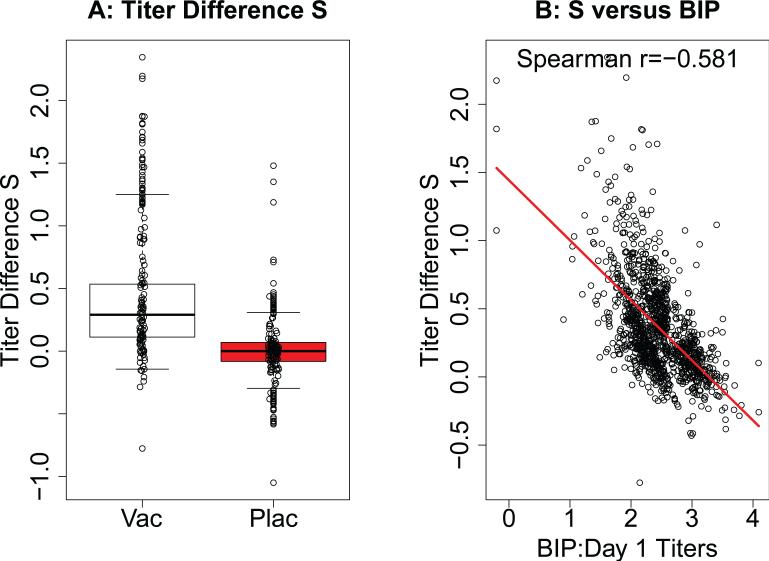
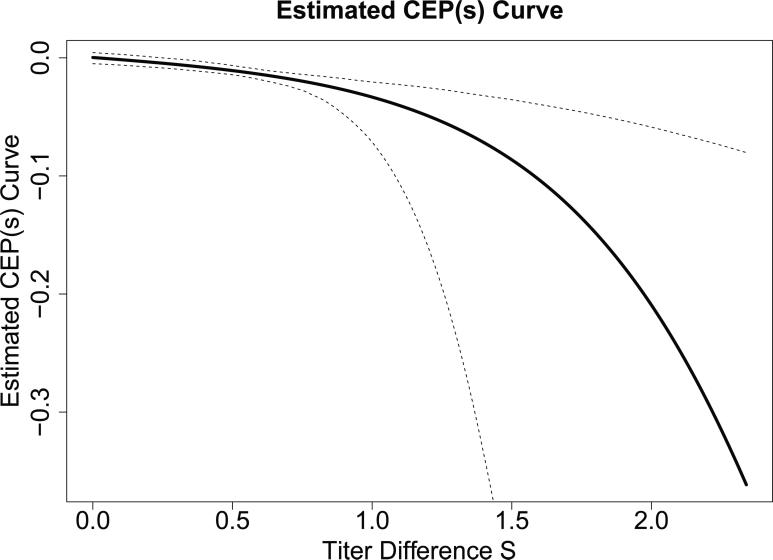
A common problem of interest within a randomized clinical trial is the evaluation of an inexpensive response endpoint as a valid surrogate endpoint for a clinical endpoint, where a chief purpose of a valid surrogate is to provide a way to make correct inferences on clinical treatment effects in future studies without needing to collect the clinical endpoint data. Within the principal stratification framework for addressing this problem based on data from a single randomized clinical efficacy trial, a variety of definitions and criteria for a good surrogate endpoint have been proposed, all based on or closely related to the "principal effects" or "causal effect predictiveness (CEP)" surface. We discuss CEP-based criteria for a useful surrogate endpoint, including (1) the meaning and relative importance of proposed criteria including average causal necessity (ACN), average causal sufficiency (ACS), and large clinical effect modification; (2) the relationship between these criteria and the Prentice definition of a valid surrogate endpoint; and (3) the relationship between these criteria and the consistency criterion (i.e., assurance against the "surrogate paradox"). This includes the result that ACN plus a strong version of ACS generally do not imply the Prentice definition nor the consistency criterion, but they do have these implications in special cases. Moreover, the converse does not hold except in a special case with a binary candidate surrogate. The results highlight that assumptions about the treatment effect on the clinical endpoint before the candidate surrogate is measured are influential for the ability to draw conclusions about the Prentice definition or consistency. In addition, we emphasize that in some scenarios that occur commonly in practice, the principal strata sub-populations for inference are identifiable from the observable data, in which cases the principal stratification framework has relatively high utility for the purpose of effect modification analysis, and is closely connected to the treatment marker selection problem. The results are illustrated with application to a vaccine efficacy trial, where ACN and ACS for an antibody marker are found to be consistent with the data and hence support the Prentice definition and consistency.
随机临床试验中一个常见的重要问题是评估一个低成本的反应终点作为临床终点的有效替代终点,有效替代终点的主要目的是提供一种方法,以便在未来研究中对临床治疗效果做出正确推断,而无需收集临床终点数据。在基于单个随机临床疗效试验数据解决此问题的主分层框架内,已经提出了多种关于良好替代终点的定义和标准,所有这些都基于“主效应”或“因果效应预测性(CEP)”表面或与之密切相关。我们讨论基于CEP的有用替代终点标准,包括:(1)所提出标准的含义和相对重要性,包括平均因果必要性(ACN)、平均因果充分性(ACS)和大临床效应修正;(2)这些标准与有效替代终点的普伦蒂斯定义之间的关系;(3)这些标准与一致性标准(即防止“替代悖论”)之间的关系。这包括以下结果:ACN加上一个更强版本的ACS通常并不意味着普伦蒂斯定义或一致性标准,但在特殊情况下它们确实有这些含义。此外,反之不成立,除非在二元候选替代指标的特殊情况下。结果强调,在测量候选替代指标之前对临床终点治疗效果的假设,对于得出关于普伦蒂斯定义或一致性的结论的能力有影响。此外,我们强调,在实践中常见的某些情况下,可以从可观察数据中识别用于推断的主分层亚组,在这些情况下,主分层框架对于效应修正分析目的具有相对较高的效用,并且与治疗标志物选择问题密切相关。通过应用于疫苗疗效试验来说明这些结果,其中发现抗体标志物的ACN和ACS与数据一致,因此支持普伦蒂斯定义和一致性。