Kogovšek Polona, Pompe-Novak Maruša, Petek Marko, Fragner Lena, Weckwerth Wolfram, Gruden Kristina
Department of Biotechnology and Systems Biology, National Institute of Biology, Večna pot 111, Ljubljana, Slovenia.
Department of Biology, Biotechnical Faculty, University of Ljubljana, Večna pot 111, Ljubljana, Slovenia.
PLoS One. 2016 Jan 4;11(1):e0146135. doi: 10.1371/journal.pone.0146135. eCollection 2016.
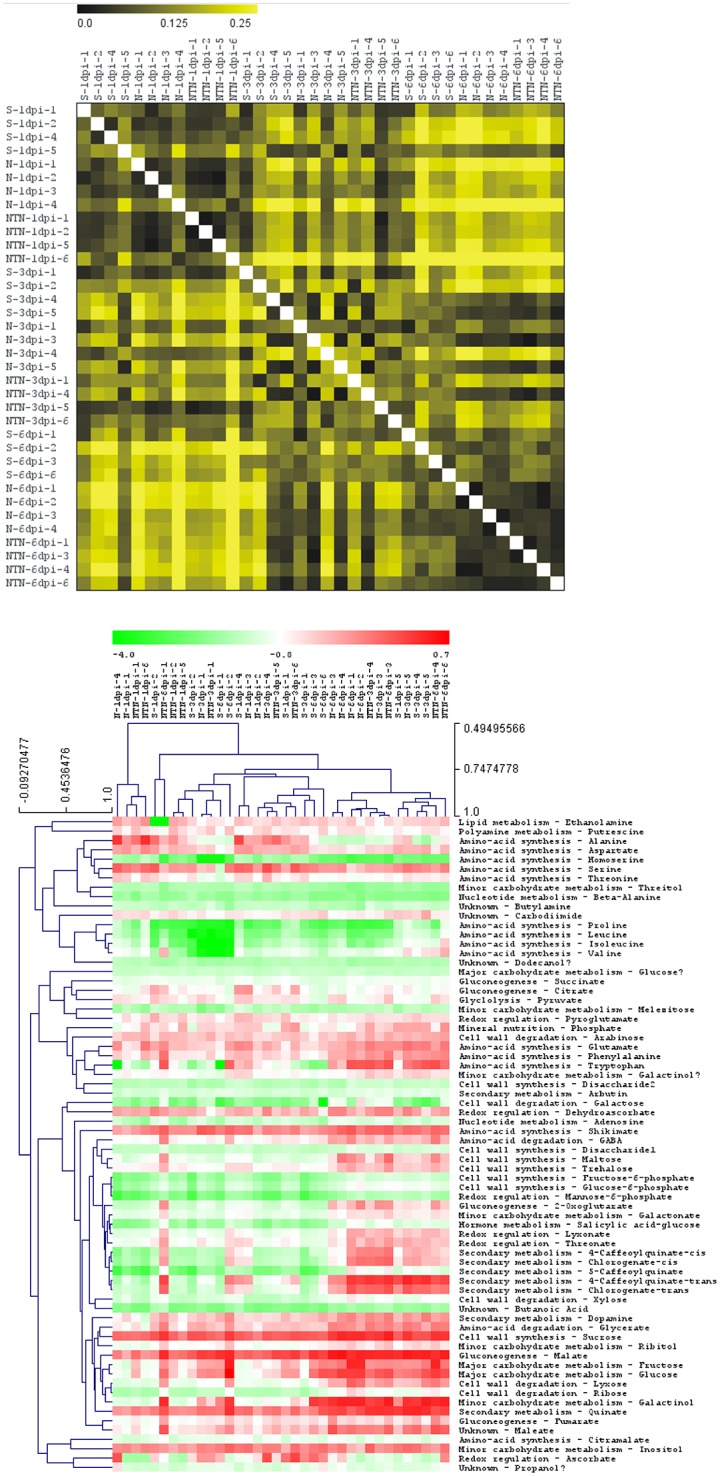
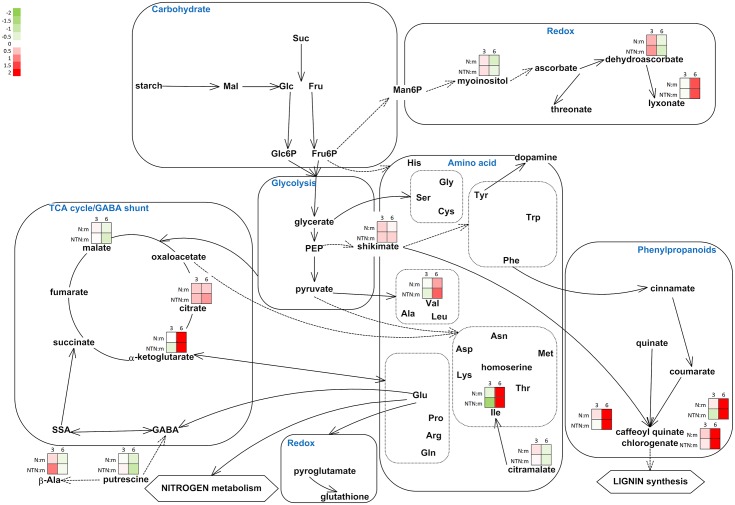
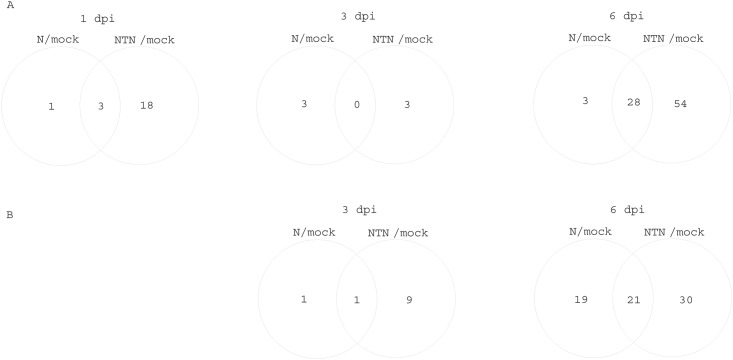
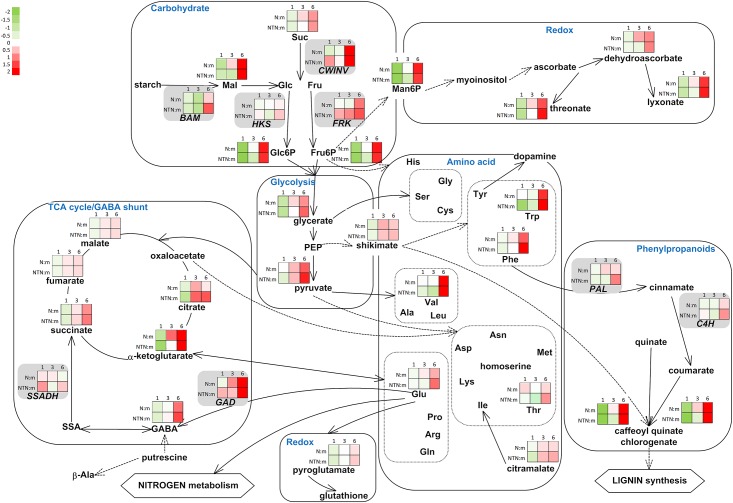
Potato production is one of the most important agricultural sectors, and it is challenged by various detrimental factors, including virus infections. To control losses in potato production, knowledge about the virus-plant interactions is crucial. Here, we investigated the molecular processes in potato plants as a result of Potato virus Y (PVY) infection, the most economically important potato viral pathogen. We performed an integrative study that links changes in the metabolome and gene expression in potato leaves inoculated with the mild PVYN and aggressive PVYNTN isolates, for different times through disease development. At the beginning of infection (1 day post-inoculation), virus-infected plants showed an initial decrease in the concentrations of metabolites connected to sugar and amino-acid metabolism, the TCA cycle, the GABA shunt, ROS scavangers, and phenylpropanoids, relative to the control plants. A pronounced increase in those metabolites was detected at the start of the strong viral multiplication in infected leaves. The alterations in these metabolic pathways were also seen at the gene expression level, as analysed by quantitative PCR. In addition, the systemic response in the metabolome to PVY infection was analysed. Systemic leaves showed a less-pronounced response with fewer metabolites altered, while phenylpropanoid-associated metabolites were strongly accumulated. There was a more rapid onset of accumulation of ROS scavengers in leaves inoculated with PVYN than those inoculated with PVYNTN. This appears to be related to the lower damage observed for leaves of potato infected with the milder PVYN strain, and at least partially explains the differences between the phenotypes observed.
马铃薯生产是最重要的农业部门之一,它受到包括病毒感染在内的各种有害因素的挑战。为了控制马铃薯生产中的损失,了解病毒与植物的相互作用至关重要。在这里,我们研究了马铃薯Y病毒(PVY)感染后马铃薯植株中的分子过程,PVY是对经济影响最重要的马铃薯病毒病原体。我们进行了一项综合研究,该研究将接种温和型PVYN和强毒株PVYNTN的马铃薯叶片在疾病发展的不同时间点的代谢组变化和基因表达联系起来。在感染初期(接种后1天),与对照植株相比,病毒感染植株中与糖和氨基酸代谢、三羧酸循环、γ-氨基丁酸分流、活性氧清除剂和苯丙烷类相关的代谢物浓度最初有所下降。在受感染叶片中病毒大量繁殖开始时,检测到这些代谢物显著增加。通过定量PCR分析,在基因表达水平上也观察到了这些代谢途径的变化。此外,还分析了代谢组对PVY感染的系统反应。系统叶的反应不那么明显,只有较少的代谢物发生变化,而与苯丙烷类相关的代谢物则大量积累。接种PVYN的叶片中活性氧清除剂的积累比接种PVYNTN的叶片更快。这似乎与感染较温和PVYN株系的马铃薯叶片观察到的较低损伤有关,并且至少部分解释了观察到的表型差异。