Cowan Jack D, Neuman Jeremy, van Drongelen Wim
Department of Mathematics, University of Chicago, 5734 South University Avenue, Chicago, IL, 60637, USA.
Department of Physics, University of Chicago, 5720 South Ellis Avenue, Chicago, IL, 60637, USA.
J Math Neurosci. 2016 Dec;6(1):1. doi: 10.1186/s13408-015-0034-5. Epub 2016 Jan 4.
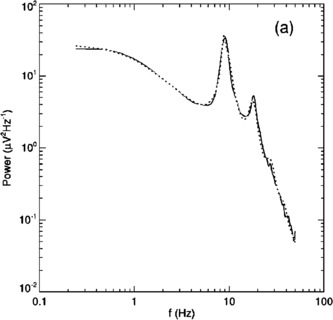
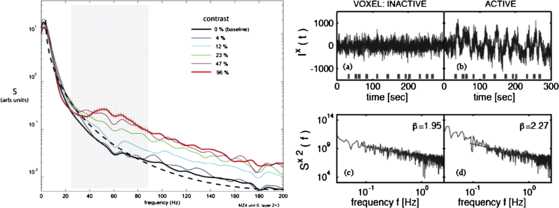
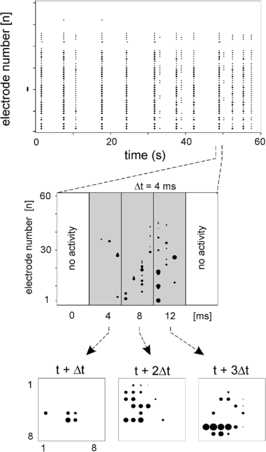
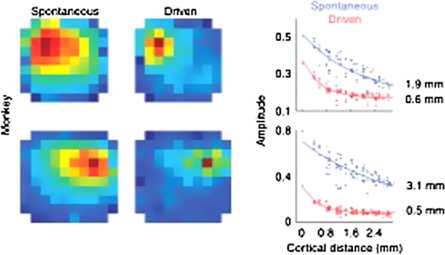
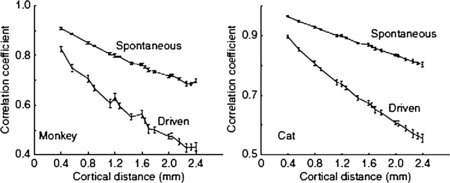
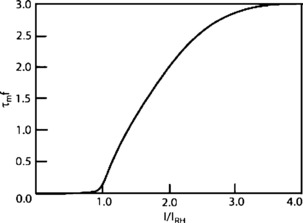
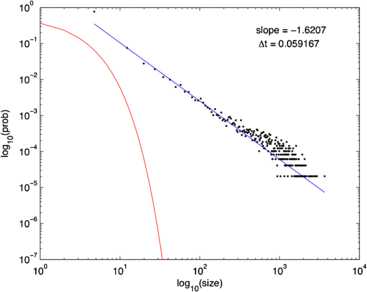
In 1972-1973 Wilson and Cowan introduced a mathematical model of the population dynamics of synaptically coupled excitatory and inhibitory neurons in the neocortex. The model dealt only with the mean numbers of activated and quiescent excitatory and inhibitory neurons, and said nothing about fluctuations and correlations of such activity. However, in 1997 Ohira and Cowan, and then in 2007-2009 Buice and Cowan introduced Markov models of such activity that included fluctuation and correlation effects. Here we show how both models can be used to provide a quantitative account of the population dynamics of neocortical activity.We first describe how the Markov models account for many recent measurements of the resting or spontaneous activity of the neocortex. In particular we show that the power spectrum of large-scale neocortical activity has a Brownian motion baseline, and that the statistical structure of the random bursts of spiking activity found near the resting state indicates that such a state can be represented as a percolation process on a random graph, called directed percolation.Other data indicate that resting cortex exhibits pair correlations between neighboring populations of cells, the amplitudes of which decay slowly with distance, whereas stimulated cortex exhibits pair correlations which decay rapidly with distance. Here we show how the Markov model can account for the behavior of the pair correlations.Finally we show how the 1972-1973 Wilson-Cowan equations can account for recent data which indicates that there are at least two distinct modes of cortical responses to stimuli. In mode 1 a low intensity stimulus triggers a wave that propagates at a velocity of about 0.3 m/s, with an amplitude that decays exponentially. In mode 2 a high intensity stimulus triggers a larger response that remains local and does not propagate to neighboring regions.
1972年至1973年期间,威尔逊和考恩提出了一个关于新皮层中通过突触耦合的兴奋性和抑制性神经元群体动力学的数学模型。该模型仅涉及激活和静止的兴奋性与抑制性神经元的平均数量,并未提及此类活动的波动和相关性。然而,1997年大平与考恩,以及随后在2007年至2009年期间,比斯和考恩引入了包含波动和相关效应的此类活动的马尔可夫模型。在此我们展示了如何使用这两种模型来定量描述新皮层活动的群体动力学。我们首先描述马尔可夫模型如何解释近期对新皮层静息或自发活动的诸多测量结果。特别地,我们表明大规模新皮层活动的功率谱具有布朗运动基线,并且在静息状态附近发现的尖峰活动随机爆发的统计结构表明,这样的状态可以表示为随机图上的渗流过程,称为定向渗流。其他数据表明,静息皮层在相邻细胞群体之间表现出成对相关性,其幅度随距离缓慢衰减,而受刺激的皮层表现出的成对相关性随距离迅速衰减。在此我们展示马尔可夫模型如何解释成对相关性的行为。最后,我们展示1972年至1973年的威尔逊 - 考恩方程如何解释近期的数据,这些数据表明皮层对刺激至少有两种不同的反应模式。在模式1中,低强度刺激触发一个以约0.3米/秒的速度传播的波,其幅度呈指数衰减。在模式2中,高强度刺激触发一个更大的反应,该反应保持局部且不传播到相邻区域。