Gonzalez-Martinez Alejandro, Rodriguez-Sanchez Alejandro, Lotti Tommaso, Garcia-Ruiz Maria-Jesus, Osorio Francisco, Gonzalez-Lopez Jesus, van Loosdrecht Mark C M
Department of Civil Engineering, University of Granada, Campus de Fuentenueva, s/n, 18071, Granada, Spain.
Institute of Water Research, University of Granada, C/Ramón y Cajal, 4, 18071, Granada, Spain.
Sci Rep. 2016 Jan 5;6:18786. doi: 10.1038/srep18786.
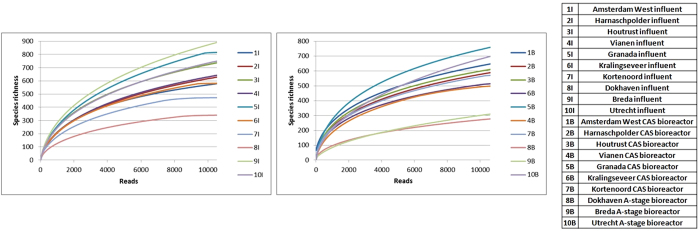
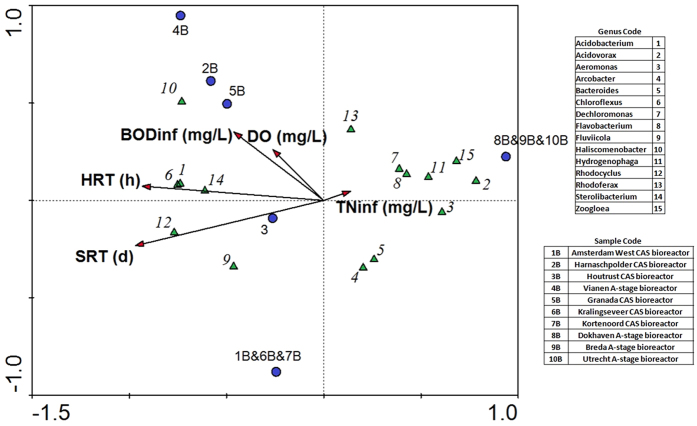
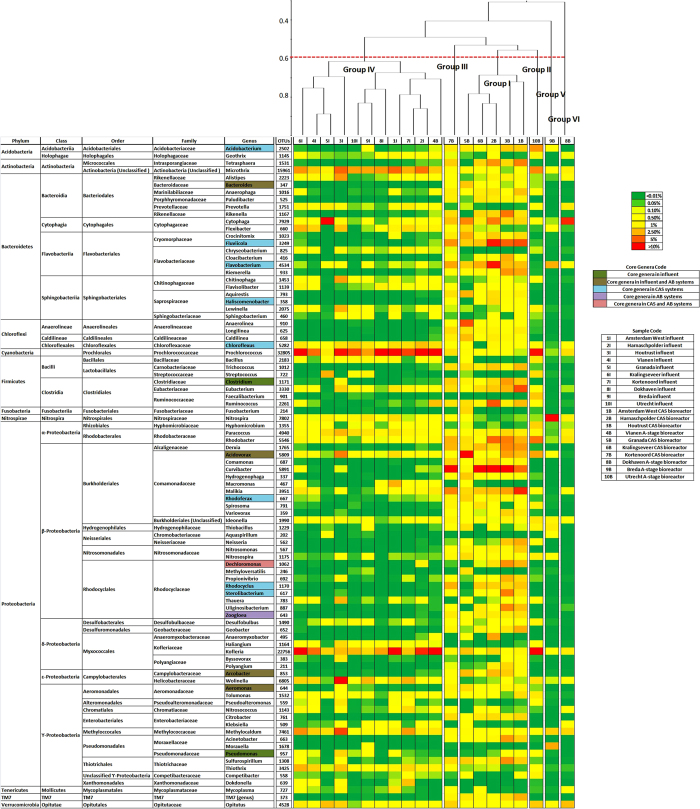
The bacterial community structure of 10 different wastewater treatment systems and their influents has been investigated through pyrosequencing, yielding a total of 283486 reads. These bioreactors had different technological configurations: conventional activated sludge (CAS) systems and very highly loaded A-stage systems. A-stage processes are proposed as the first step in an energy producing municipal wastewater treatment process. Pyrosequencing analysis indicated that bacterial community structure of all influents was similar. Also the bacterial community of all CAS bioreactors was similar. Bacterial community structure of A-stage bioreactors showed a more case-specific pattern. A core of genera was consistently found for all influents, all CAS bioreactors and all A-stage bioreactors, respectively, showing that different geographical locations in The Netherlands and Spain did not affect the functional bacterial communities in these technologies. The ecological roles of these bacteria were discussed. Influents and A-stage bioreactors shared several core genera, while none of these were shared with CAS bioreactors communities. This difference is thought to reside in the different operational conditions of the two technologies. This study shows that bacterial community structure of CAS and A-stage bioreactors are mostly driven by solids retention time (SRT) and hydraulic retention time (HRT), as suggested by multivariate redundancy analysis.
通过焦磷酸测序技术,对10种不同废水处理系统及其进水的细菌群落结构进行了研究,共获得283486条读数。这些生物反应器具有不同的工艺配置:传统活性污泥(CAS)系统和高负荷A段系统。A段工艺被提议作为城市废水能源生产处理工艺的第一步。焦磷酸测序分析表明,所有进水的细菌群落结构相似。所有CAS生物反应器的细菌群落也相似。A段生物反应器的细菌群落结构呈现出更具个案特异性的模式。分别在所有进水、所有CAS生物反应器和所有A段生物反应器中始终发现了一个核心属,这表明荷兰和西班牙的不同地理位置并未影响这些技术中功能性细菌群落。讨论了这些细菌的生态作用。进水和A段生物反应器共有几个核心属,而这些核心属均未与CAS生物反应器群落共有。这种差异被认为存在于两种技术不同的运行条件中。这项研究表明,正如多变量冗余分析所表明的那样,CAS和A段生物反应器的细菌群落结构主要受固体停留时间(SRT)和水力停留时间(HRT)的驱动。