Yi Guo-Zhong, Feng Wen-Yan, Zhou Qiang, Liu Ya-Wei, Qi Song-Tao
Department of Neurosurgery, Nanfang Hospital, Southern Medical University, Avenue North Road No.1838, Guangzhou, 510515, People's Republic of China.
The Second College of Clinical Medicine, Southern Medical University, Avenue North Road No.1838, Guangzhou, 510515, People's Republic of China.
Mol Neurobiol. 2017 Jan;54(1):22-30. doi: 10.1007/s12035-015-9539-x. Epub 2016 Jan 4.
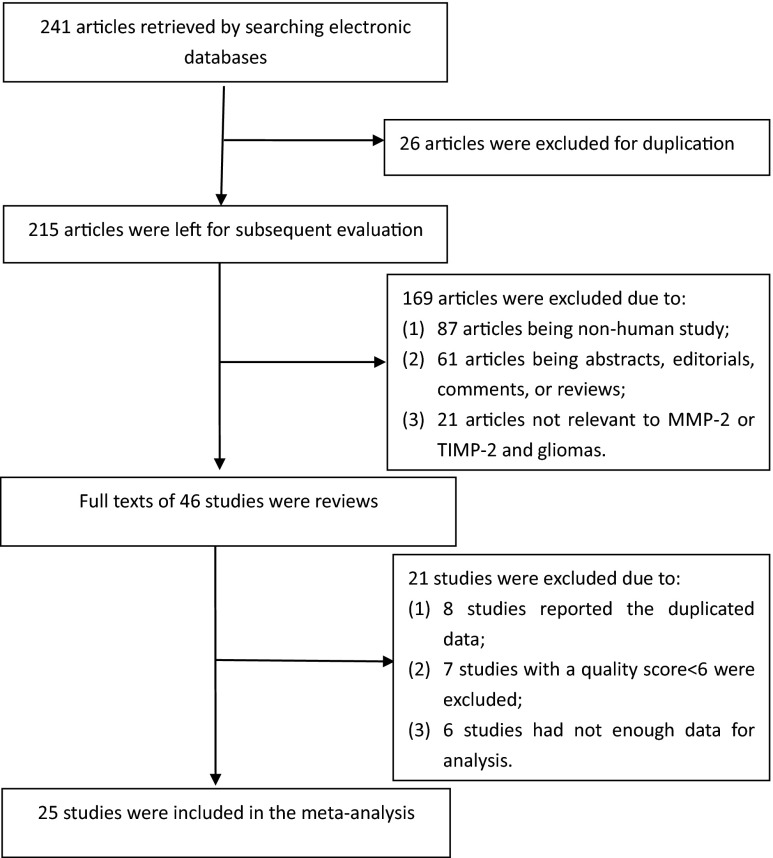
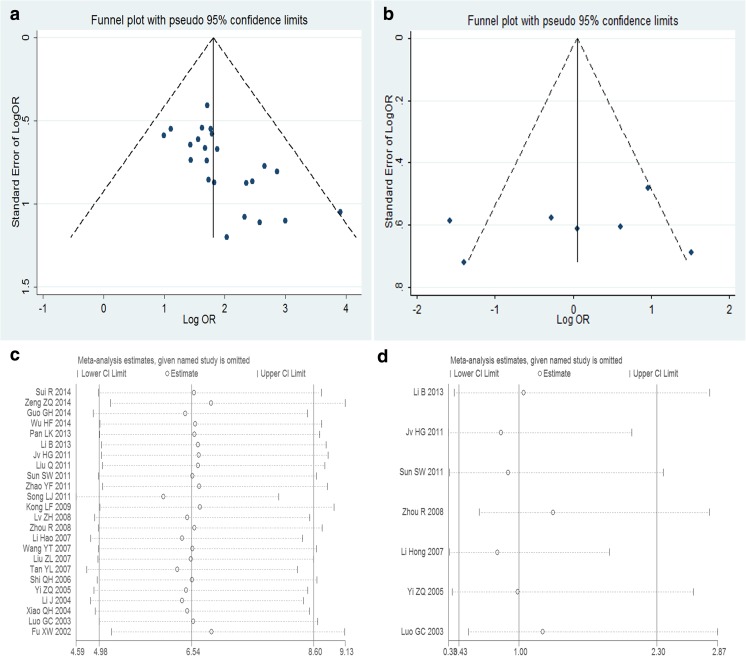
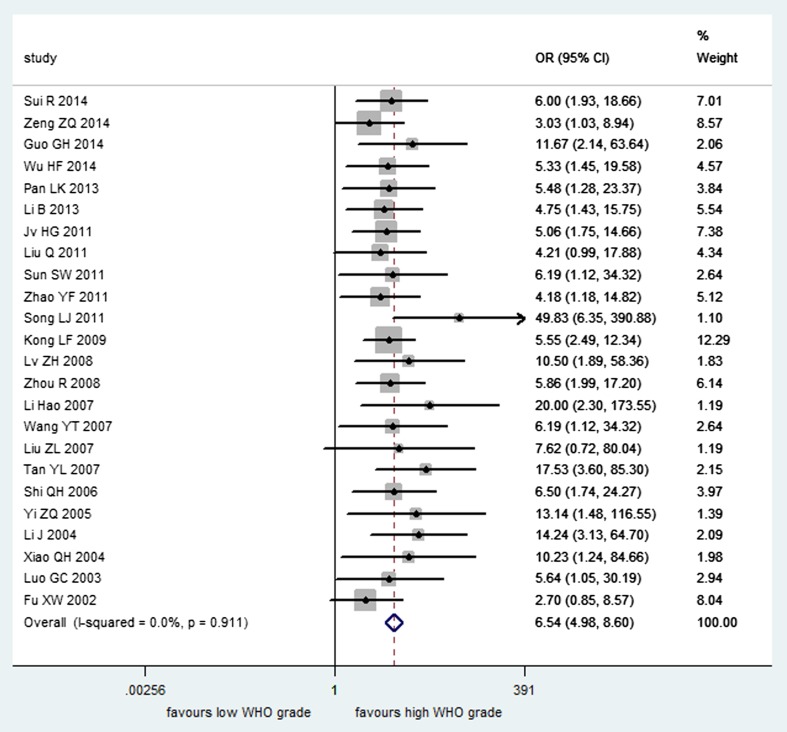
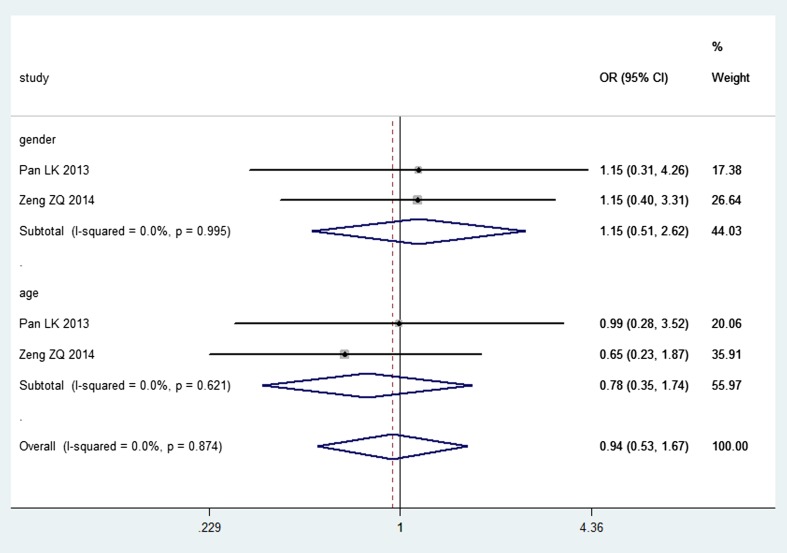
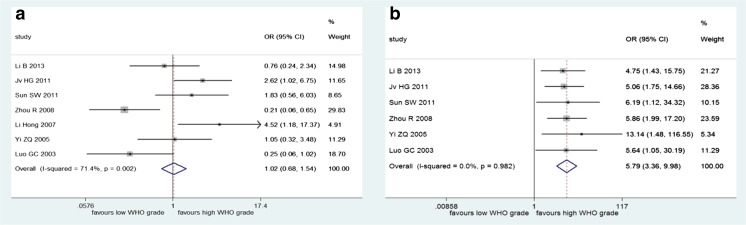
So far, the prognostic value of matrix metalloproteinase 2 (MMP-2) and tissue inhibitor of matrix metalloproteinase 2 (TIMP-2) expressions in patients with gliomas has been widely reported, especially in China. But, the results were inconsistent. Thus, we conducted a meta-analysis to determine the correlation of MMP-2 and TIMP-2 expressions with the prognosis of patients with gliomas. Identical search strategies were used to search relevant literature in electronic databases updated to May 1, 2015, and odds ratios (ORs) with 95 % confidence intervals (95 % CIs) were estimated. Funnel plots and Egger's tests were conducted for the evaluation of publication bias, and heterogeneity and sensitivity were also analyzed. Finally, a total of 25 studies involving 1572 patients were included in the meta-analysis. Coincidentally, all these studies were conducted in Chinese population. It was found that MMP-2 expression was significantly associated with high-WHO grade gliomas (n = 24, OR = 6.54, CI = 4.98-8.60; I = 0 %, P = 0.911) and poor overall survival (OS), while it did not correlate to age (n = 2, OR = 0.78, CI = 0.35-1.74; I = 0 %, P = 0.621) and gender (n = 2, OR = 1.15, CI = 0.51-2.62; I = 0 %, P = 0.995). Moreover, the results of the pooled analysis indicated that there was no association between TIMP-2 expression and the WHO grade of gliomas (n = 7, OR = 1.02, 95 % CI = 0.68-1.54; I = 71.4 %, P = 0.002), but the ratio of MMP-2 and TIMP-2 (MMP-2/TIMP-2) rose with the increase of the WHO grade of gliomas. In conclusion, there was no correlation between TIMP-2 expression and the WHO grade of gliomas, while MMP-2 expression was potently associated with high-WHO grade of gliomas.
迄今为止,基质金属蛋白酶2(MMP-2)和基质金属蛋白酶组织抑制剂2(TIMP-2)的表达在胶质瘤患者中的预后价值已被广泛报道,尤其是在中国。但是,结果并不一致。因此,我们进行了一项荟萃分析,以确定MMP-2和TIMP-2表达与胶质瘤患者预后的相关性。采用相同的检索策略在更新至2015年5月1日的电子数据库中检索相关文献,并估计比值比(OR)及95%置信区间(95%CI)。绘制漏斗图并进行Egger检验以评估发表偏倚,同时分析异质性和敏感性。最终,共有25项涉及1572例患者的研究纳入了荟萃分析。巧合的是,所有这些研究均在中国人群中进行。结果发现,MMP-2表达与高WHO分级胶质瘤显著相关(n = 24,OR = 6.54,CI = 4.98 - 8.60;I² = 0%,P = 0.911)且与总生存期(OS)较差相关,而与年龄(n = 2,OR = 0.78,CI = 0.35 - 1.74;I² = 0%,P = 0.621)和性别(n = 2,OR = 1.15,CI = 0.51 - 2.62;I² = 0%,P = 0.995)无关。此外,汇总分析结果表明,TIMP-2表达与胶质瘤的WHO分级之间无关联(n = 7,OR = 1.02, 95%CI = 0.68 - 1.54;I² = 71.4%,P = 0.002),但MMP-2与TIMP-2的比值(MMP-2/TIMP-2)随胶质瘤WHO分级的增加而升高。总之,TIMP-2表达与胶质瘤的WHO分级之间无相关性,而MMP-2表达与高WHO分级胶质瘤密切相关。