Vikeved Elisabet, Backlund Anders, Alsmark Cecilia
Division of Pharmacognosy, Department of Medicinal Chemistry, Biomedical Centre, Uppsala University, Uppsala, Sweden.
Department of Microbiology, National Veterinary Institute (SVA), Uppsala, Sweden.
PLoS Negl Trop Dis. 2016 Jan 5;10(1):e0004326. doi: 10.1371/journal.pntd.0004326. eCollection 2016 Jan.
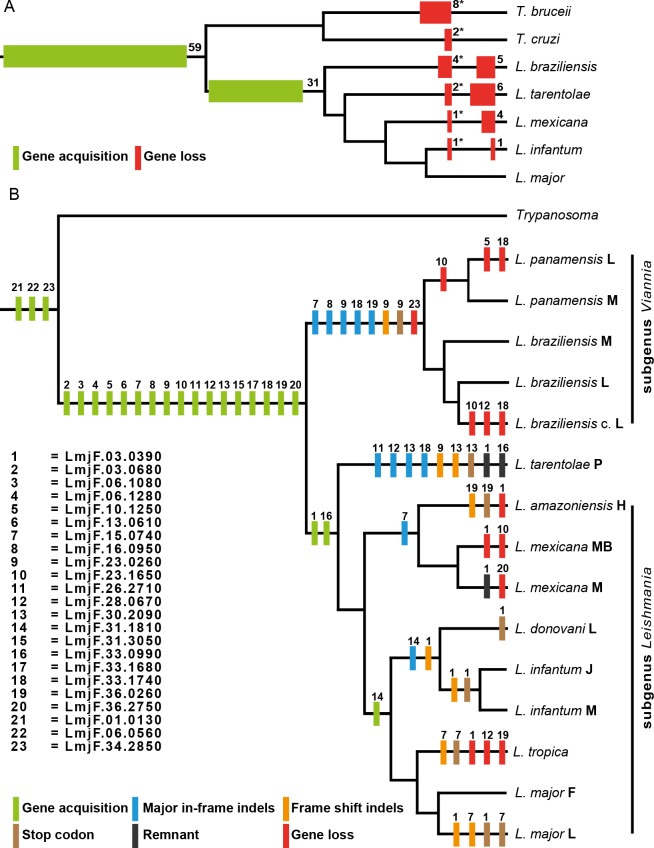
The genome of Leishmania major harbours a comparably high proportion of genes of prokaryote origin, acquired by lateral gene transfer (LGT). Some of these are present in closely related trypanosomatids, while some are detected in Leishmania only. We have evaluated the impact and destiny of LGT in genus Leishmania.
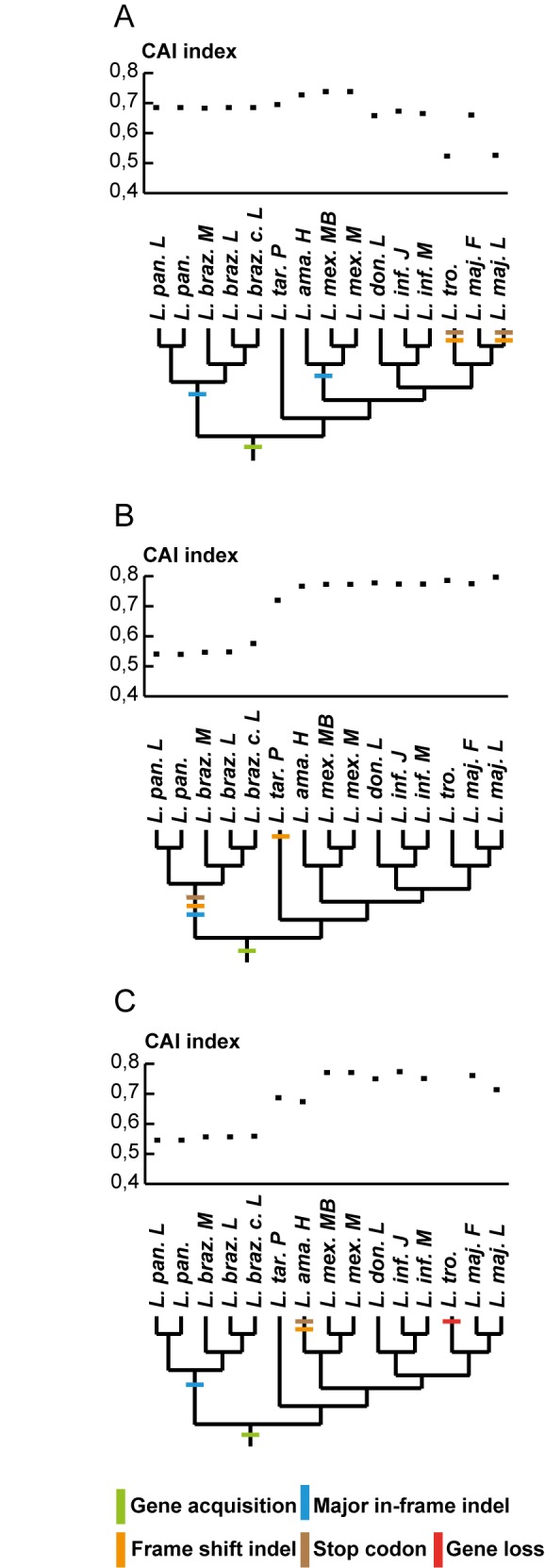
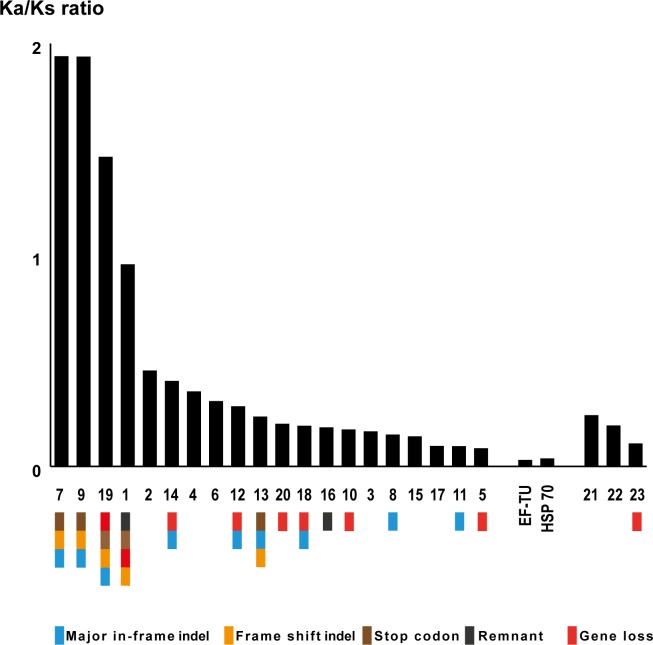
METHODOLOGY/PRINCIPAL FINDINGS: To study the dynamics and fate of LGTs we have performed phylogenetic, as well as nucleotide and amino acid composition analyses within orthologous groups of LGTs detected in Leishmania. A set of universal trypanosomatid LGTs was added as a reference group. Both groups of LGTs have, to some extent, ameliorated to resemble the recipient genomes. However, while virtually all of the universal trypanosomatid LGTs are distributed and conserved in the entire genus Leishmania, the LGTs uniquely present in genus Leishmania are more prone to gene loss and display faster rates of evolution. Furthermore, a PCR based approach has been employed to ascertain the presence of a set of twenty LGTs uniquely present in genus Leishmania, and three universal trypanosomatid LGTs, in ten additional strains of Leishmania. Evolutionary rates and predicted expression levels of these LGTs have also been estimated. Ten of the twenty LGTs are distributed and conserved in all species investigated, while the remainder have been subjected to modifications, or undergone pseudogenization, degradation or loss in one or more species.
CONCLUSIONS/SIGNIFICANCE: LGTs unique to the genus Leishmania have been acquired after the divergence of Leishmania from the other trypanosomatids, and are evolving faster than their recipient genomes. This implies that LGT in genus Leishmania is a continuous and dynamic process contributing to species differentiation and speciation. This study also highlights the importance of carefully evaluating these dynamic genes, e.g. as LGTs have been suggested as potential drug targets.
硕大利什曼原虫的基因组含有相当高比例的通过横向基因转移(LGT)获得的原核生物起源基因。其中一些基因存在于亲缘关系密切的锥虫中,而有些基因仅在利什曼原虫中被检测到。我们评估了LGT在利什曼原虫属中的影响和命运。
方法/主要发现:为了研究LGT的动态变化和命运,我们在利什曼原虫中检测到的LGT直系同源组内进行了系统发育分析以及核苷酸和氨基酸组成分析。添加了一组通用的锥虫LGT作为参考组。两组LGT在一定程度上都已改善,以类似于受体基因组。然而,虽然几乎所有通用的锥虫LGT都在整个利什曼原虫属中分布和保守,但仅在利什曼原虫属中存在的LGT更容易发生基因丢失,并且进化速度更快。此外,已采用基于PCR的方法来确定在另外十种利什曼原虫菌株中一组仅在利什曼原虫属中存在的二十种LGT以及三种通用的锥虫LGT的存在。还估计了这些LGT的进化速率和预测的表达水平。二十种LGT中有十种在所有研究的物种中分布和保守,而其余的则在一个或多个物种中发生了修饰、假基因化、降解或丢失。
结论/意义:利什曼原虫属特有的LGT是在利什曼原虫与其他锥虫分化后获得的,并且其进化速度比受体基因组更快。这意味着利什曼原虫属中的LGT是一个持续的动态过程,有助于物种分化和物种形成。这项研究还强调了仔细评估这些动态基因的重要性,例如,因为LGT已被建议作为潜在的药物靶点。