Kaneko Yuko, Atsumi Tatsuya, Tanaka Yoshiya, Inoo Masayuki, Kobayashi-Haraoka Hitomi, Amano Koichi, Miyata Masayuki, Murakawa Yohko, Yasuoka Hidekata, Hirata Shintaro, Nagasawa Hayato, Tanaka Eiichi, Miyasaka Nobuyuki, Yamanaka Hisashi, Yamamoto Kazuhiko, Takeuchi Tsutomu
Division of Rheumatology, Department of Internal Medicine, Keio University School of Medicine, Tokyo, Japan.
Division of Rheumatology, Endocrinology and Nephrology, Hokkaido University Graduate School of Medicine, Sapporo, Japan.
Ann Rheum Dis. 2016 Nov;75(11):1917-1923. doi: 10.1136/annrheumdis-2015-208426. Epub 2016 Jan 5.
To compare the efficacy and safety between tocilizumab added to methotrexate and tocilizumab switched from methotrexate in patients with active rheumatoid arthritis (RA).
This is a 2-year randomised, controlled study. RA patients with moderate or high disease activity despite methotrexate were randomly assigned either to tocilizumab added to methotrexate (add-on) or tocilizumab switched from methotrexate (switch). The primary endpoint was the DAS28 remission rate at week 24. Secondary objectives included other clinical efficacy indices, radiological outcomes assessed with the van der Heijde-modified total Sharp scoring system (mTSS), and safety.
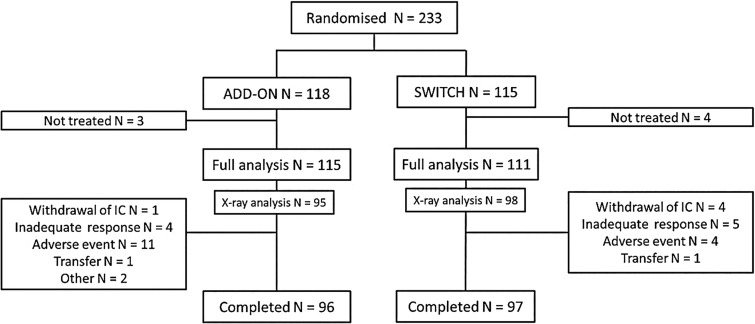
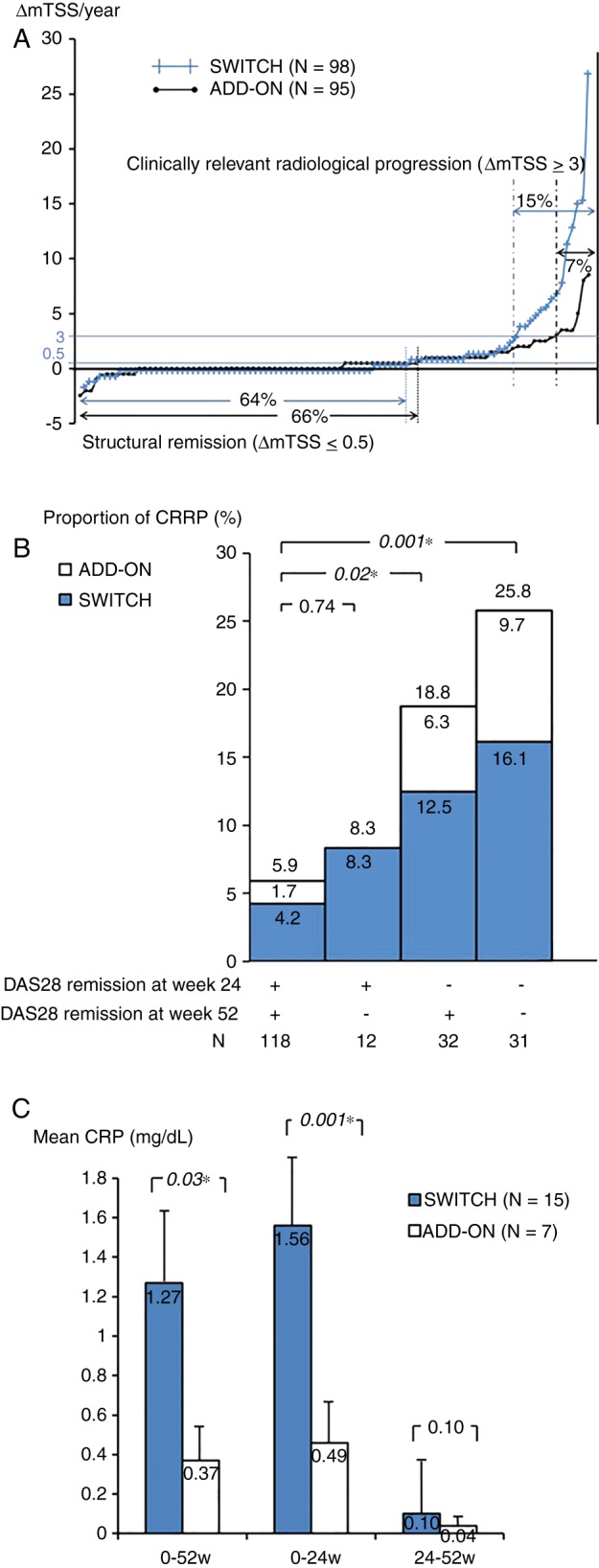
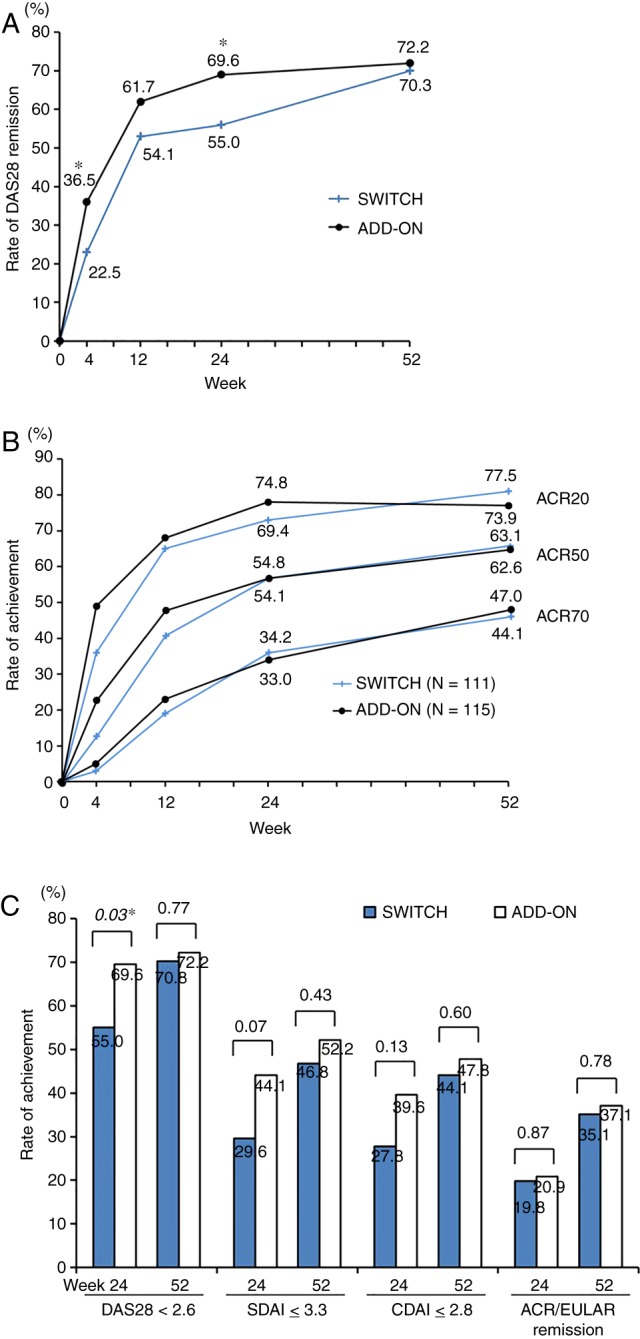
Of 223 randomised patients, 83% completed 52 weeks. DAS28 remission rates at week 24 were 70% for add-on and 55% for switch (p=0.02), but they became comparable at week 52 (72% vs 70%, p=0.86). Structural remission rates (mTSS≤0.5) at week 52 were not different (66% vs 64%, p=0.92). However, clinically relevant radiographic progression rates (CRRP; mTSS≥3) tended to be higher with the switch than with the add-on (15% vs 7%, p=0.07). Radiographic progression in the CRRP patients was larger with the switch than with the add-on (9.0/year vs 5.0/year, p=0.04). The difference in the mean C-reactive protein of the CRRP patients was significant for the first 24 weeks (1.56 vs 0.49, p=0.001) but not for the following 28 weeks (0.10 vs 0.04, p=0.1). Overall safety was preferable in the switch group.
In RA patients with inadequate response to methotrexate, tocilizumab added to methotrexate more rapidly suppressed inflammation than tocilizumab switched from methotrexate, leading to superior clinical efficacy and prevention of joint destruction.
NCT01120366.
比较在活动性类风湿关节炎(RA)患者中,托珠单抗联合甲氨蝶呤与从甲氨蝶呤转换为托珠单抗的疗效及安全性。
这是一项为期2年的随机对照研究。尽管使用了甲氨蝶呤,但疾病活动度为中度或高度的RA患者被随机分配至托珠单抗联合甲氨蝶呤组(联合组)或从甲氨蝶呤转换为托珠单抗组(转换组)。主要终点为第24周时的DAS28缓解率。次要目标包括其他临床疗效指标、采用范德海德改良的总Sharp评分系统(mTSS)评估的放射学结果以及安全性。
223例随机分组患者中,83%完成了52周的研究。联合组第24周时的DAS28缓解率为70%,转换组为55%(p = 0.02),但在第52周时二者相当(72%对70%,p = 0.86)。第52周时的结构缓解率(mTSS≤0.5)无差异(66%对64%,p = 0.92)。然而,转换组具有临床意义的放射学进展率(CRRP;mTSS≥3)倾向于高于联合组(15%对7%,p = 0.07)。CRRP患者中,转换组的放射学进展大于联合组(9.0/年对5.0/年,p = 0.04)。CRRP患者在前24周时平均C反应蛋白的差异有统计学意义(1.56对0.49,p = 0.001),但在随后的28周无差异(0.10对0.04,p = 0.1)。总体安全性在转换组更佳。
在对甲氨蝶呤反应不佳的RA患者中,托珠单抗联合甲氨蝶呤比从甲氨蝶呤转换为托珠单抗能更迅速地抑制炎症,带来更优的临床疗效并预防关节破坏。
NCT01120366。