Park Joonkoo, Starns Jeffrey J
Department of Psychological and Brain Sciences, University of Massachusetts, AmherstMA, USA; Commonwealth Honors College, University of Massachusetts, AmherstMA, USA.
Department of Psychological and Brain Sciences, University of Massachusetts, Amherst MA, USA.
Front Psychol. 2015 Dec 24;6:1955. doi: 10.3389/fpsyg.2015.01955. eCollection 2015.
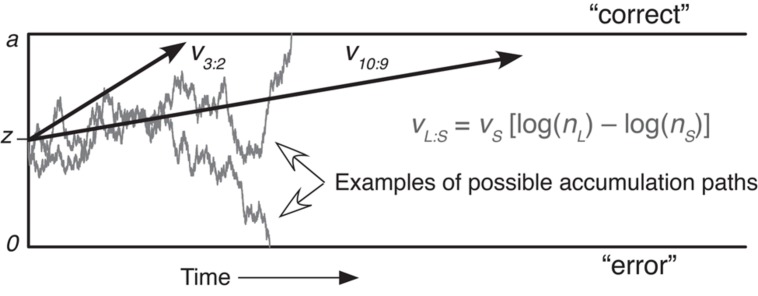
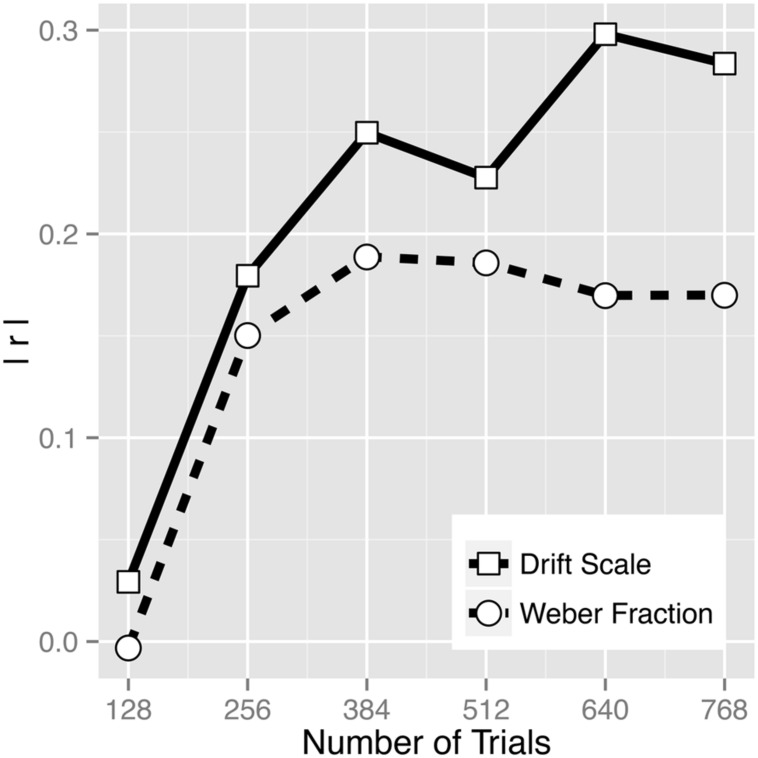
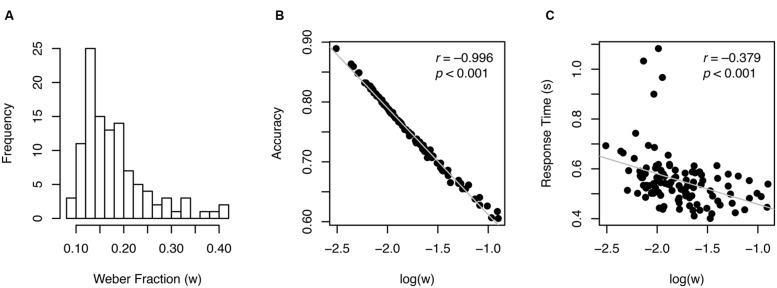
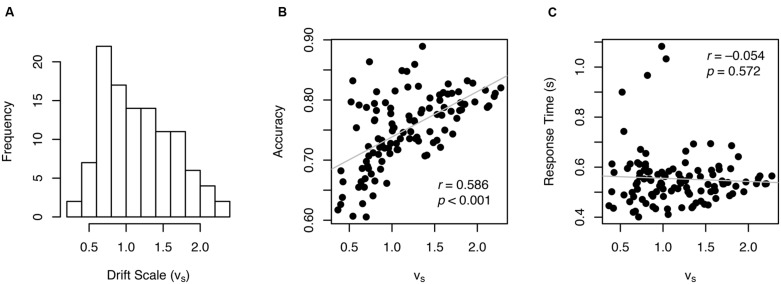
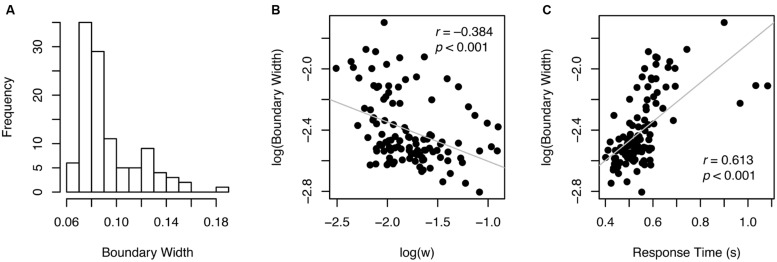
While all humans are capable of non-verbally representing numerical quantity using so-called the approximate number system (ANS), there exist considerable individual differences in its acuity. For example, in a non-symbolic number comparison task, some people find it easy to discriminate brief presentations of 14 dots from 16 dots while others do not. Quantifying individual ANS acuity from such a task has become an essential practice in the field, as individual differences in such a primitive number sense is thought to provide insights into individual differences in learned symbolic math abilities. However, the dominant method of characterizing ANS acuity-computing the Weber fraction (w)-only utilizes the accuracy data while ignoring response times (RT). Here, we offer a novel approach of quantifying ANS acuity by using the diffusion model, which accounts both accuracy and RT distributions. Specifically, the drift rate in the diffusion model, which indexes the quality of the stimulus information, is used to capture the precision of the internal quantity representation. Analysis of behavioral data shows that w is contaminated by speed-accuracy tradeoff, making it problematic as a measure of ANS acuity, while drift rate provides a measure more independent from speed-accuracy criterion settings. Furthermore, drift rate is a better predictor of symbolic math ability than w, suggesting a practical utility of the measure. These findings demonstrate critical limitations of the use of w and suggest clear advantages of using drift rate as a measure of primitive numerical competence.
虽然所有人都能够使用所谓的近似数字系统(ANS)以非语言方式表征数量,但该系统的敏锐度存在相当大的个体差异。例如,在一项非符号数字比较任务中,有些人觉得很容易区分14个点和16个点的短暂呈现,而另一些人则做不到。从这样的任务中量化个体的ANS敏锐度已成为该领域的一项基本做法,因为这种原始数字感的个体差异被认为有助于洞察所学符号数学能力的个体差异。然而,表征ANS敏锐度的主要方法——计算韦伯分数(w)——只利用了准确性数据,而忽略了反应时间(RT)。在此,我们提供一种通过使用扩散模型来量化ANS敏锐度的新方法,该模型兼顾了准确性和RT分布。具体而言,扩散模型中的漂移率(它反映了刺激信息的质量)被用来捕捉内部数量表征的精度。行为数据分析表明,w受到速度-准确性权衡的影响,使其作为ANS敏锐度的度量存在问题,而漂移率提供了一种更独立于速度-准确性标准设置的度量。此外,漂移率比w更能预测符号数学能力,这表明了该度量的实际效用。这些发现证明了使用w的关键局限性,并表明了使用漂移率作为原始数字能力度量的明显优势。