Joelsson Elisabeth, Erdei Borbála, Galbe Mats, Wallberg Ola
Department of Chemical Engineering, Lund University, P.O. Box 124, 22100 Lund, Sweden.
Biotechnol Biofuels. 2016 Jan 4;9:1. doi: 10.1186/s13068-015-0423-8. eCollection 2016.
Integration of first- and second-generation ethanol production can facilitate the introduction of second-generation lignocellulosic ethanol production. Consolidation of the second-generation with the first-generation process can potentially reduce the downstream processing cost for the second-generation process as well as providing the first-generation process with energy. This study presents novel experimental results from integrated first- and second-generation ethanol production from grain and wheat straw in a process development unit. The results were used in techno-economic evaluations to investigate the feasibility of the plant, in which the main co-products were distiller's dried grains with solubles and biogas.
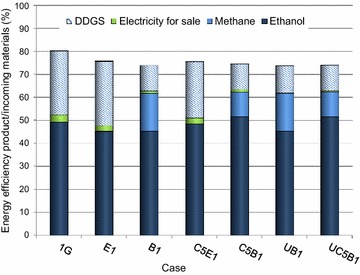
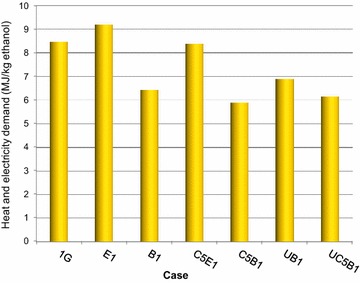
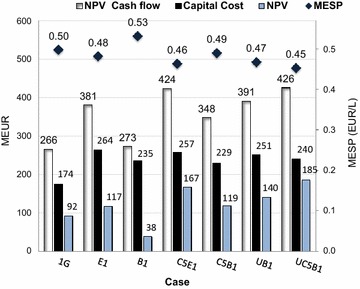
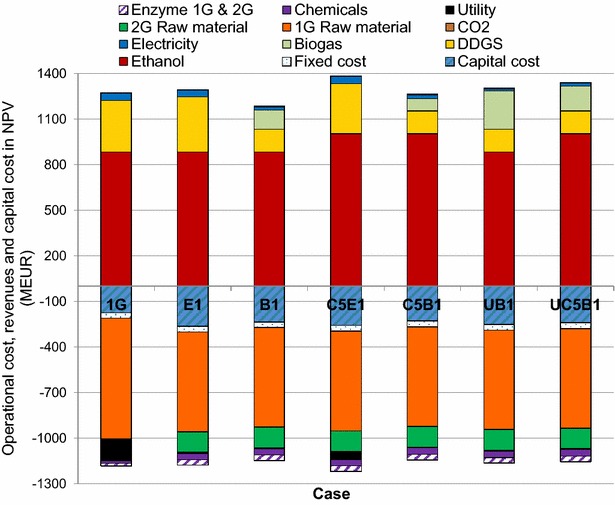
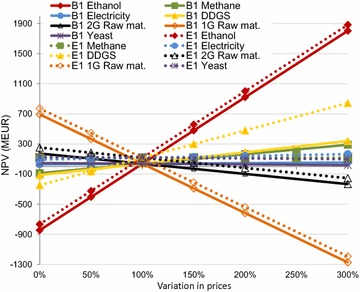
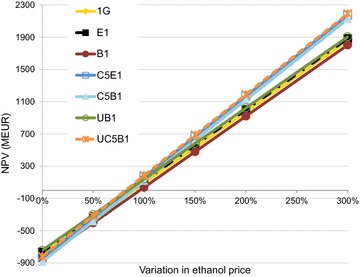
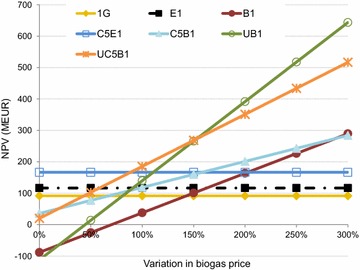
An overall glucose to ethanol yield, of 81 % of the theoretical, based on glucose available in the raw material, was achieved in the experiments. A positive net present value was found for all the base case scenarios and the minimal ethanol selling price varied between 0.45 and 0.53 EUR/L ethanol. The revenue increased with combined xylose and glucose fermentation and biogas upgrading to vehicle fuel quality. A decrease in the biogas yield from 80 to 60 % also largely affects the net present value. The energy efficiency for the energy content in products available for sale compared with the incoming energy content varied from 74 to 80 %.
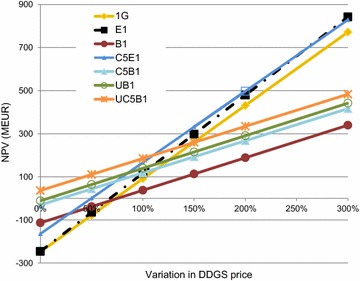
One of the two main configurations can be chosen when designing an integrated first- and second-generation ethanol production plant from grain and straw: that producing biogas or that producing distiller's dried grains with solubles from the xylose sugars. The choice depends mainly on the local market and prices for distiller's dried grains with solubles and biogas, since the prices for both co-products have fluctuated a great deal in recent years. In the current study, however, distiller's dried grains with solubles were found to be a more promising co-product than biogas, if the biogas was not upgraded to vehicle fuel quality. It was also concluded that additional experimental data from biogas production using first- and second-generation substrates are required to obtain improved economic evaluations.
第一代和第二代乙醇生产的整合有助于引入第二代木质纤维素乙醇生产。将第二代工艺与第一代工艺合并有可能降低第二代工艺的下游加工成本,并为第一代工艺提供能源。本研究展示了在工艺开发装置中从谷物和小麦秸秆综合生产第一代和第二代乙醇的新实验结果。这些结果用于技术经济评估,以研究该工厂的可行性,其中主要副产品是酒糟和沼气。
实验中实现了基于原料中可用葡萄糖的总葡萄糖到乙醇产率为理论值的81%。所有基础案例情景的净现值均为正值,乙醇最低销售价格在0.45至0.53欧元/升乙醇之间变化。木糖和葡萄糖联合发酵以及沼气升级为车用燃料质量可增加收入。沼气产量从80%降至60%也会对净现值产生很大影响。与输入能量含量相比,可供销售产品中能量含量的能源效率在74%至80%之间变化。
在设计从谷物和秸秆综合生产第一代和第二代乙醇的工厂时,可以选择两种主要配置之一:生产沼气的配置或从木糖生产酒糟的配置。选择主要取决于当地市场以及酒糟和沼气的价格,因为近年来这两种副产品的价格波动很大。然而,在本研究中,如果沼气未升级为车用燃料质量,发现酒糟比沼气更有前景作为副产品。还得出结论,需要更多使用第一代和第二代底物生产沼气的实验数据,以获得改进的经济评估。