Mosseri Jonathan, Trinquart Ludovic, Nizard Rémy, Ravaud Philippe
INSERM U1153, Paris, France.
Assistance Publique-Hôpitaux de Paris, Hôpital Lariboisière, Service de Chirurgie orthopédique et traumatologique, Paris, France.
PLoS One. 2016 Jan 6;11(1):e0146336. doi: 10.1371/journal.pone.0146336. eCollection 2016.
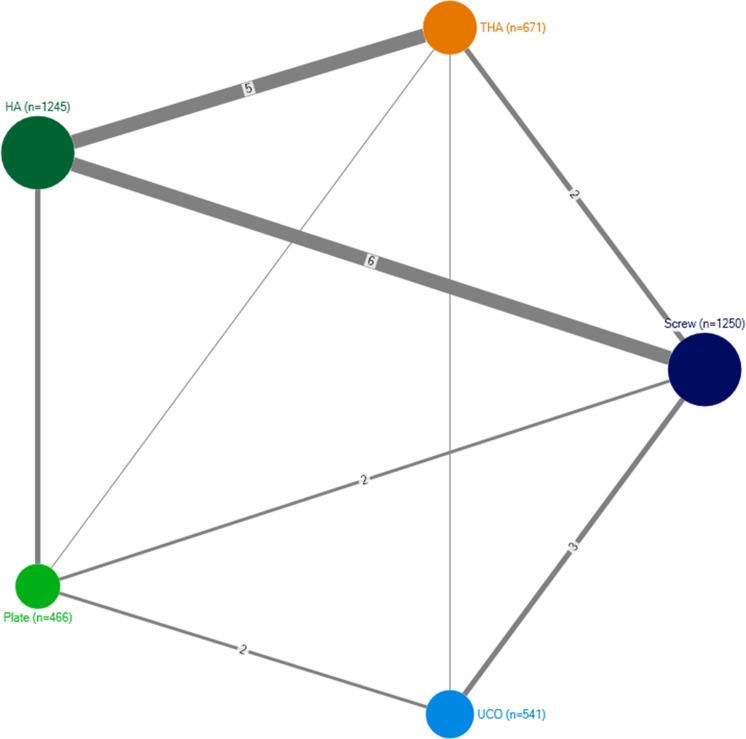
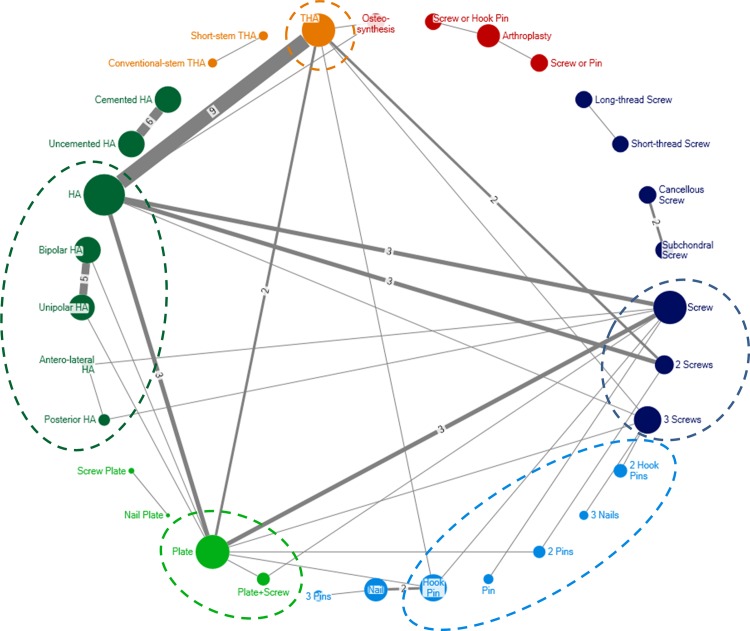
Surgical interventions raise specific methodological issues in network meta-analysis (NMA). They are usually multi-component interventions resulting in complex networks of randomized controlled trials (RCTs), with multiple groups and sparse connections.
To illustrate the applicability of the NMA in a complex network of surgical interventions and to prioritize the available interventions according to a clinically relevant outcome.
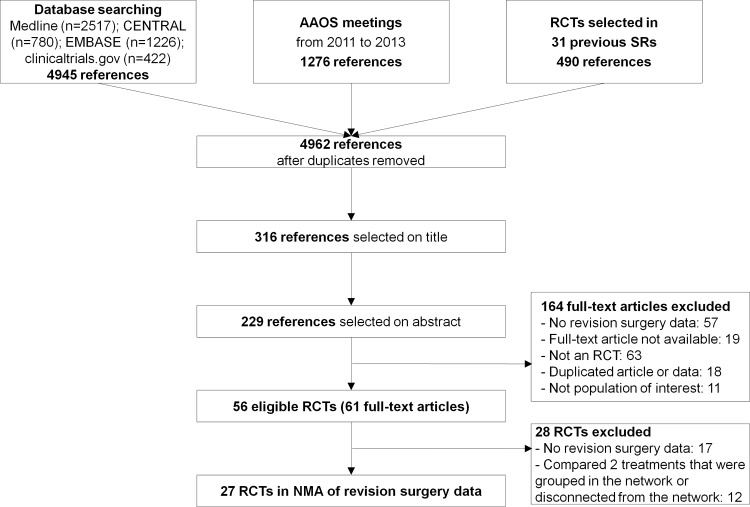
We considered RCTs of treatments for femoral neck fracture in adults. We searched CENTRAL, MEDLINE, EMBASE and ClinicalTrials.gov up to November 2015. Two reviewers independently selected trials, extracted data and used the Cochrane Collaboration's tool for assessing the risk of bias. A group of orthopedic surgeons grouped similar but not identical interventions under the same node. We synthesized the network using a Bayesian network meta-analysis model. We derived posterior odds ratios (ORs) and 95% credible intervals (95% CrIs) for all possible pairwise comparisons. The primary outcome was all-cause revision surgery.
Data from 27 trials were combined, for 4,186 participants (72% women, mean age 80 years, 95% displaced fractures). The median follow-up was 2 years. With hemiarthroplasty (HA) and total hip arthroplasty (THA) as a comparison, risk of surgical revision was significantly higher with the treatments unthreaded cervical osteosynthesis (OR 8.0 [95% CrI 3.6-15.5] and 5.9 [2.4-12.0], respectively), screw (9.4 [6.0-16.5] and 6.7 [3.9-13.6]) and plate (12.5 [5.8-23.8] and 7.8 [3.8-19.4]).
In older women with displaced femoral neck fractures, arthroplasty (HA and THA) is the most effective treatment in terms of risk of revision surgery.
PROSPERO no. CRD42013004218.
Network Meta-Analysis, Level 1.
手术干预在网状Meta分析(NMA)中引发了特定的方法学问题。它们通常是多成分干预措施,导致随机对照试验(RCT)的复杂网络,涉及多个组且联系稀疏。
阐明NMA在复杂手术干预网络中的适用性,并根据临床相关结局对现有干预措施进行优先排序。
我们纳入了成人股骨颈骨折治疗的随机对照试验。检索截至2015年11月的CENTRAL、MEDLINE、EMBASE和ClinicalTrials.gov。两名研究者独立选择试验、提取数据,并使用Cochrane协作组的工具评估偏倚风险。一组骨科医生将相似但不完全相同的干预措施归为同一节点。我们使用贝叶斯网状Meta分析模型合成网络。我们得出所有可能成对比较的后验比值比(OR)和95%可信区间(95% CrI)。主要结局是全因翻修手术。
纳入了27项试验的数据,涉及4186名参与者(72%为女性,平均年龄80岁,95%为移位骨折)。中位随访时间为2年。以半髋关节置换术(HA)和全髋关节置换术(THA)作为对照,非螺纹颈骨内固定术(OR分别为8.0 [95% CrI 3.6 - 15.5]和5.9 [2.4 - 12.0])、螺钉固定术(9.4 [6.0 - 16.5]和6.7 [3.9 - 13.6])以及钢板固定术(12.5 [5.8 - 23.8]和7.8 [3.8 - 19.4])的手术翻修风险显著更高。
对于移位型股骨颈骨折的老年女性,就翻修手术风险而言,关节置换术(HA和THA)是最有效的治疗方法。
PROSPERO编号CRD42013004218。
网状Meta分析,1级。