McGill L A, Ferreira P F, Scott A D, Nielles-Vallespin S, Giannakidis A, Kilner P J, Gatehouse P D, de Silva R, Firmin D N, Pennell D J
NIHR Cardiovascular Biomedical Research Unit, Royal Brompton Hospital, Sydney Street, London, SW3 6NP, UK.
National Heart and Lung Institute, Imperial College, London, UK.
J Cardiovasc Magn Reson. 2016 Jan 6;18:2. doi: 10.1186/s12968-015-0215-0.
In vivo cardiac diffusion tensor imaging (cDTI) is uniquely capable of interrogating laminar myocardial dynamics non-invasively. A comprehensive dataset of quantative parameters and comparison with subject anthropometrics is required.
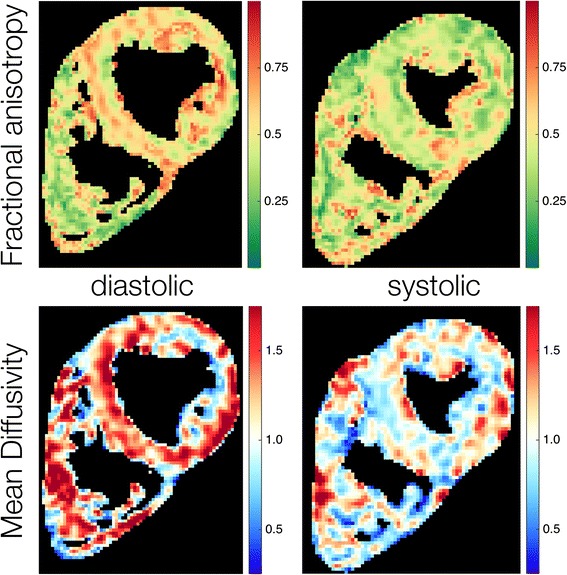
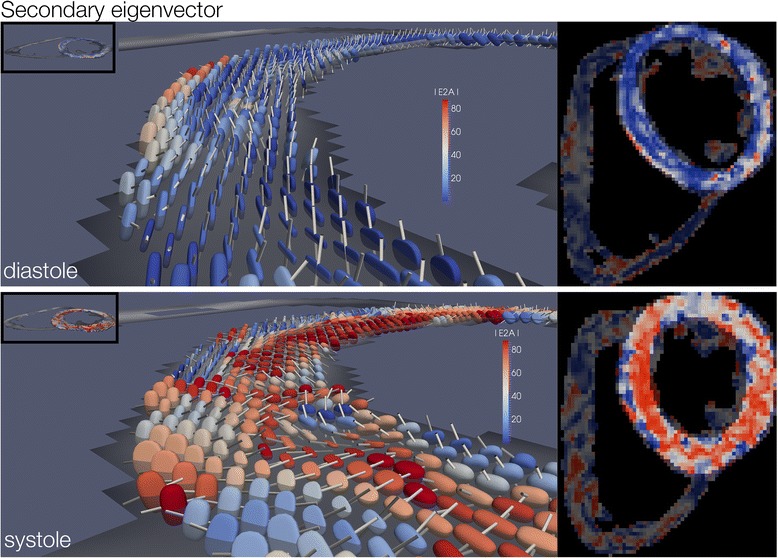
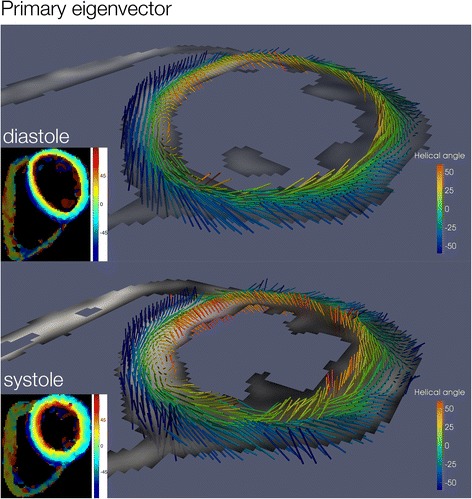
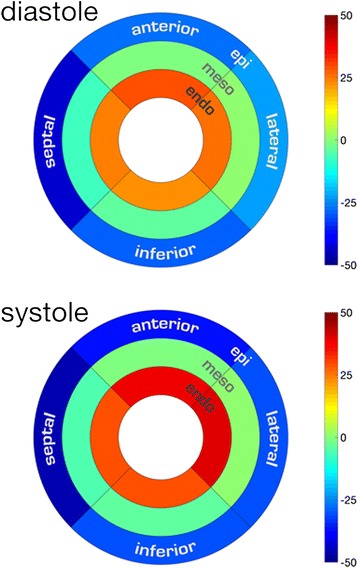
cDTI was performed at 3T with a diffusion weighted STEAM sequence. Data was acquired from the mid left ventricle in 43 subjects during the systolic and diastolic pauses. Global and regional values were determined for fractional anisotropy (FA), mean diffusivity (MD), helix angle gradient (HAg, degrees/%depth) and the secondary eigenvector angulation (E2A). Regression analysis was performed between global values and subject anthropometrics.
All cDTI parameters displayed regional heterogeneity. The RR interval had a significant, but clinically small effect on systolic values for FA, HAg and E2A. Male sex and increasing left ventricular end diastolic volume were associated with increased systolic HAg. Diastolic HAg and systolic E2A were both directly related to left ventricular mass and body surface area. There was an inverse relationship between E2A mobility and both age and ejection fraction.
Future interpretations of quantitative cDTI data should take into account anthropometric variations observed with patient age, body surface area and left ventricular measurements. Further work determining the impact of technical factors such as strain and SNR is required.
体内心脏扩散张量成像(cDTI)能够独特地以非侵入性方式研究心肌层动力学。需要一个包含定量参数的综合数据集,并与受试者人体测量学进行比较。
使用扩散加权STEAM序列在3T下进行cDTI。在43名受试者的收缩期和舒张期停顿期间,从左心室中部采集数据。确定了分数各向异性(FA)、平均扩散率(MD)、螺旋角梯度(HAg,度/%深度)和次要特征向量角度(E2A)的整体和区域值。对整体值与受试者人体测量学进行了回归分析。
所有cDTI参数均显示出区域异质性。RR间期对FA、HAg和E2A的收缩期值有显著但临床上较小的影响。男性性别和左心室舒张末期容积增加与收缩期HAg增加相关。舒张期HAg和收缩期E2A均与左心室质量和体表面积直接相关。E2A移动性与年龄和射血分数均呈负相关。
未来对定量cDTI数据的解释应考虑到随患者年龄、体表面积和左心室测量值观察到的人体测量学变化。需要进一步开展工作来确定应变和信噪比等技术因素的影响。