Long Jason S, Giotis Efstathios S, Moncorgé Olivier, Frise Rebecca, Mistry Bhakti, James Joe, Morisson Mireille, Iqbal Munir, Vignal Alain, Skinner Michael A, Barclay Wendy S
Section of Virology, Department of Medicine, Imperial College London, St Mary's Campus, London W2 1PG, UK.
Centre d'études d'agents Pathogènes et Biotechnologies pour la Santé (CPBS), FRE 3689, CNRS-UM, 34293 Montpellier, France.
Nature. 2016 Jan 7;529(7584):101-4. doi: 10.1038/nature16474.
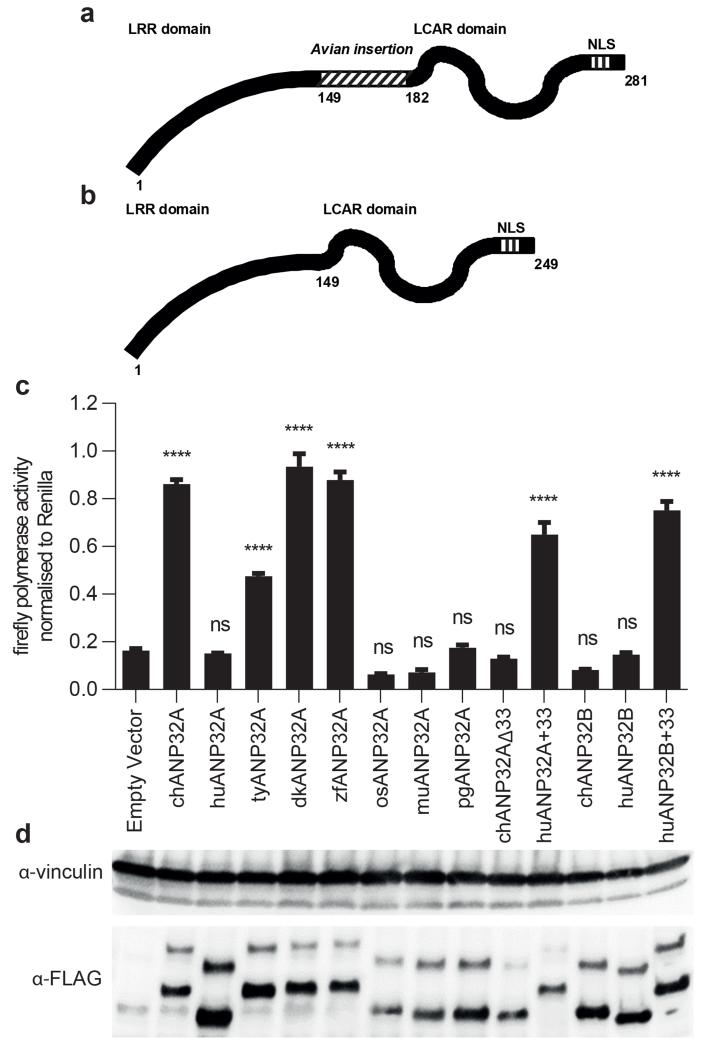
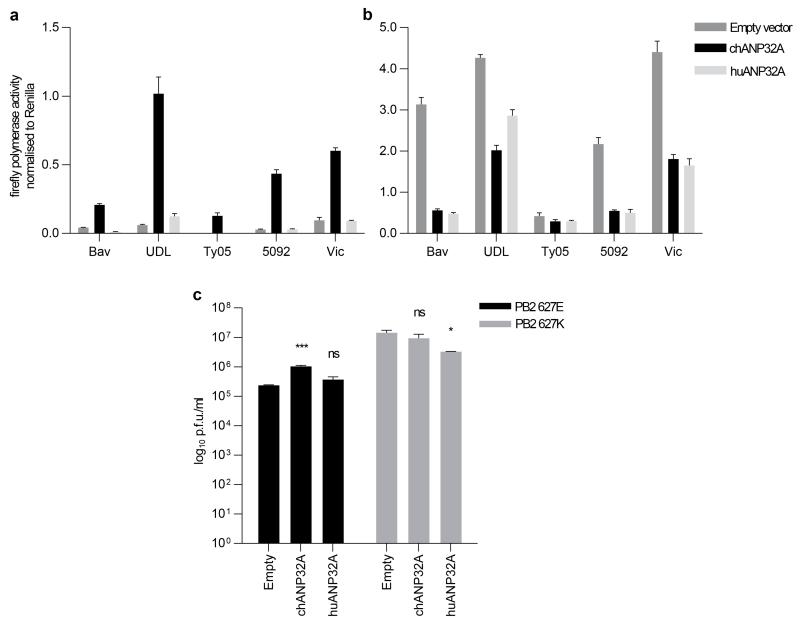
Influenza pandemics occur unpredictably when zoonotic influenza viruses with novel antigenicity acquire the ability to transmit amongst humans. Host range breaches are limited by incompatibilities between avian virus components and the human host. Barriers include receptor preference, virion stability and poor activity of the avian virus RNA-dependent RNA polymerase in human cells. Mutants of the heterotrimeric viral polymerase components, particularly PB2 protein, are selected during mammalian adaptation, but their mode of action is unknown. We show that a species-specific difference in host protein ANP32A accounts for the suboptimal function of avian virus polymerase in mammalian cells. Avian ANP32A possesses an additional 33 amino acids between the leucine-rich repeats and carboxy-terminal low-complexity acidic region domains. In mammalian cells, avian ANP32A rescued the suboptimal function of avian virus polymerase to levels similar to mammalian-adapted polymerase. Deletion of the avian-specific sequence from chicken ANP32A abrogated this activity, whereas its insertion into human ANP32A, or closely related ANP32B, supported avian virus polymerase function. Substitutions, such as PB2(E627K), were rapidly selected upon infection of humans with avian H5N1 or H7N9 influenza viruses, adapting the viral polymerase for the shorter mammalian ANP32A. Thus ANP32A represents an essential host partner co-opted to support influenza virus replication and is a candidate host target for novel antivirals.
当具有新抗原性的人畜共患流感病毒获得在人类中传播的能力时,就会不可预测地发生流感大流行。宿主范围突破受到禽流感病毒成分与人类宿主之间不相容性的限制。障碍包括受体偏好、病毒体稳定性以及禽流感病毒RNA依赖性RNA聚合酶在人类细胞中的活性较差。在哺乳动物适应过程中会选择异源三聚体病毒聚合酶成分的突变体,尤其是PB2蛋白,但其作用方式尚不清楚。我们发现宿主蛋白ANP32A的物种特异性差异导致了禽流感病毒聚合酶在哺乳动物细胞中的功能欠佳。禽源ANP32A在富含亮氨酸的重复序列和羧基末端低复杂性酸性区域结构域之间多了33个氨基酸。在哺乳动物细胞中,禽源ANP32A将禽流感病毒聚合酶的欠佳功能恢复到与适应哺乳动物的聚合酶相似的水平。从鸡ANP32A中删除禽源特异性序列消除了这种活性,而将其插入人ANP32A或密切相关的ANP32B中则支持禽流感病毒聚合酶的功能。当人类感染禽源H5N1或H7N9流感病毒时,会迅速选择PB2(E627K)等替代物,使病毒聚合酶适应较短的哺乳动物ANP32A。因此,ANP32A是支持流感病毒复制所必需的宿主伙伴,也是新型抗病毒药物的候选宿主靶点。