Tymms Peter B, Curtis Sarah E, Routen Ash C, Thomson Katie H, Bolden David S, Bock Susan, Dunn Christine E, Cooper Ashley R, Elliott Julian G, Moore Helen J, Summerbell Carolyn D, Tiffin Paul A, Kasim Adetayo S
School of Education, University of Durham, Durham, UK.
Department of Geography, University of Durham, Durham, UK.
BMJ Open. 2016 Jan 6;6(1):e009318. doi: 10.1136/bmjopen-2015-009318.
To assess the effectiveness of 2 interventions in improving the physical activity and well-being of secondary school children.
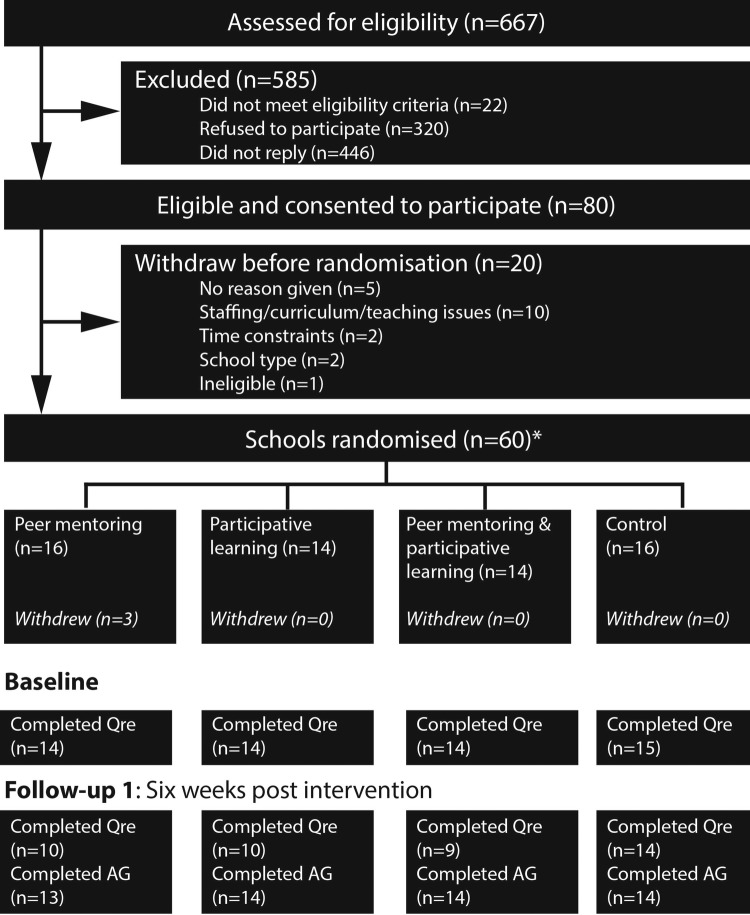
A clustered randomised controlled trial; classes, 1 per school, were assigned to 1 of 3 intervention arms or a control group based on a 2×2 factorial design. The interventions were peer-mentoring and participative learning. Year 7 children (aged 11-12) in the peer-mentoring intervention were paired with year 9 children for 6 weekly mentoring meetings. Year 7 children in the participative learning arm took part in 6 weekly geography lessons using personalised physical activity and Global Positioning System (GPS) data. Year 7 children in the combined intervention received both interventions, with the year 9 children only participating in the mentoring sessions.
1494 year 7 students from 60 schools in the North of England took part in the trial. Of these, 43 students opted out of taking part in the evaluation measurements, 2 moved teaching group and 58 changed school. Valid accelerometry outcome data were collected for 892 students from 53 schools; and well-being outcome data were available for 927 students from 52 schools.
The primary outcomes were mean minutes of accelerometer-measured moderate-to-vigorous intensity physical activity per day, and well-being as evaluated by the KIDSCREEN-27 questionnaire. These data were collected 6 weeks after the intervention; a 12-month follow-up is planned.
No significant effects (main or interaction) were observed for the outcomes. However, small positive differences were found for both outcomes for the participative learning intervention.
These findings suggest that the 2 school-based interventions did not modify levels of physical activity or well-being within the period monitored. Change in physical activity may require more comprehensive individual behavioural intervention, and/or more system-based efforts to address wider environmental influences such as family, peers, physical environment, transport and educational policy.
ISRCTN82956355.
评估两种干预措施对改善中学生身体活动和幸福感的效果。
一项整群随机对照试验;每所学校的一个班级根据2×2析因设计被分配到3个干预组或一个对照组中的一组。干预措施为同伴辅导和参与式学习。同伴辅导干预组的7年级儿童(11 - 12岁)与9年级儿童配对,每周进行6次辅导会议。参与式学习组的7年级儿童参加为期6周的地理课程,课程使用个性化身体活动和全球定位系统(GPS)数据。联合干预组的7年级儿童接受两种干预,9年级儿童仅参与辅导课程。
来自英格兰北部60所学校的1494名7年级学生参与了试验。其中,43名学生选择不参与评估测量,2名学生更换了教学组,58名学生转学。从53所学校的892名学生中收集了有效的加速度计结果数据;从52所学校的927名学生中获取了幸福感结果数据。
主要结局为加速度计测量的每天中等至剧烈强度身体活动的平均分钟数,以及通过儿童生活质量量表(KIDSCREEN - 27)问卷评估的幸福感。这些数据在干预6周后收集;计划进行12个月的随访。
未观察到结局有显著影响(主要效应或交互效应)。然而,参与式学习干预在两个结局上均发现了小的正向差异。
这些结果表明,在监测期内,这两种基于学校的干预措施并未改变身体活动水平或幸福感。身体活动的改变可能需要更全面的个体行为干预,和/或更多基于系统的努力,以应对更广泛的环境影响,如家庭、同伴、物理环境、交通和教育政策。
ISRCTN82956355