Gillespie Alex, Reader Tom W
Department of Social Psychology, London School of Economics, London, UK.
BMJ Qual Saf. 2016 Dec;25(12):937-946. doi: 10.1136/bmjqs-2015-004596. Epub 2016 Jan 6.
Letters of complaint written by patients and their advocates reporting poor healthcare experiences represent an under-used data source. The lack of a method for extracting reliable data from these heterogeneous letters hinders their use for monitoring and learning. To address this gap, we report on the development and reliability testing of the Healthcare Complaints Analysis Tool (HCAT).
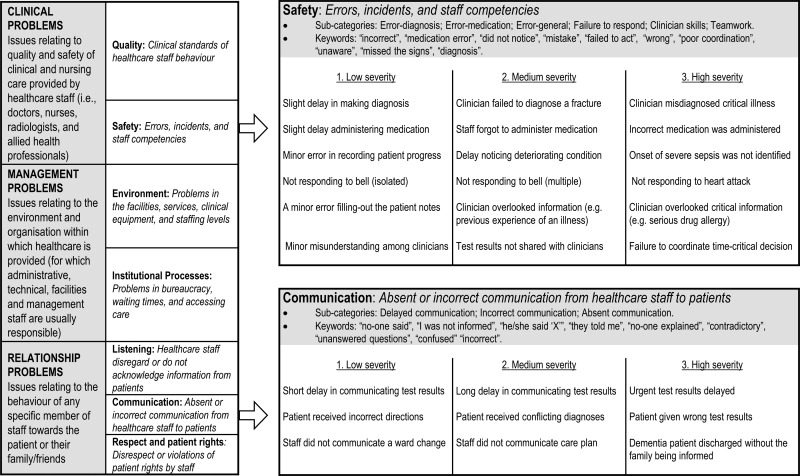
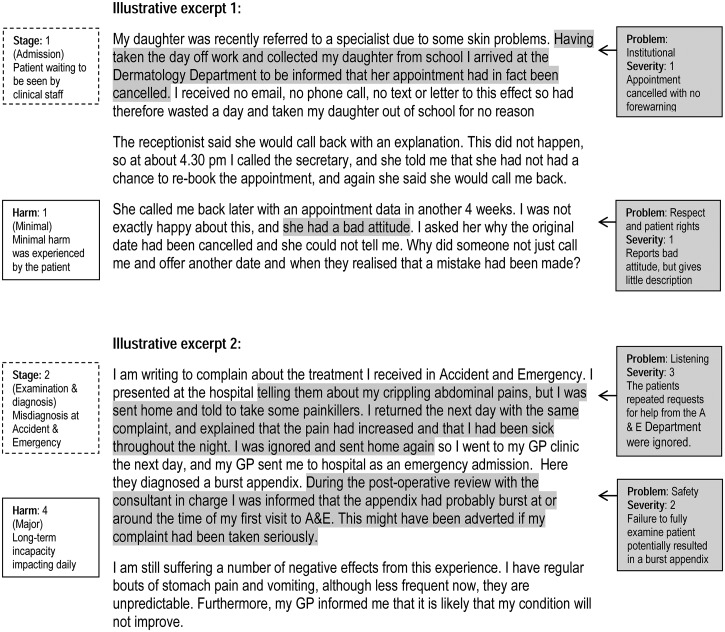
HCAT was developed from a taxonomy of healthcare complaints reported in a previously published systematic review. It introduces the novel idea that complaints should be analysed in terms of severity. Recruiting three groups of educated lay participants (n=58, n=58, n=55), we refined the taxonomy through three iterations of discriminant content validity testing. We then supplemented this refined taxonomy with explicit coding procedures for seven problem categories (each with four levels of severity), stage of care and harm. These combined elements were further refined through iterative coding of a UK national sample of healthcare complaints (n= 25, n=80, n=137, n=839). To assess reliability and accuracy for the resultant tool, 14 educated lay participants coded a referent sample of 125 healthcare complaints.
The seven HCAT problem categories (quality, safety, environment, institutional processes, listening, communication, and respect and patient rights) were found to be conceptually distinct. On average, raters identified 1.94 problems (SD=0.26) per complaint letter. Coders exhibited substantial reliability in identifying problems at four levels of severity; moderate and substantial reliability in identifying stages of care (except for 'discharge/transfer' that was only fairly reliable) and substantial reliability in identifying overall harm.
HCAT is not only the first reliable tool for coding complaints, it is the first tool to measure the severity of complaints. It facilitates service monitoring and organisational learning and it enables future research examining whether healthcare complaints are a leading indicator of poor service outcomes. HCAT is freely available to download and use.
患者及其支持者撰写的投诉信报告了不良的医疗保健经历,这是一个未得到充分利用的数据源。缺乏从这些内容各异的信件中提取可靠数据的方法,阻碍了它们用于监测和学习。为了填补这一空白,我们报告了医疗投诉分析工具(HCAT)的开发和可靠性测试情况。
HCAT是根据先前发表的系统评价中报告的医疗投诉分类法开发的。它引入了一个新颖的观点,即投诉应根据严重程度进行分析。我们招募了三组受过教育的非专业参与者(分别为n = 58、n = 58、n = 55),通过三轮判别内容效度测试对分类法进行了完善。然后,我们为七个问题类别(每个类别有四个严重程度级别)、护理阶段和伤害补充了明确的编码程序,对这个完善后的分类法进行补充。这些组合要素通过对英国全国医疗投诉样本(n = 25、n = 80、n = 137、n = 839)的迭代编码进一步完善。为了评估所得工具的可靠性和准确性,14名受过教育的非专业参与者对125份医疗投诉的参考样本进行了编码。
发现HCAT的七个问题类别(质量、安全、环境、机构流程、倾听、沟通以及尊重和患者权利)在概念上是不同的。平均而言,评分者在每封投诉信中识别出1.94个问题(标准差 = 0.26)。编码者在识别四个严重程度级别的问题时表现出高度可靠性;在识别护理阶段时表现出中等和高度可靠性(“出院/转诊”除外,其可靠性仅为一般),在识别总体伤害时表现出高度可靠性。
HCAT不仅是第一个可靠的投诉编码工具,也是第一个衡量投诉严重程度的工具。它有助于服务监测和组织学习,并使未来能够研究医疗投诉是否是服务结果不佳的领先指标。HCAT可免费下载和使用。