INSERM U1173, UFR Simone Weil, Versailles-Saint-en-Quentin University, Saint-Quentin-en-Yvelines 78180, France.
Institut Pasteur, Unit for Integrated Mycobacterial Pathogenomics, 75724, Paris Cedex 15, France.
Genome Biol Evol. 2016 Jan 8;8(2):387-402. doi: 10.1093/gbe/evw001.
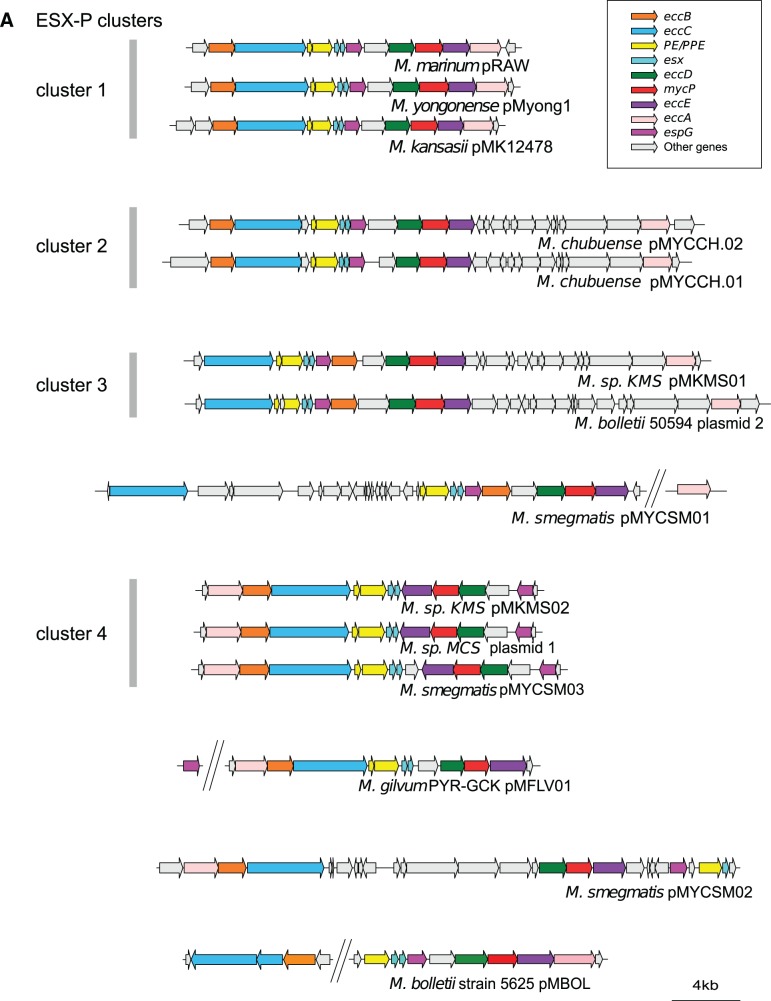
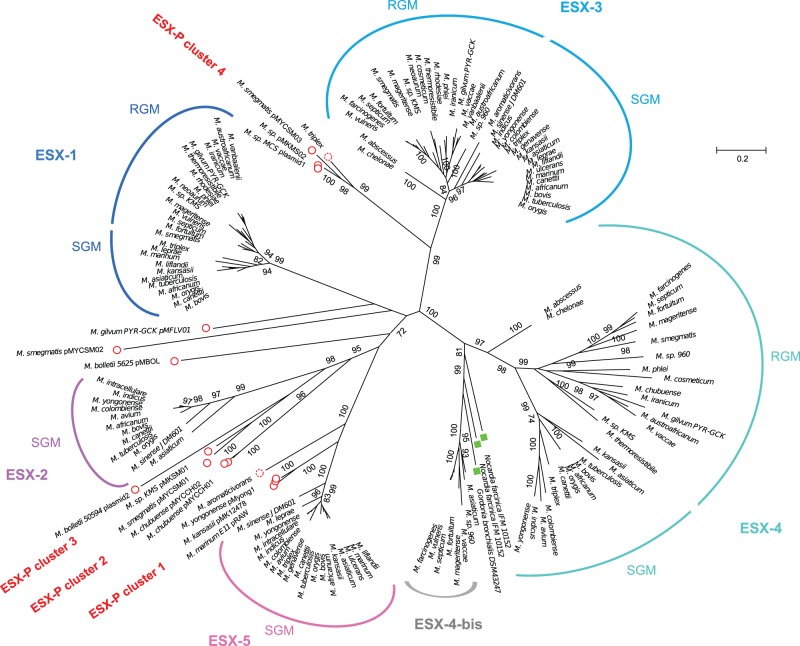
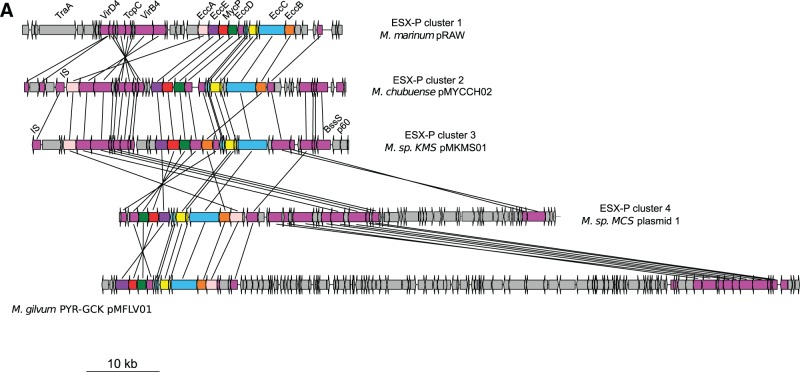
In mycobacteria, various type VII secretion systems corresponding to different ESX (ESAT-6 secretory) types, are contributing to pathogenicity, iron acquisition, and/or conjugation. In addition to the known chromosomal ESX loci, the existence of plasmid-encoded ESX systems was recently reported. To investigate the potential role of ESX-encoding plasmids on mycobacterial evolution, we analyzed a large representative collection of mycobacterial genomes, including both chromosomal and plasmid-borne sequences. Data obtained for chromosomal ESX loci confirmed the previous five classical ESX types and identified a novel mycobacterial ESX-4-like type, termed ESX-4-bis. Moreover, analysis of the plasmid-encoded ESX loci showed extensive diversification, with at least seven new ESX profiles, identified. Three of them (ESX-P clusters 1-3) were found in multiple plasmids, while four corresponded to singletons. Our phylogenetic and gene-order-analyses revealed two main groups of ESX types: 1) ancestral types, including ESX-4 and ESX-4-like systems from mycobacterial and non-mycobacterial actinobacteria and 2) mycobacteria-specific ESX systems, including ESX-1-2-3-5 systems and the plasmid-encoded ESX types. Synteny analysis revealed that ESX-P systems are part of phylogenetic groups that derived from a common ancestor, which diversified and resulted in the different ESX types through extensive gene rearrangements. A converging body of evidence, derived from composition bias-, phylogenetic-, and synteny analyses points to a scenario in which ESX-encoding plasmids have been a major driving force for acquisition and diversification of type VII systems in mycobacteria, which likely played (and possibly still play) important roles in the adaptation to new environments and hosts during evolution of mycobacterial pathogenesis.
在分枝杆菌中,各种与不同 ESX(ESAT-6 分泌)类型相对应的 VII 型分泌系统有助于致病性、铁获取和/或共轭。除了已知的染色体 ESX 基因座外,最近还报道了质粒编码的 ESX 系统的存在。为了研究 ESX 编码质粒对分枝杆菌进化的潜在作用,我们分析了大量分枝杆菌基因组的代表性集合,包括染色体和质粒携带的序列。针对染色体 ESX 基因座获得的数据证实了以前的五种经典 ESX 类型,并确定了一种新型分枝杆菌 ESX-4 样类型,称为 ESX-4-bis。此外,对质粒编码的 ESX 基因座的分析显示出广泛的多样化,确定了至少七种新的 ESX 谱。其中三个(ESX-P 簇 1-3)在多个质粒中发现,而另外四个则是单例。我们的系统发育和基因顺序分析揭示了 ESX 类型的两个主要群体:1)祖先类型,包括分枝杆菌和非分枝杆菌放线菌的 ESX-4 和 ESX-4 样系统,以及 2)分枝杆菌特异性 ESX 系统,包括 ESX-1-2-3-5 系统和质粒编码的 ESX 类型。同线性分析显示,ESX-P 系统是源自共同祖先的进化枝的一部分,通过广泛的基因重排多样化并导致不同的 ESX 类型。来自组成偏倚、系统发育和同线性分析的大量证据表明,ESX 编码质粒是 VII 型系统在分枝杆菌中获得和多样化的主要驱动力,这可能在分枝杆菌发病机制的进化过程中在适应新环境和宿主方面发挥了(并且可能仍然发挥了)重要作用。