Lin Wen-Yuan, Peng Cheng-Yuan, Lin Cheng-Chieh, Davidson Lance E, Pi-Sunyer F Xavier, Sung Pei-Kun, Huang Kuo-Chin
From the Department of Family Medicine (W-YL, C-CL); Department of Internal Medicine, China Medical University Hospital, Taichung, Taiwan (C-YP); School of Medicine, College of Medicine, China Medical University, Taichung, Taiwan(W-YL, C-CL, C-YP); Department of Family Medicine, National Taiwan University Hospital, Taipei, Taiwan (W-YL, K-CH); Institute of Health Care Administration, College of Health Science, Asia University, Taichung, Taiwan (C-CL); MJ Health Screening Center, Taipei, Taiwan (P-KS); College of Life Sciences, Brigham Young University, Utah, USA (LED); and New York Presbyterian Hospital, Columbia University, New York, USA (FXP-S).
Medicine (Baltimore). 2016 Jan;95(2):e2162. doi: 10.1097/MD.0000000000002162.
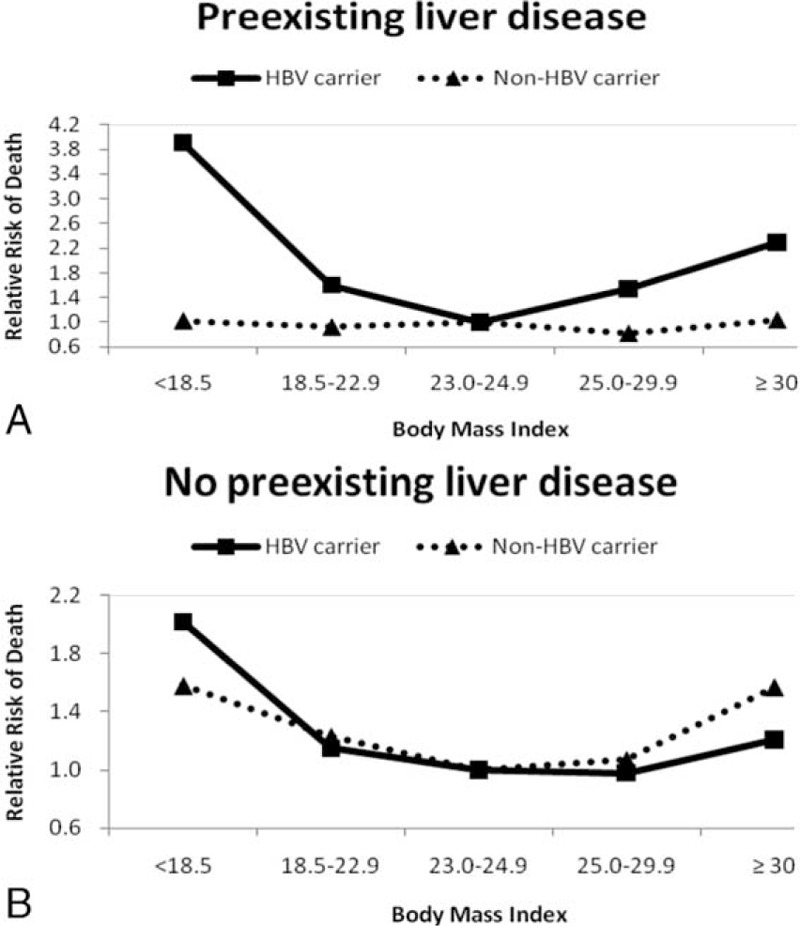
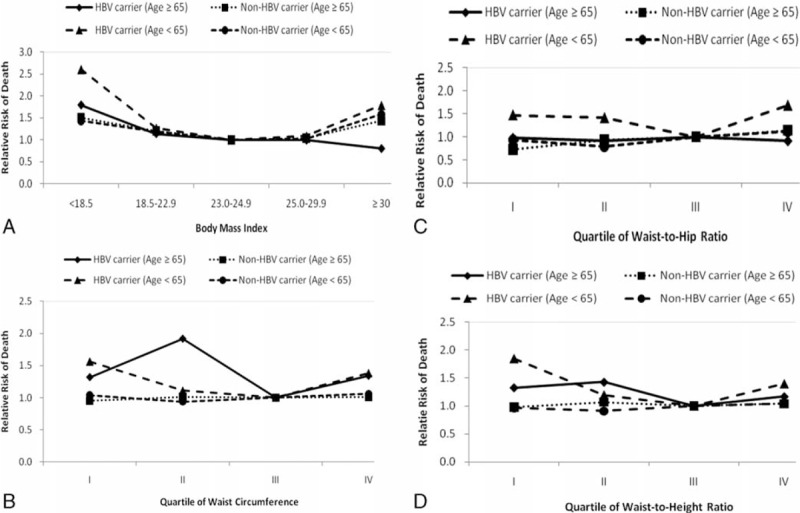
Both obesity and hepatitis B virus (HBV) infection increase the risk of death. We investigate the association between general and central obesity and all-cause mortality among adult Taiwanese HBV versus non-HBV carriers.A total of 19,850 HBV carriers and non-hepatitis C virus (HCV) carriers, aged 20 years and older at enrollment in 1998 to 1999 in Taiwan, were matched to 79,400 non-HBV and non-HCV carriers (1:4). Cox proportional-hazards models were used to estimate the relative risks for all-cause mortality during a maximum follow-up period of 10 years. Four obesity-related anthropometric indices-body mass index (BMI), waist circumference, waist-to-hip ratio, and waist-to-height ratio-were the main variables of interest.During the follow-up period, 628 and 2366 participants died among HBV and non-HBV carriers, respectively. Both underweight and general obesity were associated with an increased risk of death. The highest risk of all-cause death in relation to BMI was found in the HBV carriers with underweight (BMI <18.5 kg/m2) and non-HBV carriers with obesity (BMI ≥30 kg/m2). The lowest risks of all-cause death in relation to abdominal adiposity were found at the third quartiles of waist circumference, waist-to-hip ratio, and waist-to-height ratio among HBV carriers, but in the second quartiles among non-HBV carriers. For those with pre-existing liver disease among HBV carriers, patients with underweight have higher risk of death than those with obesity.Hepatitis B virus carriers with underweight have higher risk of death than non-HBV carriers. HBV carriers with mild abdominal obesity have the lowest risk of death, but not in the non-HBV carriers.
肥胖和乙型肝炎病毒(HBV)感染都会增加死亡风险。我们调查了台湾成年HBV携带者与非HBV携带者中一般肥胖和中心性肥胖与全因死亡率之间的关联。1998年至1999年在台湾登记入组时年龄在20岁及以上的19850名HBV携带者和非丙型肝炎病毒(HCV)携带者与79400名非HBV和非HCV携带者(1:4)进行了匹配。使用Cox比例风险模型估计在最长10年的随访期内全因死亡率的相对风险。四个与肥胖相关的人体测量指标——体重指数(BMI)、腰围、腰臀比和腰高比——是主要的研究变量。在随访期间,HBV携带者和非HBV携带者中分别有628名和2366名参与者死亡。体重过轻和一般肥胖都与死亡风险增加有关。与BMI相关的全因死亡最高风险出现在体重过轻的HBV携带者(BMI<18.5kg/m²)和肥胖的非HBV携带者(BMI≥30kg/m²)中。与腹部肥胖相关的全因死亡最低风险在HBV携带者的腰围、腰臀比和腰高比的第三个四分位数处发现,但在非HBV携带者中在第二个四分位数处发现。对于HBV携带者中已有肝病的患者,体重过轻的患者比肥胖患者有更高的死亡风险。体重过轻的HBV携带者比非HBV携带者有更高的死亡风险。轻度腹部肥胖的HBV携带者死亡风险最低,但非HBV携带者并非如此。